This website uses cookies to enhance your browsing experience and ensure the functionality of our site. For more detailed information about the types of cookies we use and how we protect your privacy, please visit our Privacy Information page.
×
Cookie Settings
This website uses different types of cookies to enhance your experience. Please select your preferences below:
Western Central Atlantic: Gulf of Mexico and east coast of US from North Carolina to Key West and along the southern shore of the Caribbean Sea. Juveniles are occasionally found as far north as Massachusetts.
Länge bei der ersten Reifung / Größe / Gewicht / Alter
Geschlechtsreife: Lm33.2 range ? - ? cm Max length : 107 cm TL Männchen/unbestimmt; (Ref. 89707); common length : 30.0 cm TL Männchen/unbestimmt; (Ref. 3708); max. veröff. Gewicht: 14.2 kg (Ref. 40637); max. veröff. Alter: 21 Jahre (Ref. 6846)
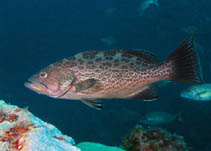
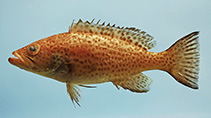
Rückenflossenstacheln (insgesamt) : 11; Rückenflossenweichstrahlen (insgesamt) : 16 - 18; Afterflossenstacheln: 3; Afterflossenweichstrahlen: 10 - 12. Distinguished by the following characteristics: four color patterns, first is brown phase with head and body pale brown covered with small reddish brown spots that extend onto median fins, second is cat's paw phase with pale brown body color with dorsolateral parts of body having several clusters of dark brown spots resembling the paw print of a cat, third is with large adults with grey-head phase with the rear two-thirds of the body dark, head and body anterior to the 6th dorsal-fin spine in silvery grey with dark reticulations and fourth is bicoloured phase with pale brown anteriorly and abruptly dark chocolate brown posteriorly; depth of body contained 3.0-3.4 times in SL; head length 2.6-3.0 times in SL; convex interorbital area; angular preopercle, angle with distinct bony lobe; serrate interopercle and subopercle; posterior nostrils of adults 2-4 times larger than anterior ones (Ref. 89707). Body shape (shape guide): fusiform / normal; Cross section: oval.
Found over ledges and high-relief rocky bottoms in the eastern Gulf of Mexico; at low-profile bottoms at depths of 30 to 100 m in North Carolina; this species was the most abundant grouper in areas of living Oculina coral formations at depths of 70 to 100 m off the east coast of Florida. This species apparently moved inshore when bottom temperature fell below 8.6°C. Juveniles found in shallow water at jetties and in mangrove areas.
Heemstra, P.C. and J.E. Randall, 1993. FAO Species Catalogue. Vol. 16. Groupers of the world (family Serranidae, subfamily Epinephelinae). An annotated and illustrated catalogue of the grouper, rockcod, hind, coral grouper and lyretail species known to date. Rome: FAO. FAO Fish. Synop. 125(16):382 p. (Ref. 5222)
IUCN Rote Liste Status (Ref. 130435: Version 2025-2 (Global))
Bevorzugte Temperatur (Ref. 123201): 20.7 - 27.5, mean 24.4 °C (based on 130 cells).
Phylogenetischer Diversitätsindex (Ref. 82804): PD50 = 0.5000 [Uniqueness, from 0.5 = low to 2.0 = high].
Bayesian length-weight: a=0.00912 (0.00416 - 0.02000), b=3.05 (2.88 - 3.22), in cm total length, based on LWR estimates for this Genus-body shape (Ref. 93245).
Trophische Ebene (Ref. 69278): 4.5 ±0.0 se; based on diet studies.
Widerstandsfähigkeit (Ref. 120179): niedrig, Verdopplung der Population dauert 4,5 - 14 Jahre. (K=0.09-0.17; tmax=21).
Anfälligkeit der Fischerei (Ref. 59153): High to very high vulnerability (69 of 100). 🛈
Klimaanfälligkeit (Ref. 125649): Moderate to high vulnerability (52 of 100). 🛈