



Platydoras hancockii (Valenciennes, 1840)
Blue-eye catfish
Hochladen Photos und videos
Bilder | Google Bild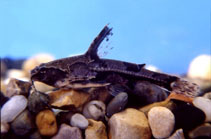 Platydoras hancockii
Photo von Landines, M./ Ana Sanabria
Bilder | Google Bild
Photo von Landines, M./ Ana Sanabria
Klassifizierung / Names Namen | Synonyme | Catalog of Fishes(Gattung, Arten) | ITIS | CoL | WoRMS | Cloffa
> Siluriformes (Catfishes) > Doradidae (Thorny catfishes) > Doradinae
Etymology: Platydoras: Greek, platys = flat + Greek, doras = skin (Ref. 45335).
Eponymy: John Hancock (1808–1890) was a British naturalist, landscape architect, ornithologist and taxidermist. [...] (Ref. 128868), visit book page.
More on author: Valenciennes.
Etymology: Platydoras: Greek, platys = flat + Greek, doras = skin (Ref. 45335).
Eponymy: John Hancock (1808–1890) was a British naturalist, landscape architect, ornithologist and taxidermist. [...] (Ref. 128868), visit book page.
More on author: Valenciennes.
Umwelt: Milieu / Klimazone / Tiefenbereich / Verbreitungsgebiet Ökologie
; süßwasser demersal; pH range: 6.0 - 8.0; dH range: 5 - 19. Tropical; 23°C - 28°C (Ref. 1672)
Verbreitung Territorien | FAO Gebiete | Ökosysteme | Vorkommen | Punkt Karte | Einführungen | Faunafri
South America: Guyana and eastern Brazil to Peru and Bolivia.
Größe / Gewicht / Alter
Kurzbeschreibung Bestimmungsschlüssel | Morphologie | Morphometrie
Rückenflossenstacheln (insgesamt) : 1; Rückenflossenweichstrahlen (insgesamt) : 6; Afterflossenweichstrahlen: 11 - 13. The body is a little elongated, without scales but with a lateral range of 24 to 28 bony plaque. Head is large and rounded. Mouth is nearly terminal and has three pairs of barbels (Ref. 35381).
Body shape (shape guide): elongated.
Body shape (shape guide): elongated.
Occurs in freshwater coastal swamps and the flood-prone zones of rivers. Gregarious, lives schools which may consist of several hundred fish. Hides under roots, leaves or stocks. Is known to build a nest of bubbles at the surface, defended by the males as the 'Atipas' do. In case of drought, it is reputed to being very resistant and to crawl in search of a new swamp while holding some water in its ears. Feeds on algae and debris (Ref. 35381).
Lebenszyklus und Paarungsverhalten Geschlechtsreife | Fortpflanzung | Ablaichen | Eier | Fruchtbarkeit | Larven
Builds a bubble nest with small parts of water plants under the surface. The male guards the nest (Ref. 1672).
Hauptreferenz
Laden Sie Ihre Referenzen hoch | Referenzen | Koordinator : Ferraris, Jr., Carl J. | Partner
Piorski, N.M., J.C. Garavello, Arce H.M. and M.H. Sabaj Pérez, 2008. Platydoras brachylecis, a new species of thorny catfish (Siluriformes: Doradidae) from northeastern Brazil. Neotrop. Ichthyol. 6(3):481-494. (Ref. 79514)
IUCN Rote Liste Status (Ref. 130435: Version 2025-2 (Global))
nicht bedroht (LC) ; Date assessed: 05 August 2020
CITES
Not Evaluated
Bedrohung für Menschen
Harmless
Nutzung durch Menschen
Fischereien: nicht kommerziell; Aquarium: Kommerziell
FAO - Publication: search | FishSource |
Mehr Information
Trophische Ökologie
Lebensmittel (Beutetiere)
Nahrungszusammensetzung
Nahrungsaufnahme
Lebensmittelrationen
Räuber
Lebensmittel (Beutetiere)
Nahrungszusammensetzung
Nahrungsaufnahme
Lebensmittelrationen
Räuber
Populationsdynamik
Wachstumsparameter
Max. Alter/Größen
Länge-Gewicht-Rel.
Länge-Länge-Verhältnis.
Längenhäufigkeiten
Massenkonvertierung
Rekrutierung
Dichte
Wachstumsparameter
Max. Alter/Größen
Länge-Gewicht-Rel.
Länge-Länge-Verhältnis.
Längenhäufigkeiten
Massenkonvertierung
Rekrutierung
Dichte
Lebenszyklus
Fortpflanzung
Geschlechtsreife
Reifung/Kiemen rel.
Fruchtbarkeit
Ablaichen
Laichaggregationen
Eier
Eientwicklung
Larven
Larven Pop.Dyn.
Fortpflanzung
Geschlechtsreife
Reifung/Kiemen rel.
Fruchtbarkeit
Ablaichen
Laichaggregationen
Eier
Eientwicklung
Larven
Larven Pop.Dyn.
Anatomie
Kiemenoberfläche
Gehirn
Otolith
Kiemenoberfläche
Gehirn
Otolith
Physiologie
Körperliche Zusammensetzung
Nährstoffe
Sauerstoffverbrauch
Schwimmart
Schwimmgeschwindigkeit
Visuelle Pigmente
Fischgeräusche
Krankheiten und Parasiten
Toxizität (LC50s)
Körperliche Zusammensetzung
Nährstoffe
Sauerstoffverbrauch
Schwimmart
Schwimmgeschwindigkeit
Visuelle Pigmente
Fischgeräusche
Krankheiten und Parasiten
Toxizität (LC50s)
Genetik
Genom
Genetik
Heterozygotie
Vererbbarkeit
Genetische Vielfalt
Genom
Genetik
Heterozygotie
Vererbbarkeit
Genetische Vielfalt
Menschenbezogen
Aquakultur-Systeme
Aquakultur Profile
Zuchtlinien
Ciguatera-Fälle
Briefmarken, Münzen, Verschiedenes.
Aquakultur-Systeme
Aquakultur Profile
Zuchtlinien
Ciguatera-Fälle
Briefmarken, Münzen, Verschiedenes.
Tools
Bio-Quiz | E-Book | Feldführer | Längenhäufigkeits Tool | Lebensdaten Tool | Punkt Karte |
Catch-MSY |
Zusatzinformationen
Download XML
Zusammenfassung | Punktdaten | Namen | Photos
Internet Quellen
AFORO (otoliths) | Aquatic Commons | BHL | Cloffa | Websites from users | FishWatcher Einträge suchen | CISTI | Catalog of Fishes: Gattung, Arten | DiscoverLife | ECOTOX | FAO - Publication: search | Faunafri | Fishipedia | Fishtrace | GloBI | Google Books | Google Scholar | Google | IGFA World Record | OneZoom | Open Tree of Life | Otolith Atlas of Taiwan Fishes | Öffentliche Aquarien | PubMed | Reef Life Survey | Socotra Atlas | TreeBase | Tree of Life | Wikipedia: Gehe zu, Suchen | World Records Freshwater Fishing | Zoologischer Rekord
Schätzungen auf der Grundlage von Modellen
Phylogenetischer Diversitätsindex (Ref. 82804): PD50 = 0.5312 [Uniqueness, from 0.5 = low to 2.0 = high].
Bayesian length-weight: a=0.01230 (0.00587 - 0.02579), b=2.96 (2.78 - 3.14), in cm total length, based on LWR estimates for this (Sub)family-body shape (Ref. 93245).
Trophische Ebene (Ref. 69278): 2.0 ±0.00 se; based on food items.
Widerstandsfähigkeit (Ref. 120179): hoch, Verdopplung der Population dauert weniger als 15 Monate. (Preliminary K or Fecundity.).