



Ladda upp din foton och Videor
Bilder | Videor | Google image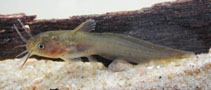 Tandanus tandanus
Bild av Coughran, J.
Bilder | Videor | Google image
Bild av Coughran, J.
Klassificering / Namn Populärnamn | synonymer | Catalog of Fishes(Släkte, Arter) | ITIS | CoL | WoRMS | Cloffa
> Siluriformes (Catfishes) > Plotosidae (Eeltail catfishes)
Etymology: Tandanus: A local name, tandan, in Australia.
Etymology: Tandanus: A local name, tandan, in Australia.
Miljö: miljö / Klimatzon / djupintervall / distributionsområde Ekologi
; sötvatten bottenlevande; flodvandrande (Ref. 51243); djupintervall 10 - ? m. Temperate; 5°C - 25°C (Ref. 2060); 12°S - 43°S
Utbredning Territorier | FAO områden | Ekosystem | Förekomster | Prickkarta | Utplanteringar | Faunafri
Oceania: endemic to Australia.
Längd vid första mognad / Storlek / Vikt / Ålder
Könsmognad: Lm 45.0 range ? - ? cm
Max length : 90.0 cm TL hane/ej könsbestämd; (Ref. 5259); common length : 45.0 cm TL hane/ej könsbestämd; (Ref. 5259); publicerad maxvikt: 6.8 kg (Ref. 36739); rapporterad maxålder: 8 år (Ref. 1107)
Max length : 90.0 cm TL hane/ej könsbestämd; (Ref. 5259); common length : 45.0 cm TL hane/ej könsbestämd; (Ref. 5259); publicerad maxvikt: 6.8 kg (Ref. 36739); rapporterad maxålder: 8 år (Ref. 1107)
Kort beskrivning Bestämningsnycklar | Morfologi | Morfometri
Head large; thick and fleshy lips; nostrils tubular. First dorsal fin high, with a strong serrated spine and 6 rays. Skin tough and smooth. Body coloration in adults vary from olive-green to brown, black or purplish dorsally and white ventrally. Urogenital papilla triangular in females; longer and cylindrical in males.
Body shape (shape guide): fusiform / normal; Cross section: circular.
Body shape (shape guide): fusiform / normal; Cross section: circular.
Adults inhabit slow moving streams, lakes and ponds with fringing vegetation. They swim close to sand or gravel bottoms. More abundant in lakes than in flowing water (Ref. 44894). Usually solitary but juveniles sometimes form loose aggregations. Mainly bottom-feeders (Ref. 44894). Feed on insect larvae, prawns, crayfish, mollusks, and small fishes. Breeding occurs between spring and mid-summer when water temperatures rise to between 20° and 24°C (Ref. 44894). Utilized for human consumption.
Livscykel och parningsbeteende Könsmognad | Reproduktion | Lek | Ägg | Fekunditet | Larver
Water temperature (20-24 °C) considered the primary spawning stimulus. There is direct pairing during spawning. Male builds nest (0.6-2.0 m in diameter) and cares for eggs in the nest up to 2 weeks. The nest is made of gravel and rocks with a central sandy depression in which the female deposits up to 20,000 eggs depending on her size (Ref. 5259). Eggs scattered into the rubble are tended and guarded by the male after the female departs (Ref. 205). Hatching occurs in 7-10 days at 18°C (Ref. 240).
Huvudreferens
Ladda upp dina referenser | referenser | Koordinator | Medarbetare
Allen, G.R., 1989. Freshwater fishes of Australia. T.F.H. Publications, Inc., Neptune City, New Jersey. (Ref. 5259)
Status på IUCN:s rödlista (Ref. 130435: Version 2025-2 (Global))
Least Concern (LC) ; Date assessed: 13 February 2019
CITES
Not Evaluated
Hot mot människor
Venomous (Ref. 4537)
Mänskliga användningsområden
Fiskeri: kommersiell; sportfisk: ja; Akvarium: Kommersiell
FAO - Publication: search | FishSource |
Ytterligare information
Populationsdynamik
Tillväxtparametrar
Max. åldrar / storlekar
Längd-vikt rel.
Längd-längd rel.
Längd-frekvenser
Massakonvertering
Rekrytering
Abundans
Tillväxtparametrar
Max. åldrar / storlekar
Längd-vikt rel.
Längd-längd rel.
Längd-frekvenser
Massakonvertering
Rekrytering
Abundans
Livscykel
Reproduktion
Könsmognad
Mognad/Gills rel.
Fekunditet
Lek
Lekande aggregat
Ägg
Utveckling av ägg
Larver
Larvdynamik
Reproduktion
Könsmognad
Mognad/Gills rel.
Fekunditet
Lek
Lekande aggregat
Ägg
Utveckling av ägg
Larver
Larvdynamik
Anatomi
Gälyta
Hjärna
Otolit
Gälyta
Hjärna
Otolit
Fysiologi
Kroppssammansättning
Näringsämnen
Syreförbrukning
Typ av simning
Simhastighet
Visuella pigment
Ljud från fisk
Sjukdomar & Parasiter
Toxicitet (LC50)
Kroppssammansättning
Näringsämnen
Syreförbrukning
Typ av simning
Simhastighet
Visuella pigment
Ljud från fisk
Sjukdomar & Parasiter
Toxicitet (LC50)
Genetik
Genom
Genetik
Heterozygositet
Ärftlighet
Genetisk mångfald
Genom
Genetik
Heterozygositet
Ärftlighet
Genetisk mångfald
Människorelaterad
Vattenbrukssystem
Vattenbruksprofiler
Avelslinjer
Ciguatera-fall
Frimärken, mynt, diverse.
Vattenbrukssystem
Vattenbruksprofiler
Avelslinjer
Ciguatera-fall
Frimärken, mynt, diverse.
Verktyg
Organisk frågesport | E-bok | Fälthandbok | Längdfördelnings-verktyg | Livshistorie-verktyg | Prickkarta |
Fångst-MSY |
Särskilda rapporter
Kontrollera för underhåll av akvarium | Kontrollera om det finns faktablad om arter | Kontrollera om det finns faktablad om vattenbruk
Ladda ner XML
Internet-källor
AFORO (otoliths) | Alien/Invasive Species database | Aquatic Commons | BHL | Cloffa | Websites from users | Check FishWatcher | CISTI | Catalog of Fishes: Släkte, Arter | DiscoverLife | ECOTOX | FAO - Publication: search | Faunafri | Fishipedia | Fishtrace | GloBI | Google Books | Google Scholar | Google | IGFA World Record | OneZoom | Open Tree of Life | Otolith Atlas of Taiwan Fishes | PubMed | Reef Life Survey | Socotra Atlas | TreeBase | Tree of Life | Wikipedia: Go, sök | World Records Freshwater Fishing | Zoologiskt register
Uppskattningar baserade på modeller
Index för fylogenetisk mångfald (Ref. 82804): PD50 = 0.5625 [Uniqueness, from 0.5 = low to 2.0 = high].
Bayesian length-weight: a=0.00631 (0.00275 - 0.01448), b=3.08 (2.88 - 3.28), in cm total length, based on LWR estimates for this species & (Sub)family-body (Ref. 93245).
Trofisk nivå (Ref. 69278): 3.3 ±0.48 se; based on food items.
Generation time: 11.0 ( na - na) years. Estimated as median ln(3)/K based on 2 growth studies.
Resiliens (Ref. 120179): Låg, lägsta populationsfördubblingstid 4,5-14 år (tm=5; K=0.10).