



Neosebastes entaxis Jordan & Starks, 1904
Orange-banded scorpionfish
Waarneming toevoegen in Fish Watcher
| Native range | All suitable habitat | Point map | Year 2050 |

|
| This map was computer-generated and has not yet been reviewed. |
| Neosebastes entaxis AquaMaps Data sources: GBIF OBIS |
Uploaden van uw Foto's en video's
Afbeeldingen | Google afbeelding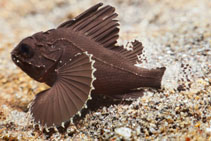 Neosebastes entaxis
Juvenile Afbeelding van Malaer, P.
Afbeeldingen | Google afbeelding
Juvenile Afbeelding van Malaer, P.
Classificatie / Namen Lokale namen | Synoniemen | Catalog of Fishes(Genus, Soort(en)) | ITIS | CoL | WoRMS | Cloffa
> Perciformes/Scorpaenoidei (Scorpionfishes) > Neosebastidae (Gurnard scorpionfishes)
Etymology: Neosebastes: Greek, neos = new + Greek, sebastes = august, venerable (Ref. 45335).
More on authors: Jordan & Starks.
Etymology: Neosebastes: Greek, neos = new + Greek, sebastes = august, venerable (Ref. 45335).
More on authors: Jordan & Starks.
Milieu: milieu / Klimaatzone / Diepte / verspreidingsgebied Ecologie
marien rifbewoner; diepte 8 - 25 m (Ref. 54394). Temperate
Verspreiding Gebieden | FAO regio's | Ecosystemen | Voorkomen | Verspreidingskaart | Introducties | Faunafri
Northwest Pacific: endemic to East Asian continental shelf.
Grootte / Gewicht / Leeftijd
Korte beschrijving Determinatiesleutels | Morfologie | Morfometrie
Dorsale stekels (totaal) : 8; Dorsale zachte stralen (totaal) : 8; Anale stekels: 3; Anale zachte stralen: 5; Wervels: 26. Diagnosis: The underside of mandible has numerous tiny pores, no ridges. Preocular spine usually divided into 2 points, and flattened anteriorly and posteriorly. There are no additional spines between lacrimal and suborbital ridges. Upper opercular spine usually simple, tip pointed. Midinterorbital space moderately deep, not covered with scales. Interorbital ridge indistinct. Pored lateral-line scales 32-36 (mode 32). Longitudinal scale rows 47-56 (49). Scale rows between last dorsal-fin spine origin and lateral line 4\.2-5\.2 (5). Pectoral-fin rays 19-21 (20). Posterior margin of maxilla not reaching a vertical at posterior margin of pupil. Pectoral fin long (2.7-3.1, mean 2.8 in SL), reaching or extending beyond a vertical at origin of last dorsal-fin spine. Interorbital width wide (5.4-7.9, 6.7 in HL). Membrane anterior to sixth dorsal-fin spine extending up to 51-63% (57%) of the spine length. First anal-fin spine 1.2-1.5 (1.3) in third spine. Second pelvic-fin soft ray 1.5-1.8 (1.7) in HL. Bilobed portion of swim bladder more than half of total swim bladder length. Color of head and body blackish in preserved specimens; body, head, and pelvic and anal fins orange when fresh; no distinct small black spots on head or lateral line (Ref. 54394).
Body shape (shape guide): short and / or deep.
Body shape (shape guide): short and / or deep.
Inhabits rocky reefs with sandy substrata. Depth extension 25-30 for underwater photographs taken off Izu Peninsula and a single specimen reported to be collected from Okinawa Trough at 205 meters (Ref. 54394). Anterolateral glandular groove with venom gland (Ref. 57406).
Levenscyclus en paargedrag Maturiteit | Voortplanting | Paaien | Eieren | Fecunditeit | Larven
Hoofdreferentie
Upload uw referenties | Referenties | Coördinator | Medewerkers
Motomura, H., 2003. Revision of the scorpionfish genus Neosebastes (Scorpaeniformes: Neosebastidae), with descriptions of five new species. Indo-Pac. Fish. (37):46 p. (Ref. 54394)
CITES
Not Evaluated
Gevaar voor de mens
Venomous (Ref. 57406)
Gebruik door de mens
FAO - Publication: search | FishSource |
Meer informatie
Trofische ecologie
Voedsel (prooien)
Dieetsamenstelling
Voedselconsumptie
Voedselrantsoenen
Predatoren
Voedsel (prooien)
Dieetsamenstelling
Voedselconsumptie
Voedselrantsoenen
Predatoren
Ecologie
Ecologie
Ecologie
Populatiedynamica
Groeiparameters
Max. leeftijden / maten
Lengte-gewicht rel.
Lengte-lengte rel.
Lengtefrequenties
Massaconversie
Rekrutering
Abundantie
Groeiparameters
Max. leeftijden / maten
Lengte-gewicht rel.
Lengte-lengte rel.
Lengtefrequenties
Massaconversie
Rekrutering
Abundantie
Levenscyclus
Voortplanting
Maturiteit
Rijpheid/kieuwen rel.
Fecunditeit
Paaien
Paaibestanden
Eieren
Ontwikkeling van de eieren
Larven
Larvale populatiedynamiek
Voortplanting
Maturiteit
Rijpheid/kieuwen rel.
Fecunditeit
Paaien
Paaibestanden
Eieren
Ontwikkeling van de eieren
Larven
Larvale populatiedynamiek
Anatomie
Kieuwoppervlak
Hersenen
Otoliet
Kieuwoppervlak
Hersenen
Otoliet
Fysiologie
Lichaamssamenstelling
Voedingsstoffen
Zuurstofverbruik
Type zwemmen
Zwemsnelheid
Visuele pigmenten
Vis geluid
Ziekten en parasieten
Toxiciteit (LC50)
Lichaamssamenstelling
Voedingsstoffen
Zuurstofverbruik
Type zwemmen
Zwemsnelheid
Visuele pigmenten
Vis geluid
Ziekten en parasieten
Toxiciteit (LC50)
Genetica
genoom
Genetica
Heterozygositeit
Erfelijkheid
Genetische diversiteit
genoom
Genetica
Heterozygositeit
Erfelijkheid
Genetische diversiteit
Menselijk gerelateerd
Aquacultuursystemen
Aquacultuurprofielen
Kweeklijnen
Ciguatera gevallen
Postzegels, munten, diversen.
Aquacultuursystemen
Aquacultuurprofielen
Kweeklijnen
Ciguatera gevallen
Postzegels, munten, diversen.
Tools
E-boek | Veldgids | Determinatiesleutels | Lengtefrequentie Tool | Levenscyclus tool | Verspreidingskaart |
Vangst-MSY |
Speciale rapporten
Bekijk gegevens voor het houden in een aquarium | Bekijk Fact Sheets voor de soort | Bekijk Aquacultuur Fact Sheets
Download XML
Internetbronnen
AFORO (otoliths) | Aquatic Commons | BHL | Cloffa | Websites from users | Bekijk FishWatcher | CISTI | Catalog of Fishes: Genus, Soort(en) | DiscoverLife | ECOTOX | FAO - Publication: search | Faunafri | Fishipedia | Fishtrace | GloBI | Google Books | Google Scholar | Google | IGFA World Record | Nationale databanken | OneZoom | Open Tree of Life | Otolith Atlas of Taiwan Fishes | PubMed | Reef Life Survey | Socotra Atlas | TreeBase | Tree of Life | Wikipedia: ga naar, zoek | World Records Freshwater Fishing | Zoobank | Zoological Record
Schattingen op basis van modellen
Gewenste temperatuur (Ref. 123201): 20 - 28.2, mean 26.9 °C (based on 637 cells).
Fylogenetische diversiteitsindex (Ref. 82804): PD50 = 0.5002 [Uniqueness, from 0.5 = low to 2.0 = high].
Bayesian length-weight: a=0.01995 (0.00906 - 0.04395), b=3.01 (2.83 - 3.19), in cm total length, based on all LWR estimates for this body shape (Ref. 93245).
Trofisch niveau (Ref. 69278): 3.6 ±0.4 se; based on size and trophs of closest relatives