This website uses cookies to enhance your browsing experience and ensure the functionality of our site. For more detailed information about the types of cookies we use and how we protect your privacy, please visit our Privacy Information page.
×
Cookie Settings
This website uses different types of cookies to enhance your experience. Please select your preferences below:
Pacific Ocean: from the Line Islands to Indonesia, north to Taiwan and southern Japan, and south to the Great Barrier Reef.
Größe / Gewicht / Alter
Geschlechtsreife: Lm? range ? - ? cm Max length : 20.0 cm TL Männchen/unbestimmt; (Ref. 9710); common length : 15.0 cm SL Männchen/unbestimmt; (Ref. 37816)
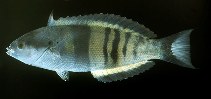
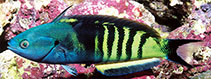
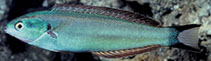
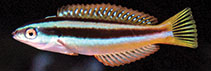
Rückenflossenstacheln (insgesamt) : 9; Rückenflossenweichstrahlen (insgesamt) : 12; Afterflossenstacheln: 3; Afterflossenweichstrahlen: 12. Color changes quickly from when moving from swimming near the bottom to open water to feed and the striped pattern of the female fades to an even grey that makes them difficult to see. Males have a variable banded pattern and this also changes with moods (Ref. 48636). Body shape (shape guide): fusiform / normal.
Found in outer reef crests in small aggregations (Ref. 8631). Females occur in small groups, and usually a male is nearby (Ref. 48636). Usually well above open bottoms with mixed sand, rubble, and coral (Ref. 9710). Found in areas periodically exposed to strong currents (Ref. 90102). Feeds on zooplankton (Ref. 9710).
Kailola, P.J., 1987. The fishes of Papua New Guinea: a revised and annotated checklist. Vol. II Scorpaenidae to Callionymidae. Research Bulletin No. 41, Research Section, Dept. of Fisheries and Marine Resources, Papua New Guinea. (Ref. 6192)
IUCN Rote Liste Status (Ref. 130435: Version 2025-2 (Global))
Bevorzugte Temperatur (Ref. 123201): 24.6 - 29, mean 27.9 °C (based on 280 cells).
Phylogenetischer Diversitätsindex (Ref. 82804): PD50 = 0.5020 [Uniqueness, from 0.5 = low to 2.0 = high].
Bayesian length-weight: a=0.00977 (0.00468 - 0.02039), b=3.07 (2.90 - 3.24), in cm total length, based on LWR estimates for this (Sub)family-body shape (Ref. 93245).
Trophische Ebene (Ref. 69278): 3.4 ±0.45 se; based on food items.
Widerstandsfähigkeit (Ref. 120179): hoch, Verdopplung der Population dauert weniger als 15 Monate. (Preliminary K or Fecundity.).
Anfälligkeit der Fischerei (Ref. 59153): Low vulnerability (10 of 100). 🛈