



Uploaden van uw Foto's en video's
Afbeeldingen | Google afbeelding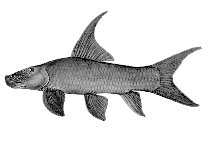 Labeo lukulae
Afbeelding van Mertens, P.
Afbeeldingen | Google afbeelding
Afbeelding van Mertens, P.
Classificatie / Namen Lokale namen | Synoniemen | Catalog of Fishes(Genus, Soort(en)) | ITIS | CoL | WoRMS | Cloffa
> Cypriniformes (Carps) > Cyprinidae (Minnows or carps) > Labeoninae
Etymology: Labeo: Latin, labeo = one who has large lips (Ref. 45335); lukulae: Named after the river where the type material was collected (Ref. 26190).
Eponymy: A toponym referring to the Lukula (Lakula) River, Democratic Republic of Congo; the type locality. (Ref. 128868), visit book page.
More on author: Boulenger.
Etymology: Labeo: Latin, labeo = one who has large lips (Ref. 45335); lukulae: Named after the river where the type material was collected (Ref. 26190).
Eponymy: A toponym referring to the Lukula (Lakula) River, Democratic Republic of Congo; the type locality. (Ref. 128868), visit book page.
More on author: Boulenger.
Milieu: milieu / Klimaatzone / Diepte / verspreidingsgebied Ecologie
; zoet water benthopelagisch. Tropical; 15°N - 15°S
Verspreiding Gebieden | FAO regio's | Ecosystemen | Voorkomen | Verspreidingskaart | Introducties | Faunafri
Africa: principal coastal basins of Cameroon to the Chiloango in Democratic Republic of the Congo; in the Congo basin known from the Kasai and Kwango in Angola, and the Aruwimi and Wagenia Falls in Democratic Republic of the Congo (Ref. 26192). Presence in the southern Congo basin in Angola not confirmed in Ref. 120641.
Grootte / Gewicht / Leeftijd
Korte beschrijving Determinatiesleutels | Morfologie | Morfometrie
Dorsale zachte stralen (totaal) : 12 - 13; Wervels: 29 - 31. Diagnosis: snout prominent, large and somewhat pointed, 44.6-60.0% of HL, with a deep and wide transverse furrow and ending in a fleshy appendage; scale formula: 34-37 (35 commonly observed); 4.5-6.5 (5.5 commonly observed); 3.0-4.5 (4.0 commonly observed); 13-17 (16 commonly observed); dorsal fin with 3 unbranched and 9-10 (10 commonly observed) branched rays; upper edge of dorsal fin always concave; 29-31 (30 commonly observed) vertebrae; ventral fin origin located under the 4th branched dorsal ray; genital opening distant from anal fin origin; no longitudinal band on flanks or spot on scaled base of caudal fin (Ref. 81639).
Body shape (shape guide): fusiform / normal.
Body shape (shape guide): fusiform / normal.
Levenscyclus en paargedrag Maturiteit | Voortplanting | Paaien | Eieren | Fecunditeit | Larven
Hoofdreferentie
Upload uw referenties | Referenties | Coördinator | Medewerkers
Tshibwabwa, S.M., 1997. Systématique des espèces africaines du genre Labeo (Teleostei, Cyprinidae) dans les régions ichtyogéographiques de Basse-Guinée et du Congo. II. Presses Universitaires de Namur, Namur, Belgique. 227 p. (Ref. 26192)
Status op de Rode Lijst van het IUCN (Ref. 130435: Version 2025-2 (Global))
Niet bedreigd (LC) ; Date assessed: 16 February 2009
CITES
Not Evaluated
Gevaar voor de mens
Harmless
Gebruik door de mens
Visserij: van geen belang
FAO - Publication: search | FishSource |
Meer informatie
Trofische ecologie
Voedsel (prooien)
Dieetsamenstelling
Voedselconsumptie
Voedselrantsoenen
Predatoren
Voedsel (prooien)
Dieetsamenstelling
Voedselconsumptie
Voedselrantsoenen
Predatoren
Ecologie
Ecologie
Ecologie
Populatiedynamica
Groeiparameters
Max. leeftijden / maten
Lengte-gewicht rel.
Lengte-lengte rel.
Lengtefrequenties
Massaconversie
Rekrutering
Abundantie
Groeiparameters
Max. leeftijden / maten
Lengte-gewicht rel.
Lengte-lengte rel.
Lengtefrequenties
Massaconversie
Rekrutering
Abundantie
Levenscyclus
Voortplanting
Maturiteit
Rijpheid/kieuwen rel.
Fecunditeit
Paaien
Paaibestanden
Eieren
Ontwikkeling van de eieren
Larven
Larvale populatiedynamiek
Voortplanting
Maturiteit
Rijpheid/kieuwen rel.
Fecunditeit
Paaien
Paaibestanden
Eieren
Ontwikkeling van de eieren
Larven
Larvale populatiedynamiek
Anatomie
Kieuwoppervlak
Hersenen
Otoliet
Kieuwoppervlak
Hersenen
Otoliet
Fysiologie
Lichaamssamenstelling
Voedingsstoffen
Zuurstofverbruik
Type zwemmen
Zwemsnelheid
Visuele pigmenten
Vis geluid
Ziekten en parasieten
Toxiciteit (LC50)
Lichaamssamenstelling
Voedingsstoffen
Zuurstofverbruik
Type zwemmen
Zwemsnelheid
Visuele pigmenten
Vis geluid
Ziekten en parasieten
Toxiciteit (LC50)
Genetica
genoom
Genetica
Heterozygositeit
Erfelijkheid
Genetische diversiteit
genoom
Genetica
Heterozygositeit
Erfelijkheid
Genetische diversiteit
Menselijk gerelateerd
Aquacultuursystemen
Aquacultuurprofielen
Kweeklijnen
Ciguatera gevallen
Postzegels, munten, diversen.
Aquacultuursystemen
Aquacultuurprofielen
Kweeklijnen
Ciguatera gevallen
Postzegels, munten, diversen.
Tools
E-boek | Veldgids | Determinatiesleutels | Lengtefrequentie Tool | Levenscyclus tool | Verspreidingskaart |
Vangst-MSY |
Speciale rapporten
Bekijk gegevens voor het houden in een aquarium | Bekijk Fact Sheets voor de soort | Bekijk Aquacultuur Fact Sheets
Download XML
Internetbronnen
AFORO (otoliths) | Aquatic Commons | BHL | Cloffa | Websites from users | Bekijk FishWatcher | CISTI | Catalog of Fishes: Genus, Soort(en) | DiscoverLife | ECOTOX | FAO - Publication: search | Faunafri | Fishipedia | Fishtrace | GloBI | Google Books | Google Scholar | Google | IGFA World Record | OneZoom | Open Tree of Life | Otolith Atlas of Taiwan Fishes | PubMed | Reef Life Survey | Socotra Atlas | TreeBase | Tree of Life | Wikipedia: ga naar, zoek | World Records Freshwater Fishing | Zoobank | Zoological Record
Schattingen op basis van modellen
Fylogenetische diversiteitsindex (Ref. 82804): PD50 = 0.5000 [Uniqueness, from 0.5 = low to 2.0 = high].
Bayesian length-weight: a=0.00871 (0.00433 - 0.01753), b=3.04 (2.87 - 3.21), in cm total length, based on LWR estimates for this species & Genus-body shape (Ref. 93245).
Weerstandsvermogen (Ref. 120179): Gemiddeld, minimale populatieverdubbelingstijd 1,4-4,4 jaar (Preliminary K or Fecundity.).