



Yasuhikotakia morleti (Tirant, 1885)
Skunk botia
Envoyez vos Photos et vidéos
Images | Images Google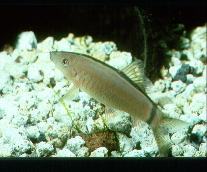 Yasuhikotakia morleti
Photo de Ott, G.
Images | Images Google
Photo de Ott, G.
Classification / Noms Noms communs | Synonymes | Catalog of Fishes(Genre, Espèce) | ITIS | CoL | WoRMS | Cloffa
> Cypriniformes (Carps) > Botiidae (Pointface loaches) > Botiinae
Eponymy: Dr Yasuhiko Taki (1931-2020) was an Japanese ichthyologist and researcher ‘…who contributed very much’ to the study of loaches, according to the etymology. [...] Laureut-Joseph Morlet (1823–1893) was a French biologist and conchologist who worked at MNHN Paris. He wrote: Diagnoses de mollusques terrestres et fluviatiles du Tonkin (1886). (Ref. 128868), visit book page.
Eponymy: Dr Yasuhiko Taki (1931-2020) was an Japanese ichthyologist and researcher ‘…who contributed very much’ to the study of loaches, according to the etymology. [...] Laureut-Joseph Morlet (1823–1893) was a French biologist and conchologist who worked at MNHN Paris. He wrote: Diagnoses de mollusques terrestres et fluviatiles du Tonkin (1886). (Ref. 128868), visit book page.
Environnement : milieu / zone climatique / profondeur / gamme de distribution Écologie
; eau douce démersal; pH range: 6.0 - 8.0; dH range: 5 - 12. Tropical; 26°C - 30°C (Ref. 1672)
Distribution Territoires | Zones FAO | Écosystèmes | Occurrences | Carte par point | Introductions | Faunafri
Asia: Mekong, Chao Phraya and Meklong basins, and peninsular Thailand.
Taille / Poids / Âge
Description synthétique Clés d'identification | Morphologie | Morphométrie
Rayons mous dorsaux (Total) : 12 - 13; Rayons mous anaux: 9 - 10; Vertèbres: 28 - 30. Has 7-9 branched dorsal-fin rays; a mid-dorsal stripe from head to tail, extending ventrally as vertical bar on caudal peduncle; erect ethmoid spine perpendicular to snout when viewed from above; large mental lobe; body golden brown, sometimes with a series of narrow bars in young individuals (Ref. 12693); a few vertical dark vermiculations on flank; few black dots on caudal fin (Ref. 43281).
Body shape (shape guide): elongated.
Body shape (shape guide): elongated.
Occurs in medium to large-sized rivers (Ref. 12975). Inhabits standing and flowing waters. Found in crevices in rocks or excavates burrows under rocks or logs (Ref. 12693), usually in sandy habitats (Ref. 43281). Feeds on mollusks and benthic invertebrates. Oviparous (Ref. 205). Probably moves into temporarily flooded areas during high water levels. Young of the year return to rivers in November and December in the lower Mekong. Commonly seen in aquarium trade (Ref. 12693).
Cycle de vie et comportement reproducteur Maturité | Reproduction | Frai | Œufs | Fécondité | Larves
Référence principale
Téléchargez vos références | Références | Coordinateur | Collaborateurs
Kottelat, M., 2004. Botia kubotai, a new species of loach (Teleostei: Cobitidae) from the Ataran River basin (Myanmar), with comments on botiine nomenclature and diagnosis of a new genus. Zootaxa 401:1-18. (Ref. 50472)
Statut dans la liste rouge de l'IUCN (Ref. 130435: Version 2025-2 (Global))
Préoccupation mineure (LC) ; Date assessed: 15 February 2011
CITES
Not Evaluated
Menace pour l'homme
Harmless
Utilisations par l'homme
Pêcheries: commercial; Aquarium: Commercial
FAO - Publication: search | FishSource |
Plus d'informations
Écologie trophique
Aliments (proies)
Composition du régime alimentaire
Consommation alimentaire
Rations alimentaires
Prédateurs
Aliments (proies)
Composition du régime alimentaire
Consommation alimentaire
Rations alimentaires
Prédateurs
Dynamique des populations
Paramètres de croissance
Âges / tailles maximales
Longueur-poids rel.
Rel. longueur-longueur.
Fréquences de longueurs
Conversion de masse
Recrutement
Abondance
Paramètres de croissance
Âges / tailles maximales
Longueur-poids rel.
Rel. longueur-longueur.
Fréquences de longueurs
Conversion de masse
Recrutement
Abondance
Cycle de vie
Reproduction
Maturité
Maturité/épines rel.
Fécondité
Frai
Agrégats de frai
Œufs
Développement de l'œuf
Larves
Dynamique des populations larvaires
Reproduction
Maturité
Maturité/épines rel.
Fécondité
Frai
Agrégats de frai
Œufs
Développement de l'œuf
Larves
Dynamique des populations larvaires
Anatomie
Surface branchiale
Cerveau
Otolithe
Surface branchiale
Cerveau
Otolithe
Physiologie
Composition corporelle
Nutriments
Consommation d'oxygène
Type de natation
Vitesse de nage
Pigments visuels
Son de poisson
Maladies et parasites
Toxicité (CL50)
Composition corporelle
Nutriments
Consommation d'oxygène
Type de natation
Vitesse de nage
Pigments visuels
Son de poisson
Maladies et parasites
Toxicité (CL50)
Génétique
génôme
Génétique
Hétérozygotie
Héritabilité
Diversité génétique
génôme
Génétique
Hétérozygotie
Héritabilité
Diversité génétique
Liées à l'homme
Systèmes d'aquaculture
Profils d'aquaculture
Souches
Cas de ciguatera
Timbres, pièces de monnaie, divers
Systèmes d'aquaculture
Profils d'aquaculture
Souches
Cas de ciguatera
Timbres, pièces de monnaie, divers
Outils
Quiz bio | E-book | Guide de terrain | Générateur de fréquences de longueur | Outil de dynamique de population | Carte par point |
Capture-MSY |
Articles particuliers
Télécharger en XML
Sources Internet
AFORO (otoliths) | Alien/Invasive Species database | Aquatic Commons | BHL | Cloffa | Websites from users | FishWatcher | CISTI | Catalog of Fishes: Genre, Espèce | DiscoverLife | ECOTOX | FAO - Publication: search | Faunafri | Fishipedia | Fishtrace | GloBI | Google Books | Google Scholar | Google | IGFA World Record | OneZoom | Open Tree of Life | Otolith Atlas of Taiwan Fishes | PubMed | Reef Life Survey | Socotra Atlas | TreeBase | Arbre de Vie | Wikipedia: aller à, chercher | World Records Freshwater Fishing | Zoological Record
Estimations basées sur des modèles
Indice de diversité phylogénétique (Réf. 82804): PD50 = 0.5078 [Uniqueness, from 0.5 = low to 2.0 = high].
Bayesian length-weight: a=0.00589 (0.00250 - 0.01388), b=3.08 (2.88 - 3.28), in cm total length, based on LWR estimates for this (Sub)family-body shape (Ref. 93245).
Niveau trophique (Réf. 69278): 3.5 ±0.44 se; based on food items.