



Azurina multilineata (Guichenot, 1853)
Brown chromis
Sube tu fotos y Vídeos
Imágenes | Vídeos | Sellos, monedas, varios | Google image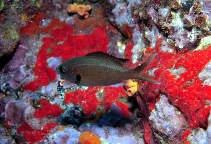 Azurina multilineata
Foto de Wirtz, P.
Imágenes | Vídeos | Sellos, monedas, varios | Google image
Foto de Wirtz, P.
Clasificación / Nombres Nombres comunes | Sinónimos | Catalog of Fishes(Género, Especie) | ITIS | CoL | WoRMS | Cloffa
> Ovalentaria/misc (Various families in series Ovalentaria) > Pomacentridae (Damselfishes) > Chrominae
Etymology: Azurina: Latin, azurinus = blue, pale blue; the name of Leuciscus caeruleus, blue Roach; 1600 (Ref. 45335).
More on author: Guichenot.
Etymology: Azurina: Latin, azurinus = blue, pale blue; the name of Leuciscus caeruleus, blue Roach; 1600 (Ref. 45335).
More on author: Guichenot.
Taxonomic Remarks
The Ascension I. population differs from the St. Helena I. population in having a bright spot at the rear end of the base of the dorsal fin. No genetic differences were found between the two populations that seem closest to the population from Brazil (Rocha et al., 2008).
Entorno: milieu / zona climática / rango de profundidad / gama de distribución Ecología
marino asociado a arrecife; no migratorio; rango de profundidad 0 - 60 m (Ref. 58047). Subtropical; 33°N - 31°S, 100°W - 19°E
Distribución Territorios | Áreas FAO | Ecosistemas | Ocurrencias, apariciones | Mapa de puntos | Introducciones | Faunafri
Western Atlantic: Florida and Texas (USA) and throughout the Caribbean Sea to Brazil (Ref. 9626, 35834). Eastern Atlantic: St. Helena and Ascension islands and from São Tomé.
Tamaño / Peso / Edad
Madurez: Lm ? range ? - ? cm
Max length : 20.0 cm TL macho / no sexado; (Ref. 3139); common length : 12.0 cm TL macho / no sexado; (Ref. 3139)
Max length : 20.0 cm TL macho / no sexado; (Ref. 3139); common length : 12.0 cm TL macho / no sexado; (Ref. 3139)
Descripción breve Claves de identificación | Morfología | Morfometría
Espinas dorsales (total) : 12; Radios blandos dorsales (total) : 12 - 13; Espinas anales: 2; Radios blandos anales: 11 - 13. A prominent black spot at the pectoral-fin base, and a white spot just behind the posterior base of the soft dorsal fin (Ref. 7247). Grayish brown on back, shading to silvery gray on sides; dorsal fin broadly edged with bright yellow; upper and lower edges of caudal fin narrowly yellow with a submarginal dark band (Ref. 13442).
Body shape (shape guide): fusiform / normal; Cross section: compressed.
Body shape (shape guide): fusiform / normal; Cross section: compressed.
Adults generally occur in steep slopes and patch reefs. Diurnal species (Ref. 9626), they most commonly form moderate-sized feeding-schools over reef tops, rising above the bottom to feed on plankton, mainly copepods. Often seen with Chromis cyanea (Ref. 9710). Oviparous, distinct pairing during breeding (Ref. 205). Eggs are demersal and adhere to the substrate (Ref. 205). Males guard and aerate the eggs (Ref. 205). Rarely marketed (Ref. 3139).
Ciclo vital y comportamiento de apareamiento Madurez | Reproducción | Puesta | Huevos | Fecundidad | Larva
Oviparous, distinct pairing during breeding (Ref. 205). Eggs are demersal and adhere to the substrate (Ref. 205). Males guard and aerate the eggs (Ref. 205).
Referencia principal
Suba sus referencias | Referencias | Coordinador : Allen, Gerald R. | Colaboradores
Allen, G.R., 1991. Damselfishes of the world. Mergus Publishers, Melle, Germany. 271 p. (Ref. 7247)
Situación en la Lista Roja de la UICN (Ref. 130435: Version 2025-2 (Global))
Least Concern (LC) ; Date assessed: 15 November 2010
CITES
Not Evaluated
Amenaza para el ser humano
Harmless
Usos humanos
Pesquerías: pesquerías de subsistencia; Acuario: Comercial
FAO - Publication: search | FishSource |
Más información
Ecología Trófica
Alimentos (presas)
Composición de la dieta
consumo de alimento
Raciones de comida
Despredadores
Alimentos (presas)
Composición de la dieta
consumo de alimento
Raciones de comida
Despredadores
Dinámica de la población
Coeficiente del crecimiento para
Edades / tallas máximas
Longitud-peso rel.
Longitud-longitud rel.
Longitud-frecuencias
Conversión de masas
Reclutamiento
Abundancia
Coeficiente del crecimiento para
Edades / tallas máximas
Longitud-peso rel.
Longitud-longitud rel.
Longitud-frecuencias
Conversión de masas
Reclutamiento
Abundancia
Ciclo de vida
Reproducción
Madurez
Madurez/Gills rel.
Fecundidad
Puesta
Agregaciones de desove
Huevos
Desarrollo de los huevos
Larva
Dinámica larvaria
Reproducción
Madurez
Madurez/Gills rel.
Fecundidad
Puesta
Agregaciones de desove
Huevos
Desarrollo de los huevos
Larva
Dinámica larvaria
Distribución
Territorios
Áreas FAO
Ecosistemas
Ocurrencias, apariciones
Introducciones
BRUVS - Vídeos
Territorios
Áreas FAO
Ecosistemas
Ocurrencias, apariciones
Introducciones
BRUVS - Vídeos
Fisiología
Composición corporal
Nutrientes
Consumo del oxígeno
Tipo de natación
Velocidad de natación
Pigmentos visuales
Sonido de peces
Enfermedades y parásitos
Toxicidad (CL50)
Composición corporal
Nutrientes
Consumo del oxígeno
Tipo de natación
Velocidad de natación
Pigmentos visuales
Sonido de peces
Enfermedades y parásitos
Toxicidad (CL50)
Relacionados con el ser humano
Sistemas de acuicultura
Perfiles de acuicultura
Razas
Ciguatera cases
Sellos, monedas, varios
Sistemas de acuicultura
Perfiles de acuicultura
Razas
Ciguatera cases
Sellos, monedas, varios
Herramientas
Cuestionario orgánico | Libro electrónico | Guía de campo | Asistente para frecuencias de tallas | Herramienta de ciclo de vida | Mapa de puntos |
Catch-MSY |
Informes especiales
Comprobar el mantenimiento del acuario | Buscar fichas sobre especies | Consulte las hojas informativas sobre acuicultura
Descargar XML
Fuentes de Internet
AFORO (otoliths) | Aquatic Commons | BHL | Cloffa | Websites from users | Check FishWatcher | CISTI | Catalog of Fishes: Género, Especie | DiscoverLife | ECOTOX | FAO - Publication: search | Faunafri | Fishipedia | Fishtrace | GloBI | Google Books | Google Scholar | Google | IGFA World Record | Bases de datos nacionales | OneZoom | Open Tree of Life | Otolith Atlas of Taiwan Fishes | Acuarios públicos | PubMed | Reef Life Survey | Socotra Atlas | TreeBase | Árbol de la vida | Wikipedia: Go, búsqueda | World Records Freshwater Fishing | Expediente Zoológico
Estimaciones basadas en modelos
Temperatura preferida (Referencia 123201): 24.5 - 28, mean 26.9 °C (based on 374 cells).
Índice de diversidad filogenética (Referencia 82804): PD50 = 0.5010 [Uniqueness, from 0.5 = low to 2.0 = high].
Bayesian length-weight: a=0.01259 (0.00569 - 0.02786), b=3.03 (2.84 - 3.22), in cm total length, based on LWR estimates for this (Sub)family-body shape (Ref. 93245).
Nivel trófico (Referencia 69278): 3.0 ±0.0 se; based on diet studies.
Resiliencia (Referencia 120179): Medio, población duplicada en un tiempo mínimo de 1.4-4.4 años (Preliminary K or Fecundity.).
Nutrientes (Ref. 124155): Calcium = 46.6 [20.8, 84.9] mg/100g; Iron = 0.752 [0.445, 1.242] mg/100g; Protein = 19.3 [18.2, 20.3] %; Omega3 = 0.222 [0.129, 0.370] g/100g; Selenium = 12.8 [6.4, 25.7] μg/100g; VitaminA = 106 [35, 310] μg/100g; Zinc = 1.01 [0.65, 1.50] mg/100g (wet weight);