



Hochladen Photos und videos
Google Bild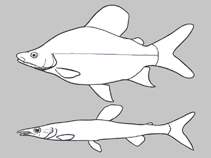 No image available for this species;
drawing shows typical species in Distichodontidae.
Google Bild
drawing shows typical species in Distichodontidae.
Klassifizierung / Names Namen | Synonyme | Catalog of Fishes(Gattung, Arten) | ITIS | CoL | WoRMS | Cloffa
> Characiformes (Characins) > Distichodontidae (Distichodus)
Etymology: Distichodus: Greek, di = two + Greek, stix, stichos = line, row (Ref. 45335).
More on author: Bonnaterre.
Etymology: Distichodus: Greek, di = two + Greek, stix, stichos = line, row (Ref. 45335).
More on author: Bonnaterre.
Taxonomic Remarks
See explanation of name change from Distichodus niloticus (Hasselquist, 1762) in Eschmeyer (CofF ver. Oct. 2012: Ref. 92135) according to Fricke (2008: Ref. 83466).
Umwelt: Milieu / Klimazone / Tiefenbereich / Verbreitungsgebiet Ökologie
; süßwasser pelagisch. Tropical
Verbreitung Territorien | FAO Gebiete | Ökosysteme | Vorkommen | Punkt Karte | Einführungen | Faunafri
Africa: Lake Albert (Ref. 4903, 49805), Lakes Turkana and No, Murchison Nile (Ref. 4903), White and Blue Nile, and the Chad basin where it is uncommon (Ref. 7094).
Größe / Gewicht / Alter
Geschlechtsreife: Lm ? range ? - ? cm
Max length : 83.0 cm TL Männchen/unbestimmt; (Ref. 7094); max. veröff. Gewicht: 6.2 kg (Ref. 7094)
Max length : 83.0 cm TL Männchen/unbestimmt; (Ref. 7094); max. veröff. Gewicht: 6.2 kg (Ref. 7094)
Kurzbeschreibung Bestimmungsschlüssel | Morphologie | Morphometrie
Rückenflossenweichstrahlen (insgesamt) : 22 - 26; Afterflossenweichstrahlen: 13 - 15. Diagnosis: depth of body 2.5-3.5 times in standard length, length of head 3 (in young fishes) to 5 times (in adults) (Ref. 4903). Snout not elongated (Ref. 28714), rounded (Ref. 4903), not or slightly projecting beyond the mouth (Ref. 4903, 28714). Maxilla extending to below the nostrils; upper surface of the head, and the operculum ridged with low, radiating striations (Ref. 4903). Teeth all small and bicuspidate (Ref. 28714), in two series, outer with 24-36 teeth (Ref. 4903). Dorsal fin with 22-26 rays, the first 3-6 unbranched (Ref. 4903). Adipose fin covered with small scales (Ref. 4903, 28714), small, its basal length about 2-4 times its distance from the posterior margin of the dorsal fin (Ref. 28714). Anal fin with 13-15 rays, the first 3-4 unbranched; caudal fin forked, its rounded lobes almost entirely scaled; lateral line with 90-110 scales (Ref. 4903). 18-21 scales between lateral line and dorsal-fin origin (Ref. 4903, 28714). 15-18 scales between insertion of pelvic fin and lateral line (Ref. 4903). Large robust fish as adults (Ref. 28714).
Coloration: purplish-silver above, silver below; young fishes with several vertical dark bars on the flank (Ref. 4903).
In Lake Albert found in the shallow inshore waters, especially in the region of
deltas; also in rivers (Ref. 4903). Macro-herbivore, feeds on submerged water plants (Ref. 4903, 28714), Eichornia roots and periphyton (Ref. 28714), but also molluscs and small Crustacea (Ref. 4903). Oviparous (Ref. 205).
Lebenszyklus und Paarungsverhalten Geschlechtsreife | Fortpflanzung | Ablaichen | Eier | Fruchtbarkeit | Larven
Oviparous (Ref. 205). Distinct pairing occurs (Ref. 205). Males lingering near the nesting site deemed as the closest thing to parental care (Ref. 205).
Hauptreferenz
Laden Sie Ihre Referenzen hoch | Referenzen | Koordinator | Partner
Daget, J. and J.-P. Gosse, 1984. Distichodontidae. p. 184-211. In J. Daget, J.-P. Gosse and D.F.E. Thys van den Audenaerde (eds.) Check-list of the freshwater fishes of Africa (CLOFFA). ORSTOM, Paris and MRAC, Tervuren. Vol. 1. (Ref. 7094)
IUCN Rote Liste Status (Ref. 130435: Version 2025-2 (Global))
Verwundbar (VU) (A2bcd+3cd); Date assessed: 12 April 2021
CITES
Not Evaluated
Bedrohung für Menschen
Harmless
Nutzung durch Menschen
FAO - Publication: search | FishSource |
Mehr Information
Trophische Ökologie
Lebensmittel (Beutetiere)
Nahrungszusammensetzung
Nahrungsaufnahme
Lebensmittelrationen
Räuber
Lebensmittel (Beutetiere)
Nahrungszusammensetzung
Nahrungsaufnahme
Lebensmittelrationen
Räuber
Populationsdynamik
Wachstumsparameter
Max. Alter/Größen
Länge-Gewicht-Rel.
Länge-Länge-Verhältnis.
Längenhäufigkeiten
Massenkonvertierung
Rekrutierung
Dichte
Wachstumsparameter
Max. Alter/Größen
Länge-Gewicht-Rel.
Länge-Länge-Verhältnis.
Längenhäufigkeiten
Massenkonvertierung
Rekrutierung
Dichte
Lebenszyklus
Fortpflanzung
Geschlechtsreife
Reifung/Kiemen rel.
Fruchtbarkeit
Ablaichen
Laichaggregationen
Eier
Eientwicklung
Larven
Larven Pop.Dyn.
Fortpflanzung
Geschlechtsreife
Reifung/Kiemen rel.
Fruchtbarkeit
Ablaichen
Laichaggregationen
Eier
Eientwicklung
Larven
Larven Pop.Dyn.
Anatomie
Kiemenoberfläche
Gehirn
Otolith
Kiemenoberfläche
Gehirn
Otolith
Physiologie
Körperliche Zusammensetzung
Nährstoffe
Sauerstoffverbrauch
Schwimmart
Schwimmgeschwindigkeit
Visuelle Pigmente
Fischgeräusche
Krankheiten und Parasiten
Toxizität (LC50s)
Körperliche Zusammensetzung
Nährstoffe
Sauerstoffverbrauch
Schwimmart
Schwimmgeschwindigkeit
Visuelle Pigmente
Fischgeräusche
Krankheiten und Parasiten
Toxizität (LC50s)
Genetik
Genom
Genetik
Heterozygotie
Vererbbarkeit
Genetische Vielfalt
Genom
Genetik
Heterozygotie
Vererbbarkeit
Genetische Vielfalt
Menschenbezogen
Aquakultur-Systeme
Aquakultur Profile
Zuchtlinien
Ciguatera-Fälle
Briefmarken, Münzen, Verschiedenes.
Aquakultur-Systeme
Aquakultur Profile
Zuchtlinien
Ciguatera-Fälle
Briefmarken, Münzen, Verschiedenes.
Tools
Zusatzinformationen
Download XML
Zusammenfassung | Punktdaten | Namen | Photos
Internet Quellen
AFORO (otoliths) | Alien/Invasive Species database | Aquatic Commons | BHL | Cloffa | Websites from users | FishWatcher Einträge suchen | CISTI | Catalog of Fishes: Gattung, Arten | DiscoverLife | ECOTOX | FAO - Publication: search | Faunafri | Fishipedia | Fishtrace | GloBI | Google Books | Google Scholar | Google | IGFA World Record | OneZoom | Open Tree of Life | Otolith Atlas of Taiwan Fishes | PubMed | Reef Life Survey | Socotra Atlas | TreeBase | Tree of Life | Wikipedia: Gehe zu, Suchen | World Records Freshwater Fishing | Zoologischer Rekord
Schätzungen auf der Grundlage von Modellen
Phylogenetischer Diversitätsindex (Ref. 82804): PD50 = 0.5000 [Uniqueness, from 0.5 = low to 2.0 = high].
Bayesian length-weight: a=0.00447 (0.00186 - 0.01072), b=3.17 (2.97 - 3.37), in cm total length, based on LWR estimates for this (Sub)family-body shape (Ref. 93245).
Trophische Ebene (Ref. 69278): 2.0 ±0.00 se; based on food items.