



Cromeria occidentalis Daget, 1954
Hochladen Photos und videos
Bilder | Google Bild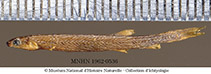 Cromeria occidentalis
Photo von MNHN
Bilder | Google Bild
Photo von MNHN
Klassifizierung / Names Namen | Synonyme | Catalog of Fishes(Gattung, Arten) | ITIS | CoL | WoRMS | Cloffa
> Gonorynchiformes (Milkfishes) > Kneriidae (Shellears)
Etymology: Cromeria: Perhaps related to the prehistoric Stone Age in eastern England; for the stone implements found in Cromer but needs more data.
Eponymy: Lord Cromer Evelyn Baring (1841–1917), 1st Earl of Cromer, was a soldier (1858–1877) and a particularly oppressive and racist colonial administrator. [...] (Ref. 128868), visit book page.
Etymology: Cromeria: Perhaps related to the prehistoric Stone Age in eastern England; for the stone implements found in Cromer but needs more data.
Eponymy: Lord Cromer Evelyn Baring (1841–1917), 1st Earl of Cromer, was a soldier (1858–1877) and a particularly oppressive and racist colonial administrator. [...] (Ref. 128868), visit book page.
Umwelt: Milieu / Klimazone / Tiefenbereich / Verbreitungsgebiet Ökologie
; süßwasser benthopelagisch; pH range: 6.2 - 7.5. Tropical; 25°C - 30°C (Ref. 91322)
Verbreitung Territorien | FAO Gebiete | Ökosysteme | Vorkommen | Punkt Karte | Einführungen | Faunafri
Africa: basins of upper and middle Niger River, Benoué and upper Volta in Guinea, Mali, Burkina Faso, Ghana, Benin, Cameroon (Ref. 57474), Chad (Ref. 367) and Ivory Coast (Ref. 3066). Probably also in Togo, Nigeria and Niger (Ref. 57474).
Größe / Gewicht / Alter
Kurzbeschreibung Bestimmungsschlüssel | Morphologie | Morphometrie
Rückenflossenweichstrahlen (insgesamt) : 9 - 10; Afterflossenweichstrahlen: 7 - 8; Wirbelzahl: 40 - 43. Diagnosis: pelvic fin origin at level of anterior base of dorsal fin; preorbital stripe present; caudal peduncle depth 6.9-11% of SL; dorsal precaudal fin fold not reaching base of dorsal fin; 8-9 pectoral fin rays; 7 pelvic fin rays; 2 supernumerary rays in anal fin; 8 dorsal fin pterygiophores; 9+9 principal caudal fin rays; cephalic lateral line canals and supraorbital bone present; parasphenoid wide, with foramina for internal carotid arteries; neural spine of 2nd vertebra short and wide, only the length of its vertebral centrum and different from subsequent neural spines (Ref. 57474).
Body shape (shape guide): elongated; Cross section: compressed.
Body shape (shape guide): elongated; Cross section: compressed.
Maximum TL was recorded at 4.1 cm (Ref. 3566). Occurs on several substrates from fine mud to rough gravel and plant material; almost never buries into the substrate (Ref. 57474). Feeds on plankton (Ref. 57474, 91322) and phytoplankton (Ref. 91322). Reproduction likely takes place during the rainy season (August to September) (Ref. 57474) at high water levels in floodplains, brooks or rice fields (Ref. 91276, 91322).
Lebenszyklus und Paarungsverhalten Geschlechtsreife | Fortpflanzung | Ablaichen | Eier | Fruchtbarkeit | Larven
Hauptreferenz
Laden Sie Ihre Referenzen hoch | Referenzen | Koordinator | Partner
Moritz, T., R. Britz and K.E. Linsenmair, 2006. Cromeria nilotica and C. occidentalis, two valid species of the African freshwater fish family Kneriidae (Teleostei: Gonorhynchiformes). Ichthyol. Explor. Freshwat. 17(1):65-72. (Ref. 57474)
IUCN Rote Liste Status (Ref. 130435: Version 2025-2 (Global))
nicht bedroht (LC) ; Date assessed: 15 May 2019
CITES
Not Evaluated
Bedrohung für Menschen
Harmless
Nutzung durch Menschen
FAO - Publication: search | FishSource |
Mehr Information
Trophische Ökologie
Lebensmittel (Beutetiere)
Nahrungszusammensetzung
Nahrungsaufnahme
Lebensmittelrationen
Räuber
Lebensmittel (Beutetiere)
Nahrungszusammensetzung
Nahrungsaufnahme
Lebensmittelrationen
Räuber
Populationsdynamik
Wachstumsparameter
Max. Alter/Größen
Länge-Gewicht-Rel.
Länge-Länge-Verhältnis.
Längenhäufigkeiten
Massenkonvertierung
Rekrutierung
Dichte
Wachstumsparameter
Max. Alter/Größen
Länge-Gewicht-Rel.
Länge-Länge-Verhältnis.
Längenhäufigkeiten
Massenkonvertierung
Rekrutierung
Dichte
Lebenszyklus
Fortpflanzung
Geschlechtsreife
Reifung/Kiemen rel.
Fruchtbarkeit
Ablaichen
Laichaggregationen
Eier
Eientwicklung
Larven
Larven Pop.Dyn.
Fortpflanzung
Geschlechtsreife
Reifung/Kiemen rel.
Fruchtbarkeit
Ablaichen
Laichaggregationen
Eier
Eientwicklung
Larven
Larven Pop.Dyn.
Anatomie
Kiemenoberfläche
Gehirn
Otolith
Kiemenoberfläche
Gehirn
Otolith
Physiologie
Körperliche Zusammensetzung
Nährstoffe
Sauerstoffverbrauch
Schwimmart
Schwimmgeschwindigkeit
Visuelle Pigmente
Fischgeräusche
Krankheiten und Parasiten
Toxizität (LC50s)
Körperliche Zusammensetzung
Nährstoffe
Sauerstoffverbrauch
Schwimmart
Schwimmgeschwindigkeit
Visuelle Pigmente
Fischgeräusche
Krankheiten und Parasiten
Toxizität (LC50s)
Genetik
Genom
Genetik
Heterozygotie
Vererbbarkeit
Genetische Vielfalt
Genom
Genetik
Heterozygotie
Vererbbarkeit
Genetische Vielfalt
Menschenbezogen
Aquakultur-Systeme
Aquakultur Profile
Zuchtlinien
Ciguatera-Fälle
Briefmarken, Münzen, Verschiedenes.
Aquakultur-Systeme
Aquakultur Profile
Zuchtlinien
Ciguatera-Fälle
Briefmarken, Münzen, Verschiedenes.
Tools
Zusatzinformationen
Download XML
Zusammenfassung | Punktdaten | Namen | Photos
Internet Quellen
AFORO (otoliths) | Aquatic Commons | BHL | Cloffa | Websites from users | FishWatcher Einträge suchen | CISTI | Catalog of Fishes: Gattung, Arten | DiscoverLife | ECOTOX | FAO - Publication: search | Faunafri | Fishipedia | Fishtrace | GloBI | Google Books | Google Scholar | Google | IGFA World Record | OneZoom | Open Tree of Life | Otolith Atlas of Taiwan Fishes | PubMed | Reef Life Survey | Socotra Atlas | TreeBase | Tree of Life | Wikipedia: Gehe zu, Suchen | World Records Freshwater Fishing | Zoologischer Rekord