



Parakneria fortuita Penrith, 1973
Cubango kneria
Carregue seu(sua) Fotos e vídeos
Imagem do Google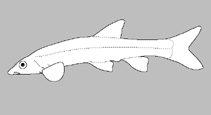 No image available for this species;
drawing shows typical species in Kneriidae.
Imagem do Google
drawing shows typical species in Kneriidae.
Classificação / Nomes Nomes comuns | Sinônimos | Catalog of Fishes(Gênero, Espécies) | ITIS | CoL | WoRMS | Cloffa
> Gonorynchiformes (Milkfishes) > Kneriidae (Shellears)
Etymology: fortuita: Name reflects a number of fortuitous circumstances that were involved in collecting this species; camp was made at sunset at river under the impression it was the Okavango, when next morning the error was discovered it was impossible to go on to the Okavango as the Cutato bridge was burnt down and heavy rain had closed the alternate route, leaving this the only place to work that day; also October 13 1972 was a Friday (Ref. 86888).
Eponymy: This is not an eponym, but an interesting name nonetheless. [...] (Ref. 128868), visit book page.
Etymology: fortuita: Name reflects a number of fortuitous circumstances that were involved in collecting this species; camp was made at sunset at river under the impression it was the Okavango, when next morning the error was discovered it was impossible to go on to the Okavango as the Cutato bridge was burnt down and heavy rain had closed the alternate route, leaving this the only place to work that day; also October 13 1972 was a Friday (Ref. 86888).
Eponymy: This is not an eponym, but an interesting name nonetheless. [...] (Ref. 128868), visit book page.
Meio ambiente: milieu / Zona climática / intervalo de profundidade / faixa de distribuição Ecologia
; Água doce bentopelágico. Tropical; 13°S - 15°S
Distribuição Territórios | Áreas da FAO | Ecossistemas | Ocorrências | Mapa de pontos | Introduções | Faunafri
Tamanho / Peso / Idade
Descrição suscinta Chaves de identificação | Morfologia | Morfometria
Espinhos dorsais (total) : 0; Raios dorsais (total) : 11; Espinhos anais: 0; Raios anais : 8; Vértebras: 43. Diagnosis: elongate, small species, body depth 6.4-8.0 times in SL; body width 8.2-10.0 times in SL; head rather short, 4.9-5.5 times in SL, about twice as long as broad (Ref. 86888). Head smooth, round in front, flat below (Ref. 52193). Eye laterodorsal (Ref. 86888), about 4.1-5 times in HL, 0.9-1.3 times in interorbital distance and 1.6-2.1 times in snout length (Ref. 89112), its horizontal diameter slightly less than interorbital distance; snout length equal to postorbital distance; interorbital distance about equal to mouth width; jaws without teeth, but with horny edges to jaws (Ref. 86888). Mouth straight, tadpole-like; gill openings form a slit above pectoral fins (Ref. 52193). Dorsal fin origin very slightly anterior to pelvic fin origin, slightly posterior to midpoint of SL (Ref. 86888), nearer to origin of caudal fin than to snout (Ref. 52193). Anal fin well posterior (Ref. 86888), closer to caudal fin origin than pelvic fin origin (Ref. 52193, 86888). Anal fin membrane relatively thick; pectoral fin large and ventral, its length 0.9 times in HL, 6.0 times in SL; pelvic fin 1.3 times in pectoral, 8.1 times in SL; strip of belly between pectoral and pelvic fins appears naked but has fine transparent scales; top, bottom and sides of head naked (Ref. 86888).
Body shape (shape guide): elongated; Cross section: circular.
Body shape (shape guide): elongated; Cross section: circular.
Lives among rocks in flowing water; feeds off diatoms and other algae and detritus scraped from rock surfaces (Ref. 7248, 52193).
Ciclo de vida ou comportamento de acasalamento Maturidade | Reprodução | Desova | Ovos | Fecundidade | Larvas
Referência principal
Carregar suas referências | Referências | Coordenador | Colaboradores
Poll, M., 1984. Kneriidae. p. 129-133. In J. Daget, J.-P. Gosse and D.F.E. Thys van den Audenaerde (eds.) Check-list of the freshwater fishes of Africa (CLOFFA). ORSTOM, Paris and MRAC, Tervuren. Vol. 1. (Ref. 3565)
Status na Lista Vermelha da UICN (Ref. 130435: Version 2025-2 (Global))
Dados insuficientes (DD) ; Date assessed: 01 March 2007
CITES
Not Evaluated
Ameaça para os humanos
Harmless
Uso pelos humanos
FAO - Publication: search | FishSource |
Mais informação
Ecologia Trófica
Itens alimentares (presas)
Composição da dieta
Consumo alimentar
Rações alimentares
Predadores
Itens alimentares (presas)
Composição da dieta
Consumo alimentar
Rações alimentares
Predadores
Dinâmica populacional
Parâmetros de crescimento
Idade máxima / tamanhos
Relação comprimento-peso.
Relação comprimento-comprimento.
Frequências de comprimento
Conversão de massa
Recrutamento
Abundância
Parâmetros de crescimento
Idade máxima / tamanhos
Relação comprimento-peso.
Relação comprimento-comprimento.
Frequências de comprimento
Conversão de massa
Recrutamento
Abundância
Ciclo de vida
Reprodução
Maturidade
Maturidade/Rel. das guelras
Fecundidade
Desova
Agregações de desova
Ovos
Desenvolvimento dos ovos
Larvas
Dinâmica larval
Reprodução
Maturidade
Maturidade/Rel. das guelras
Fecundidade
Desova
Agregações de desova
Ovos
Desenvolvimento dos ovos
Larvas
Dinâmica larval
Anatomia
Área branquial
Cérebro
Otólito
Área branquial
Cérebro
Otólito
Fisiologia
Composição corporal
Nutrientes
Consumo de oxigênio
Tipo de natação
Velocidade de natação
Pigmentos visuais
Som de peixe
Doenças e Parasitas
Toxicidade (LC50s)
Composição corporal
Nutrientes
Consumo de oxigênio
Tipo de natação
Velocidade de natação
Pigmentos visuais
Som de peixe
Doenças e Parasitas
Toxicidade (LC50s)
Genética
genoma
Genética
Heterozigosidade
Hereditariedade
Diversidade genética
genoma
Genética
Heterozigosidade
Hereditariedade
Diversidade genética
Relacionado a humanos
Sistemas de aquicultura
Perfis para aquacultura
Estirpes
Casos de Ciguatera
Selos, moedas, diversos.
Sistemas de aquicultura
Perfis para aquacultura
Estirpes
Casos de Ciguatera
Selos, moedas, diversos.
Ferramentas
Livro eletrônico | Guia de campo | Ferramenta auxiliar de frequências de comprimento | Ferramenta sobre a história de vida | Mapa de pontos |
Catch-MSY |
Relatórios especiais
Checar Manutenção em Aquário | Checar Planilhas de Fatos sobre as Espécies | Checar Planilhas de Fatos sobre Aquicultura
Baixar XML
Fontes da internet
AFORO (otoliths) | Aquatic Commons | BHL | Cloffa | Websites from users | Checar Observador de Peixes (FishWatcher) | CISTI | Catalog of Fishes: Gênero, Espécies | DiscoverLife | ECOTOX | FAO - Publication: search | Faunafri | Fishipedia | Fishtrace | GloBI | Google Books | Google Scholar | Google | IGFA World Record | OneZoom | Open Tree of Life | Otolith Atlas of Taiwan Fishes | PubMed | Reef Life Survey | Socotra Atlas | TreeBase | Árvore da vida | Wikipedia: Ir para, procura | World Records Freshwater Fishing | Zoobank | Registro zoológico
Estimativas baseadas em modelos
Índice de diversidade filogenética (Ref. 82804): PD50 = 0.5000 [Uniqueness, from 0.5 = low to 2.0 = high].
Bayesian length-weight: a=0.00389 (0.00180 - 0.00842), b=3.12 (2.94 - 3.30), in cm total length, based on all LWR estimates for this body shape (Ref. 93245).
Nível Trófico (Ref. 69278): 2.0 ±0.00 se; based on food items.