



Hochladen Photos und videos
Bilder | Google Bild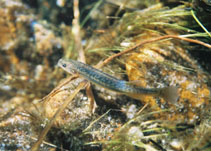 Galaxias zebratus
Photo von Marr, S.
Bilder | Google Bild
Photo von Marr, S.
Klassifizierung / Names Namen | Synonyme | Catalog of Fishes(Gattung, Arten) | ITIS | CoL | WoRMS | Cloffa
> Galaxiiformes (Southern smelts) > Galaxiidae (Galaxiids) > Galaxiinae
Etymology: Galaxias: Greek, galaxias, ou = a kind of fish (Ref. 45335).
More on author: Castelnau.
Etymology: Galaxias: Greek, galaxias, ou = a kind of fish (Ref. 45335).
More on author: Castelnau.
Taxonomic Remarks
The high level of genetic divergence between most of the populations in South Africa suggests that it may represent a species complex rather than a single species (Ref. 32965, 93589). There is an urgent need for detailed morphological diagnostic studies, and the determination of the ecological requirements and conservation status of each of the cryptic forms of this species (Ref. 93589).
Umwelt: Milieu / Klimazone / Tiefenbereich / Verbreitungsgebiet Ökologie
; süßwasser benthopelagisch. Subtropical; 18°C - 24°C (Ref. 12468); 30°S - 34°S
Verbreitung Territorien | FAO Gebiete | Ökosysteme | Vorkommen | Punkt Karte | Einführungen | Faunafri
Africa: endemic to South Africa, occurs in Cape coastal streams and rivers from the Krom and upper Gamtoos River systems (south coast) to the Clanwilliam Olifants system (west coast)(Ref. 32965, 52193, 93589, 93786).
Länge bei der ersten Reifung / Größe / Gewicht / Alter
Kurzbeschreibung Bestimmungsschlüssel | Morphologie | Morphometrie
Rückenflossenstacheln (insgesamt) : 0; Rückenflossenweichstrahlen (insgesamt) : 9 - 13; Afterflossenstacheln: 0; Afterflossenweichstrahlen: 9 - 14; Wirbelzahl: 36 - 42. Diagnosis: body slender and cylindrical, without scales; dorsal fin placed far back over anal fin; caudal fin truncated; mouth terminal, jaws with teeth; large eyes; internal organs visible in live specimens (Ref. 52193). Loss of two laterosensory pores beneath the lower jaw; elongate caudal peduncle (Ref. 93822).
Body shape (shape guide): elongated; Cross section: oval.
Body shape (shape guide): elongated; Cross section: oval.
Facultative air-breathing in the genus (Ref. 126274); May penetrate some distance inland and is widespread in lakes and rivers (Ref. 3563), which may be either acid (pH 5-6,5) or alkaline (pH 8-9) (Ref. 93592, 93822). Prefers gentle currents within shelter of banks near the head of pools (Ref. 3563, 52193). Small but extremely hardy, they are known to tolerate a wide range of water and temperature conditions (Ref. 5214, 6164, 52193, 93591, 93592). Feeds on small drifting invertebrates (Ref. 7248, 52193). Spawning period occurs in spring up to middle of summer (Ref. 5214, 33843, 52193), depending on the conditions (Ref. 52193). Ripe eggs are demersal, relatively large and numbering about 30-40 (Ref. 93592). Their small size and cryptic color enable them to avoid predators (Ref. 52193).
Lebenszyklus und Paarungsverhalten Geschlechtsreife | Fortpflanzung | Ablaichen | Eier | Fruchtbarkeit | Larven
Breeding occurs in spring or summer depending on local conditions (Ref. 52193). Galaxias zebratus does not migrate to the sea for breeding purposes (Ref. 41543, 93592).
Hauptreferenz
Laden Sie Ihre Referenzen hoch | Referenzen | Koordinator : Berra, Tim M. | Partner
Skelton, P.H., 2001. A complete guide to the freshwater fishes of southern Africa. Cape Town (South Africa): Struik Publishers, 395 p. (Ref. 52193)
IUCN Rote Liste Status (Ref. 130435: Version 2025-2 (Global))
Daten mangelhaft (DD) ; Date assessed: 01 March 2007
CITES
Not Evaluated
Bedrohung für Menschen
Harmless
Nutzung durch Menschen
Fischereien: nicht kommerziell; Aquarium: Kommerziell
FAO - Publication: search | FishSource |
Mehr Information
Trophische Ökologie
Lebensmittel (Beutetiere)
Nahrungszusammensetzung
Nahrungsaufnahme
Lebensmittelrationen
Räuber
Lebensmittel (Beutetiere)
Nahrungszusammensetzung
Nahrungsaufnahme
Lebensmittelrationen
Räuber
Populationsdynamik
Wachstumsparameter
Max. Alter/Größen
Länge-Gewicht-Rel.
Länge-Länge-Verhältnis.
Längenhäufigkeiten
Massenkonvertierung
Rekrutierung
Dichte
Wachstumsparameter
Max. Alter/Größen
Länge-Gewicht-Rel.
Länge-Länge-Verhältnis.
Längenhäufigkeiten
Massenkonvertierung
Rekrutierung
Dichte
Lebenszyklus
Fortpflanzung
Geschlechtsreife
Reifung/Kiemen rel.
Fruchtbarkeit
Ablaichen
Laichaggregationen
Eier
Eientwicklung
Larven
Larven Pop.Dyn.
Fortpflanzung
Geschlechtsreife
Reifung/Kiemen rel.
Fruchtbarkeit
Ablaichen
Laichaggregationen
Eier
Eientwicklung
Larven
Larven Pop.Dyn.
Anatomie
Kiemenoberfläche
Gehirn
Otolith
Kiemenoberfläche
Gehirn
Otolith
Physiologie
Körperliche Zusammensetzung
Nährstoffe
Sauerstoffverbrauch
Schwimmart
Schwimmgeschwindigkeit
Visuelle Pigmente
Fischgeräusche
Krankheiten und Parasiten
Toxizität (LC50s)
Körperliche Zusammensetzung
Nährstoffe
Sauerstoffverbrauch
Schwimmart
Schwimmgeschwindigkeit
Visuelle Pigmente
Fischgeräusche
Krankheiten und Parasiten
Toxizität (LC50s)
Menschenbezogen
Aquakultur-Systeme
Aquakultur Profile
Zuchtlinien
Ciguatera-Fälle
Briefmarken, Münzen, Verschiedenes.
Aquakultur-Systeme
Aquakultur Profile
Zuchtlinien
Ciguatera-Fälle
Briefmarken, Münzen, Verschiedenes.
Tools
E-Book | Feldführer | Bestimmungsschlüssel | Längenhäufigkeits Tool | Lebensdaten Tool | Punkt Karte |
Catch-MSY |
Zusatzinformationen
Download XML
Zusammenfassung | Punktdaten | Namen | Photos
Internet Quellen
AFORO (otoliths) | Aquatic Commons | BHL | Cloffa | Websites from users | FishWatcher Einträge suchen | CISTI | Catalog of Fishes: Gattung, Arten | DiscoverLife | ECOTOX | FAO - Publication: search | Faunafri | Fishipedia | Fishtrace | GloBI | Google Books | Google Scholar | Google | IGFA World Record | OneZoom | Open Tree of Life | Otolith Atlas of Taiwan Fishes | PubMed | Reef Life Survey | Socotra Atlas | TreeBase | Tree of Life | Wikipedia: Gehe zu, Suchen | | Zoologischer Rekord
Schätzungen auf der Grundlage von Modellen
|
Phylogenetischer Diversitätsindex (Ref. 82804) |
PD50 = 0.5000 [Uniqueness, from 0.5 = low to 2.0 = high]. |
| Bayesian length-weight | a=0.00490 (0.00205 - 0.01170), b=3.12 (2.91 - 3.33), in cm total length, based on LWR estimates for this (Sub)family-body shape (Ref. 93245). |
|
Trophische Ebene (Ref. 69278) |
3.5 ±0.37 se; based on food items. |
|
Widerstandsfähigkeit (Ref. 120179) |
niedrig, Verdopplung der Population dauert 4,5 - 14 Jahre. (Fec<50). |
|
Anfälligkeit der Fischerei (Ref. 59153) |
Low vulnerability (12 of 100). 🛈 |