



Ladda upp din foton och Videor
Bilder | Google image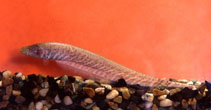 Gymnotus carapo
Bild av Landines, M.
Bilder | Google image
Bild av Landines, M.
Klassificering / Namn Populärnamn | synonymer | Catalog of Fishes(Släkte, Arter) | ITIS | CoL | WoRMS | Cloffa
> Gymnotiformes (Knifefishes) > Gymnotidae (Naked-back knifefishes) > Gymnotinae
Etymology: Gymnotus: Greek, gymnos = naked (Ref. 45335).
More on author: Linnaeus.
Etymology: Gymnotus: Greek, gymnos = naked (Ref. 45335).
More on author: Linnaeus.
Miljö: miljö / Klimatzon / djupintervall / distributionsområde Ekologi
; sötvatten bentopelagisk; pH range: 6.0 - 7.5; dH range: ? - 15; flodvandrande (Ref. 51243). Subtropical; 22°C - 28°C (Ref. 1672)
Utbredning Territorier | FAO områden | Ekosystem | Förekomster | Prickkarta | Utplanteringar | Faunafri
Central and South America: southern Mexico to Paraguay, including Trinidad.
Längd vid första mognad / Storlek / Vikt / Ålder
Könsmognad: Lm 19.4, range 25 - ? cm
Max length : 76.0 cm TL hane/ej könsbestämd; (Ref. 79585); publicerad maxvikt: 1.2 kg (Ref. 79585)
Max length : 76.0 cm TL hane/ej könsbestämd; (Ref. 79585); publicerad maxvikt: 1.2 kg (Ref. 79585)
Kort beskrivning Bestämningsnycklar | Morfologi | Morfometri
Body shape (shape guide): elongated.
Facultative air-breathing (Ref. 126274); Aggressive (Ref. 27188). Inhabits turbid slow moving or standing waters (Ref. 11225). Found also in shallow edges of streams (Ref. 75964). Can survive when ditches, canals and small ponds dry out. (Ref. 11225). Feeds mainly at night on worms, insects (e.g. odonate larvae), shrimps, fish (preferably small characids, e.g. Ctenobrycon and Curimata) and plant matter (Ref. 7020; 10011). Oviparous (Ref. 205). Mouth brooding by males is observed in this species (Ref. 55570). Males provide parental care in nests excavated for eggs and larvae (Ref. 55570). Uses its long anal fin for locomotion. Can distinguish between a `friendly neighbor' and a potentially `threatening stranger' based on electric organ discharge (EOD) waveform alone (Ref. 10011). Relationship between EOD pattern and agonistic behavior in this species has been demonstrated (Refs. 10531, 10532, 10533). Shows auditory abilities, responding best to a frequency of 1000 Hz, with an upper limit above 5000 Hz (Ref. 10831). Also responds to vibratory stimuli (water waves: 125-250 Hz) with transient increase in EOD rate (Ref. 10834). 'Prefers' temperatures of 24-25°C (Ref. 10836).
Livscykel och parningsbeteende Könsmognad | Reproduktion | Lek | Ägg | Fekunditet | Larver
Parental care is provided by the male. The male sits on a depression with its anal fin expanded horizontally guarding a cluster of larvae. More larvae are spread out in leaf litter up to 2 m away (Ref. 55570).
Huvudreferens
Ladda upp dina referenser | referenser | Koordinator : Campos-da-Paz, Ricardo | Medarbetare
Campos-da-Paz, R., 2003. Gymnotidae (Naked-back knifefishes). p. 483-486. In R.E. Reis, S.O. Kullander and C.J. Ferraris, Jr. (eds.) Checklist of the Freshwater Fishes of South and Central America. Porto Alegre EDIPUCRS, Brasil. (Ref. 36692)
Status på IUCN:s rödlista (Ref. 130435: Version 2025-2 (Global))
Least Concern (LC) ; Date assessed: 09 July 2018
CITES
Not Evaluated
Hot mot människor
Harmless
Mänskliga användningsområden
Fiskeri: saknar intresse; Akvarium: Kommersiell
FAO - Publication: search | FishSource |
Ytterligare information
Populationsdynamik
Tillväxtparametrar
Max. åldrar / storlekar
Längd-vikt rel.
Längd-längd rel.
Längd-frekvenser
Massakonvertering
Rekrytering
Abundans
Tillväxtparametrar
Max. åldrar / storlekar
Längd-vikt rel.
Längd-längd rel.
Längd-frekvenser
Massakonvertering
Rekrytering
Abundans
Livscykel
Reproduktion
Könsmognad
Mognad/Gills rel.
Fekunditet
Lek
Lekande aggregat
Ägg
Utveckling av ägg
Larver
Larvdynamik
Reproduktion
Könsmognad
Mognad/Gills rel.
Fekunditet
Lek
Lekande aggregat
Ägg
Utveckling av ägg
Larver
Larvdynamik
Fysiologi
Kroppssammansättning
Näringsämnen
Syreförbrukning
Typ av simning
Simhastighet
Visuella pigment
Ljud från fisk
Sjukdomar & Parasiter
Toxicitet (LC50)
Kroppssammansättning
Näringsämnen
Syreförbrukning
Typ av simning
Simhastighet
Visuella pigment
Ljud från fisk
Sjukdomar & Parasiter
Toxicitet (LC50)
Människorelaterad
Vattenbrukssystem
Vattenbruksprofiler
Avelslinjer
Ciguatera-fall
Frimärken, mynt, diverse.
Vattenbrukssystem
Vattenbruksprofiler
Avelslinjer
Ciguatera-fall
Frimärken, mynt, diverse.
Verktyg
Organisk frågesport | E-bok | Fälthandbok | Längdfördelnings-verktyg | Livshistorie-verktyg | Prickkarta |
Fångst-MSY |
Särskilda rapporter
Kontrollera för underhåll av akvarium | Kontrollera om det finns faktablad om arter | Kontrollera om det finns faktablad om vattenbruk
Ladda ner XML
Internet-källor
AFORO (otoliths) | Alien/Invasive Species database | Aquatic Commons | BHL | Cloffa | Websites from users | Check FishWatcher | CISTI | Catalog of Fishes: Släkte, Arter | DiscoverLife | ECOTOX | FAO - Publication: search | Faunafri | Fishipedia | Fishtrace | GloBI | Google Books | Google Scholar | Google | IGFA World Record | Nationella databaser | OneZoom | Open Tree of Life | Otolith Atlas of Taiwan Fishes | PubMed | Reef Life Survey | Socotra Atlas | TreeBase | Tree of Life | Wikipedia: Go, sök | World Records Freshwater Fishing | Zoobank | Zoologiskt register
Uppskattningar baserade på modeller
Index för fylogenetisk mångfald (Ref. 82804): PD50 = 0.5000 [Uniqueness, from 0.5 = low to 2.0 = high].
Bayesian length-weight: a=0.00380 (0.00293 - 0.00494), b=2.92 (2.84 - 3.00), in cm total length, based on LWR estimates for this species (Ref. 93245).
Trofisk nivå (Ref. 69278): 3.6 ±0.56 se; based on food items.
Generation time: 3.6 ( na - na) years. Estimated as median ln(3)/K based on 2 growth studies.
Resiliens (Ref. 120179): Mellan, lägsta populationsfördubblingstid 1,4-4,4 år (tm=2).
Näringsämnen (Ref. 124155): Calcium = 51.3 [21.6, 112.8] mg/100g; Iron = 0.975 [0.510, 1.782] mg/100g; Protein = 18.3 [17.1, 19.6] %; Omega3 = 0.33 [0.13, 0.83] g/100g; Selenium = 25.6 [9.8, 63.4] μg/100g; VitaminA = 21.8 [6.9, 67.1] μg/100g; Zinc = 1 [1, 1] mg/100g (wet weight);