This website uses cookies to enhance your browsing experience and ensure the functionality of our site. For more detailed information about the types of cookies we use and how we protect your privacy, please visit our Privacy Information page.
×
Cookie Settings
This website uses different types of cookies to enhance your experience. Please select your preferences below:
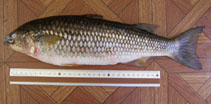
Taxonomic Remarks Genetic data indicate that Chelon monticola is a complex of species with partially overlapping distributions, At least 4 species have been recognized in separate areas (Durand & Borsa, 2015: Ref. 123262), The name should be applied only in the Caribbean sea (see Fig.3 in McMahan et al., 2013: Ref. 123341).
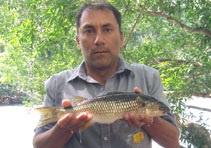
Adults inhabit pools and runs of small to medium rivers (Ref. 86798). They live in freshwater rivers and streams. Young are encountered occasionally in brackish waters. This is the only mullet that ascends far inland and spends all its adult life in freshwater (Ref. 11225). Tend to be few and solitary in upper streams, but form uneven schools in larger streams at lower elevations (Ref. 11225). Oviparous, eggs are pelagic and non-adhesive (Ref. 205). Usually spawn during the rainy season (Ref. 42119). Caught and consumed by local populations in some parts of central America.
Harrison, I.J., 1995. Mugilidae. Lisas. p. 1293-1298. In W. Fischer, F. Krupp, W. Schneider, C. Sommer, K.E. Carpenter and V. Niem (eds.) Guia FAO para Identification de Especies para lo Fines de la Pesca. Pacifico Centro-Oriental. 3 Vols. FAO, Rome. (Ref. 9321)
Κατάσταση Κόκκινου Καταλόγου IUCN (Ref. 130435: Version 2025-2 (Global))
Προτιμώμενη θερμοκρασία (Αναφ. 123201): 24.4 - 28, mean 26.8 °C (based on 208 cells).
Δείκτης φυλογενετικής ποικιλότητας (Αναφ. 82804): PD50 = 1.0000 [Uniqueness, from 0.5 = low to 2.0 = high].
Bayesian length-weight: a=0.01202 (0.00791 - 0.01828), b=3.03 (2.91 - 3.15), in cm total length, based on LWR estimates for this species & (Sub)family-body (Ref. 93245).
Τροφικό Επίπεδο (Αναφ. 69278): 3.0 ±0.40 se; based on food items.
Ελαστικότητα (Αναφ. 120179): Υψηλό, ελάχιστος χρόνος για διπλασιασμό πληθυσμού < 15 μήνες (Fec = 128,827).
Ευπάθεια στην αλιεία (Ref. 59153): Low to moderate vulnerability (26 of 100). 🛈