This website uses cookies to enhance your browsing experience and ensure the functionality of our site. For more detailed information about the types of cookies we use and how we protect your privacy, please visit our Privacy Information page.
×
Cookie Settings
This website uses different types of cookies to enhance your experience. Please select your preferences below:
> Cyprinodontiformes (Rivulines, killifishes and live bearers) > Valenciidae (Toothcarps)
Etymology: Valencia:After Valenciennes, the ichthyologist?. Eponymy: Aristide Horace Letourneux (1820–1890) was a botanist and entomologist in Algiers. [...] (Ref. 128868), visit book page. More on author: Sauvage.
Entorno: milieu / zona climática / rango de profundidad / gama de distribución Ecología
; agua dulce demersal; no migratorio. Subtropical; 15°C - 24°C (Ref. 2060); 41°N - 39°N, 19°E - 22°E
Europe: Albania and western Greece, from Lake Butrint to Alfios drainages, and Corfu and Lefkas islands where it has been extirpated.
Tamaño / Peso / Edad
Madurez: Lm? range ? - ? cm Max length : 8.0 cm TL macho / no sexado; (Ref. 27139); edad máxima reportada: 3.00 años (Ref. 59043)
Descripción breve Claves de identificación | Morfología | Morfometría
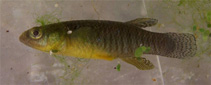
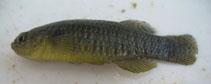
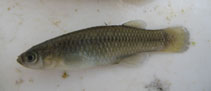
Radios blandos anales: 11. Can be diagnosed from other species of Valenciidae, Fundulidae and Cyprinodontidae in Europe by the following characters: males bluish to greyish, possessing 1-14 darker bars narrower than or as wide as interspaces, not always distinct anteriorly, with iridescent spots; males with caudal fin hyaline to bluish, with or without dark posterior margin, and spots organized into 2-4 vertical rows; dorsal and anal fins of adult male not reaching caudal fin; 28-30 scales in midlateral series on body; anal fin usually with 11 rays; pectoral fin with 12-14 rays (Ref. 59043).
A short-lived species. Adults inhabit swamps, lowland water courses with little current, lagoons, springs and associated wetlands (Ref. 26100). Can tolerate salinity of up to 4 ppt in the wild and 46 ppt under laboratory conditions, but prefer freshwater. They feed mainly on insects, especially chironomids (Ref. 59043). Threatened due to the introduction of other species and water abstraction (Ref. 26100). Not a seasonal killifish. Difficult to maintain in aquarium (Ref. 27139).
Ciclo vital y comportamiento de apareamiento Madurez | Reproducción | Puesta | Huevos | Fecundidad | Larva
Eggs are scattered among fine-feathered water plants. Young hatch after 16-20 days (Ref. 2060). Eggs of about 2-mm in diameter are laid probably in batches (Ref. 59043).
Ecología Trófica Alimentos (presas) Composición de la dieta consumo de alimento Raciones de comida Despredadores
Ecología Ecología
Dinámica de la población Coeficiente del crecimiento para Edades / tallas máximas Longitud-peso rel. Longitud-longitud rel. Longitud-frecuencias Conversión de masas Reclutamiento Abundancia
Ciclo de vida Reproducción Madurez Madurez/Gills rel. Fecundidad Puesta Agregaciones de desove Huevos Desarrollo de los huevos Larva Dinámica larvaria
Fisiología Composición corporal Nutrientes Consumo del oxígeno Tipo de natación Velocidad de natación Pigmentos visuales Sonido de peces Enfermedades y parásitos Toxicidad (CL50)
Índice de diversidad filogenética (Referencia 82804): PD50 = 0.7500 [Uniqueness, from 0.5 = low to 2.0 = high].
Bayesian length-weight: a=0.00490 (0.00189 - 0.01269), b=3.14 (2.91 - 3.37), in cm total length, based on LWR estimates for this (Sub)family-body shape (Ref. 93245).
Nivel trófico (Referencia 69278): 3.2 ±0.4 se; based on size and trophs of closest relatives
Generation time: 1.1 ( na - na) years. Estimated as median ln(3)/K based on 1 growth studies.
Resiliencia (Referencia 120179): Alto, población duplicada en un tiempo mínimo inferior a 15 meses (tmax=3).
Vulnerabilidad pesquera (Ref. 59153): Low vulnerability (14 of 100). 🛈