This website uses cookies to enhance your browsing experience and ensure the functionality of our site. For more detailed information about the types of cookies we use and how we protect your privacy, please visit our Privacy Information page.
×
Cookie Settings
This website uses different types of cookies to enhance your experience. Please select your preferences below:
Trachinotus goodei, Great pompano : fisheries, aquaculture, gamefish
> Carangiformes (Jacks) > Carangidae (Jacks and pompanos) > Trachinotinae
Etymology: Trachinotus:Greek, trachys, -eia, -ys = rough + Greek,noton = back (Ref. 45335). Eponymy: Dr George Brown Goode (1851–1896) was an American ichthyologist and museum administrator at the Smithsonian. [...] (Ref. 128868), visit book page. More on authors: Jordan & Evermann.
Ambiente: milieu / zona climática / intervalo de profundidade / gama de distribuição Ecologia
marinhas associadas(os) a recifes; intervalo de profundidade 0 - 12 m (Ref. 9710). Subtropical; 43°N - 37°S
Western Atlantic: Massachusetts (USA), Bermuda, and the Gulf of Mexico to Argentina.
Tamanho / Peso / Idade
Maturidade: Lm? range ? - ? cm Max length : 50.0 cm TL macho/indeterminado; (Ref. 7251); common length : 35.0 cm TL macho/indeterminado; (Ref. 5217); peso máx. Publicado: 560.00 g (Ref. 40637)
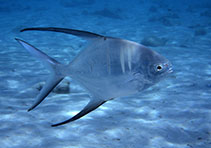
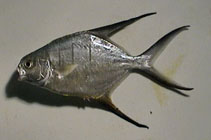
Espinhos dorsais (total) : 7 - 8; Raios dorsais moles (total) : 19 - 20; Espinhos anais: 2 - 3; Raios anais moles: 16 - 18. Dorsal and anal fins have very long, dark anterior lobes (Ref. 26938). Bluish silver on back, shading to silver on sides, with four narrow dark bars on upper of body (Ref. 13442). Body shape (shape guide): short and / or deep.
Adults form schools in clear coastal areas, usually near coral formations (Ref. 5217). Juveniles common in clean sandy beaches (Ref. 5217). Adults feed on crustaceans, polychaete worms, insect pupae, mollusks and fishes (Ref. 9626). Between 1995 and 2000, at least 2 specimens were traded as aquarium fish at Fortaleza, Ceará (Ref. 49392).
Ciclo de vida e comportamento de acasalamento Maturidade | Reprodução | Desova | Ovos | Fecundidade | Larvas
Ciclo de vida Reprodução Maturidade Maturidade/Rel. das guelras Fecundidade Desova Agregações de desova Ovos Desenvolvimento dos ovos Larvas Dinâmica larvar
Fisiologia Composição corporal Nutrientes Consumo de oxigénio Tipo de natação Velocidade de natação Pigmentos visuais Som de peixe Doenças e Parasitas Toxicidade (LC50s)
Temperatura preferida (Ref. 123201): 23.2 - 28.1, mean 27.3 °C (based on 851 cells).
Índice de diversidade filogenética (Ref. 82804): PD50 = 0.5000 [Uniqueness, from 0.5 = low to 2.0 = high].
Bayesian length-weight: a=0.01698 (0.00966 - 0.02985), b=2.87 (2.72 - 3.02), in cm total length, based on LWR estimates for this species & Genus-body shape (Ref. 93245).
Nível Trófico (Ref. 69278): 4.3 ±0.4 se; based on diet studies.
Resiliência (Ref. 120179): Médio, tempo mínimo de duplicação da população 1,4 - 4,4 anos (Assuming tm=2-4).
Vulnerabilidade da pesca (Ref. 59153): Moderate vulnerability (40 of 100). 🛈