This website uses cookies to enhance your browsing experience and ensure the functionality of our site. For more detailed information about the types of cookies we use and how we protect your privacy, please visit our Privacy Information page.
×
Cookie Settings
This website uses different types of cookies to enhance your experience. Please select your preferences below:
> Clupeiformes (Herrings) > Alosidae (Shads and Sardines)
Etymology: Alosa:Latin, alausa = a fish cited by Ausonius and Latin, halec = pickle, dealing with the Greek word hals = salt; it is also the old Saxon name for shad = "alli" ; 1591 (Ref. 45335). More on author: Linnaeus.
Окружающая среда: среда / климатическая зона / пределы глубины / диапазон распространения экология
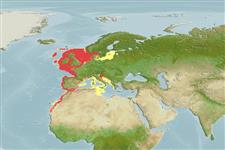
Northeast Atlantic: Norway to Morocco, the British Isles, Germany, the Netherlands, Belgium, France, Spain and Portugal; known to enter the southern Baltic Sea and western Mediterranean Sea at least until the Ebro River in Spain.
Длина при первой зрелости / Размер / Вес / Возраст
половая зрелость: Lm47.8, range 45 - 50 cm Max length : 69.0 cm TL самец/пол неопределен; (Ref. 10536); 83.0 cm TL (female); common length : 40.0 cm TL самец/пол неопределен; (Ref. 2945); common length :70 cm TL (female); наибольший вес (опубликованные данные): 4.0 kg (Ref. 30578); наибольший возраст (опубликованны данные): 10 годы (Ref. 10536)
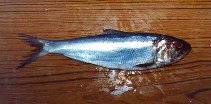
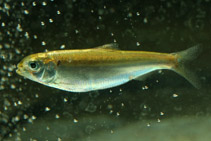
колючие лучи спинного плавника (общее число) : 0; членистые (мягкие) лучи спинного плавника (общее число) : 18 - 21; колючие лучи анального плавника: 0; членистые (мягкие) лучи анального плавника: 20 - 27; позвонки: 57 - 58. Diagnosis: Body somewhat compressed, fairly deep with depth at pectoral fin more than head length, scutes apparent along belly (Ref. 188, 51442). Upper jaw with a distinct median notch, lower jaw fitting into it; no teeth on palatine and vomer; gillrakers long, thin and numerous, a total of 85 to 155 on first arch, longer than gill filaments (Ref. 188, 6683, 59043). A dark spot posterior to gill opening, but sometimes absent, sometimes followed by several small blotches (Ref. 188, 59043). Alosa alosa resembles Alosa fallax, which has fewer and shorter gillrakers and 7 or 8 black spots along flank (Ref. 188).
Body shape (shape guide): fusiform / normal; Cross section: compressed.
Amphihaline species, schooling and strongly migratory, penetrating far up rivers but not into small tributaries (Refs. 188, 59043). Adults are usually found in open waters along the coast (Ref. 51442). In freshwater, they inhabit major rivers but may also enter tributaries, if water temperature is equal to or is warmer than the main river (Ref. 188, 10536). Known lake populations from Morocco and Portugal need access to rivers to spawn (Refs. 10536, 89647, 89648). Larvae and small juveniles inhabit deep slow-flowing areas of rivers (Ref. 89649), some swimming upstream in late summer and autumn (Ref. 10536). Juveniles (up to 1+ years) are usually found near estuaries or river mouths (Refs. 10536, 59043), possibly making vertical diurnal movements synchronized with the tides; they remain in estuaries for over one year (Ref. 89630). Adults primarily feed on a wide range of planktonic crustaceans; larger individuals feed on small schooling fishes (Ref. 188, 51442, 59043). Juveniles in freshwater prey on insect larvae. Females in European rivers commonly reach 70 cm total length (Ref. 10536). Females grow faster and are always larger than males of the same age (Ref. 10536). Less common than Alosa fallax but both have suffered from pollution and weirs or other obstructions (Ref. 188). It has been suggested that members of the genus Alosa are hearing specialists with the American shad (Alosa sapidissima) having been found to detect and respond to sounds up to at least 180 kHz (Ref. 89631). This may aid in predator avoidance (e.g. cetaceans) (Ref. 89632). Hybridization with the twaite shad (Alosa fallax) has been reported from the Rhine (Ref. 89633) as well as from rivers in France and Algeria (Ref. 10536). Shad hybrids may reproduce (Ref. 27567). Marketed fresh and frozen; eaten sautéed, broiled, fried and baked (Ref. 9988).
Adults in the sea begin to move towards the coast in February and congregate near or in estuaries (Ref. 10536). They ascend rivers in April and May when water temperature is 9-12 °C, peaking at 13-16 °C. Adults may migrate up to 700 km from the sea into major rivers and occasionally into the largest tributaries of these rivers to spawn (Ref. 10536). Males migrate upriver at 3-9 years; females first reproduce 1-3 years later than males. Gametogenesis occurs during spawning migration.
Males arrive first in the upper reaches and occupy appropriate spawning sites, with females arriving 1-2 weeks later (Ref. 10536). Spawning sites are usually shallow areas (<1.5 m depth) of rivers near a confluence with strong currents and clean gravel bottoms (Refs. 188, 10536, 59043). Spawning occurs at night (over several nights), in large and very noisy schools that form near the surface.when water temperature reaches at least 15 °C and is believed to be optimal between 22-24 °C. (Ref. 88171). Coupling happens side by side, thrashing caudal fins on water surface and swimming in circles while expulsing eggs and sperms in the surrounding water. Eggs are fertilized in mid-water and then sink to the gravel bottom. Eggs hatch after 4-8 days (22-24 °C) (Ref. 89630). After spawning, adults return to the sea but many die before reaching it (Ref. 188, 51442, 59043). Only 5-6 % of the adults spawn more than once in their lifetime (Ref. 89655). After 3-4 months juveniles (8-12 cm length) move towards the sea until mature (Ref. 10536). Individual fish apparently return to their natal spawning site (Ref. 59043). Also Refs. 5744, 5745.
Whitehead, P.J.P., 1985. FAO Species Catalogue. Vol. 7. Clupeoid fishes of the world (suborder Clupeoidei). An annotated and illustrated catalogue of the herrings, sardines, pilchards, sprats, shads, anchovies and wolf-herrings. FAO Fish. Synop. 125(7/1):1-303. Rome: FAO. (Ref. 188)
Статус Красного Списка МСОП (Ref. 130435: Version 2025-2 (Global))
Физиология Состав тела Питательные вещества Потребление кислорода Тип плавания Скорость плавания Зрительные пигменты Звук рыбы Болезни и паразиты Токсичность (LC50s)
Предпочтительная температура (ссылка 123201): 7 - 15.6, mean 10.1 °C (based on 480 cells).
Индекс филогенетического разнообразия (ссылка 82804): PD50 = 0.5000 [Uniqueness, from 0.5 = low to 2.0 = high].
Bayesian length-weight: a=0.00631 (0.00516 - 0.00771), b=3.09 (3.05 - 3.13), in cm total length, based on LWR estimates for this species (Ref. 93245).
Трофический уровень (ссылка 69278): 3.0 ±0.2 se; based on diet studies.
устойчивость к внешним воздействиям (ссылка 120179): средний (среднего размера), минимальное время удвоения популяции 1.4-4.4 года (K=0.19-0.29; tm=3.5; tmax=10).