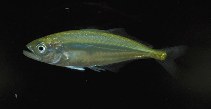
Oligoplites saurus, Leatherjacket : fisheries, gamefish, bait

Oligoplites saurus (Bloch & Schneider, 1801)

Leatherjacket
Beobachtung melden im Fish Watcher
Native range | All suitable habitat | Point map | Year 2050
This map was computer-generated and has not yet been reviewed.
Oligoplites saurus   AquaMaps   Data sources: GBIF OBIS
Hochladen Photos und videos
Bilder | Laute | Google Bild

Klassifizierung / Names Namen | Synonyme | Catalog of Fishes(Gattung, Arten) | ITIS | CoL | WoRMS | Cloffa

> Carangiformes (Jacks) > Carangidae (Jacks and pompanos) > Scomberoidinae
Etymology: Oligoplites: Greek, oligos = small + Greek, hoplites = armed (Ref. 45335).
More on authors: Bloch & Schneider.

Umwelt: Milieu / Klimazone / Tiefenbereich / Verbreitungsgebiet Ökologie

seewasser; brackwasser riff-verbunden; tiefenbereich 0 - 50 m (Ref. 96339). Subtropical; 43°N - 35°S, 116°W - 31°W

Verbreitung Territorien | FAO Gebiete | Ökosysteme | Vorkommen | Punkt Karte | Einführungen | Faunafri

Western Atlantic: Maine, USA and northern Gulf of Mexico to Uruguay; throughout most of the West Indies (Ref. 3277). Absent from the Bahamas (Ref. 26938). Eastern Pacific: Baja California, Mexico to Ecuador (Ref. 9283). Two subspecies exists (Ref. 3277): Oligoplites saurus saurus (western Atlantic population) and Oligoplites saurus inornatus (eastern Pacific population).

Größe / Gewicht / Alter

Geschlechtsreife: Lm ?  range ? - ? cm
Max length : 35.0 cm TL Männchen/unbestimmt; (Ref. 5217); common length : 27.0 cm TL Männchen/unbestimmt; (Ref. 5217); max. veröff. Gewicht: 287.00 g (Ref. 3277)

Kurzbeschreibung Bestimmungsschlüssel | Morphologie | Morphometrie

Rückenflossenstacheln (insgesamt) : 5 - 6; Rückenflossenweichstrahlen (insgesamt) : 19 - 21; Afterflossenstacheln: 2 - 3; Afterflossenweichstrahlen: 18 - 21. Body elongate and strongly compressed (depth from 3.5 to 4.4 times in standard length); posterior end of upper jaw reaching posterior rim of eye; upper jaw teeth small and villiform; lower branch of first gill arch with 14 to 18 gill rakers; scales small but visible, needle-shaped, embedded in the skin; back blue green; flanks and belly silvery to white, sometimes with yellow or golden highlights; pectoral and caudal fins yellowish (Ref. 55763); Dorsal fin has 5 nearly separate spines.
Body shape (shape guide): fusiform / normal.

Biologie     Fachlexikon (Englisch) (z.B. epibenthic)

Adults are found inshore, usually along sandy beaches, in bays and inlets. They enter estuaries and fresh water, preferring turbid water. They occur in schools, usually large and fast moving, often leaping out of the water. Juveniles may float at the surface with tail bent and head down. Adults feed on fishes and crustaceans. The dorsal and anal spines are connected to venomous glands that can inflict painful wounds (Ref. 9283). Venom glands were not visible however, and cannot be confirmed in the specimen according to Smith and Wheeler, 2006 (Ref. 57406). Current information for this species as being dangerous need verification. Juveniles have incisor-like outer teeth and serve as cleaners for other fish; as fish grow, their teeth become conical and their diet changes (Ref. 26938). Marketed fresh and salted or dried but the flesh is not highly esteemed (Ref. 9283).

Lebenszyklus und Paarungsverhalten Geschlechtsreife | Fortpflanzung | Ablaichen | Eier | Fruchtbarkeit | Larven

Hauptreferenz Laden Sie Ihre Referenzen hoch | Referenzen | Koordinator : Smith-Vaniz, William F. | Partner

Smith-Vaniz, W.F., 1995. Carangidae. Jureles, pámpanos, cojinúas, zapateros, cocineros, casabes, macarelas, chicharros, jorobados, medregales, pez pilota. p. 940-986. In W. Fischer, F. Krupp, W. Schneider, C. Sommer, K.E. Carpenter and V. Niem (eds.) Guia FAO para Identification de Especies para lo Fines de la Pesca. Pacifico Centro-Oriental. 3 Vols. FAO, Rome. (Ref. 9283)

IUCN Rote Liste Status (Ref. 130435: Version 2025-2 (Global))

  nicht bedroht (LC) ; Date assessed: 07 September 2018

CITES

Not Evaluated

CMS (Ref. 116361)

Not Evaluated

Bedrohung für Menschen

  Venomous (Ref. 9283)


Nutzung durch Menschen

Fischereien: weniger kommerziell; Sportfisch: ja; Köder: occasionally
FAO - Publication: search | FishSource |

Mehr Information

Trophische Ökologie
Lebensmittel (Beutetiere)
Nahrungszusammensetzung
Nahrungsaufnahme
Lebensmittelrationen
Räuber
Ökologie
Ökologie
Populationsdynamik
Wachstumsparameter
Max. Alter/Größen
Länge-Gewicht-Rel.
Länge-Länge-Verhältnis.
Längenhäufigkeiten
Massenkonvertierung
Rekrutierung
Dichte
Lebenszyklus
Fortpflanzung
Geschlechtsreife
Reifung/Kiemen rel.
Fruchtbarkeit
Ablaichen
Laichaggregationen
Eier
Eientwicklung
Larven
Larven Pop.Dyn.
Verbreitung
Territorien
FAO Gebiete
Ökosysteme
Vorkommen
Einführungen
BRUVS - Videos
Anatomie
Kiemenoberfläche
Gehirn
Otolith
Physiologie
Körperliche Zusammensetzung
Nährstoffe
Sauerstoffverbrauch
Schwimmart
Schwimmgeschwindigkeit
Visuelle Pigmente
Fischgeräusche
Krankheiten und Parasiten
Toxizität (LC50s)
Genetik
Genom
Genetik
Heterozygotie
Vererbbarkeit
Genetische Vielfalt
Menschenbezogen
Aquakultur-Systeme
Aquakultur Profile
Zuchtlinien
Ciguatera-Fälle
Briefmarken, Münzen, Verschiedenes.
Aufsuchen
Partner
Referenzen
Referenzen

Tools

Zusatzinformationen

Download XML

Internet Quellen

Schätzungen auf der Grundlage von Modellen

Bevorzugte Temperatur (Ref. 123201): 21.8 - 28, mean 25.5 °C (based on 554 cells).
Phylogenetischer Diversitätsindex (Ref. 82804):  PD50 = 0.5312   [Uniqueness, from 0.5 = low to 2.0 = high].
Bayesian length-weight: a=0.00708 (0.00525 - 0.00954), b=2.88 (2.82 - 2.94), in cm total length, based on LWR estimates for this species (Ref. 93245).
Trophische Ebene (Ref. 69278):  4.3   ±0.5 se; based on diet studies.
Widerstandsfähigkeit (Ref. 120179):  hoch, Verdopplung der Population dauert weniger als 15 Monate. (Preliminary K or Fecundity.).
Anfälligkeit der Fischerei (Ref. 59153):  Low vulnerability (25 of 100). 🛈
Preiskategorie (Ref. 80766):   Medium.
Nährstoffe (Ref. 124155):  Calcium = 43.3 [17.4, 91.0] mg/100g; Iron = 0.907 [0.475, 1.732] mg/100g; Protein = 20.7 [19.6, 21.8] %; Omega3 = 0.275 [0.157, 0.475] g/100g; Selenium = 13.3 [6.0, 26.5] μg/100g; VitaminA = 63.6 [18.5, 220.9] μg/100g; Zinc = 0.738 [0.467, 1.117] mg/100g (wet weight);