



Add your observation in Fish Watcher
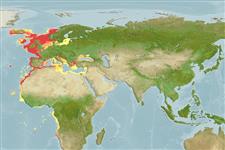
| Native range | All suitable habitat | Point map | Year 2050 |
|
| This map was computer-generated and has not yet been reviewed. |
| Trachurus trachurus AquaMaps Data sources: GBIF OBIS |
Upload your photos and videos
Pictures | Videos | Stamps, coins, misc. | Google image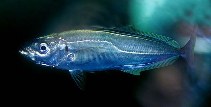 Trachurus trachurus
Picture by JJPhoto
Pictures | Videos | Stamps, coins, misc. | Google image
Picture by JJPhoto
Classification / Names Common names | Synonyms | Catalog of Fishes(genus, species) | ITIS | CoL | WoRMS | Cloffa
Teleostei (teleosts) > Carangiformes (Jacks) > Carangidae (Jacks and pompanos) > Caranginae
Etymology: Trachurus: Greek, trachys, -eia, -ys = rough + Greek, oura = tail (Ref. 45335).
More on author: Linnaeus.
Etymology: Trachurus: Greek, trachys, -eia, -ys = rough + Greek, oura = tail (Ref. 45335).
More on author: Linnaeus.
Environment: milieu / climate zone / depth range / distribution range Ecology
Marine; pelagic-neritic; oceanodromous (Ref. 51243); depth range 0 - 1050 m (Ref. 54256), usually 100 - 200 m (Ref. 54256). Subtropical; 67°N - 38°S, 26°W - 42°E
Distribution Territories | FAO areas | Ecosystems | Occurrences | Point map | Introductions | Faunafri
Eastern Atlantic: Norway to Cape of Good Hope, South Africa to southwestern Indian Ocean (South Africa to southern Mozambique), and Baltic Sea, North Sea, Mediterranean Sea and Black Sea.
Length at first maturity / Size / Weight / Age
Maturity: Lm 22.9, range 21 - 30 cm
Max length : 70.0 cm TL male/unsexed; (Ref. 3197); common length : 22.0 cm FL male/unsexed; (Ref. 3397); max. published weight: 2.0 kg (Ref. 27584)
Max length : 70.0 cm TL male/unsexed; (Ref. 3197); common length : 22.0 cm FL male/unsexed; (Ref. 3397); max. published weight: 2.0 kg (Ref. 27584)
Short description Identification keys | Morphology | Morphometrics
Dorsal spines (total): 9; Dorsal soft rays (total): 30 - 36; Anal spines: 3; Anal soft rays: 24 - 32. Bluish green, grey or black above, silvery white below; opercle with black spot (Ref. 3197). Lateral scales tall and keeled. Gill cover with a distinct black spot. First dorsal fin tall (Ref. 35388).
Body shape (shape guide): fusiform / normal.
Body shape (shape guide): fusiform / normal.
Adults form large schools in coastal areas with sandy substrate. They feed on fish, crustaceans, and cephalopods. Are batch spawners (Ref. 51846). Females lay 140,000 eggs, which hatch into 5mm long larvae (Ref. 35388). Eggs are pelagic (Ref. 4233). Utilized fresh, smoked, canned and frozen; can be fried, broiled and baked (Ref. 9988). Divided into two stocks: West stock and North Sea stock. West stock spawns in a belt from the Biscay to Ireland in early spring, migrates north and eastwards to southern Norway and northern North Sea. North Sea stock spawns in the southern North Sea in summer, migrates to central North Sea, Skagerrak and Kattegat.
Life cycle and mating behavior Maturity | Reproduction | Spawning | Eggs | Fecundity | Larvae
Main reference
Upload your references | References | Coordinator : Smith-Vaniz, William F. | Collaborators
Smith-Vaniz, W.F., 1986. Carangidae. p. 815-844. In P.J.P. Whitehead, M.-L. Bauchot, J.-C. Hureau, J. Nielsen and E. Tortonese (eds.) Fishes of the north-eastern Atlantic and the Mediterranean. UNESCO, Paris. vol. 2. (Ref. 4233)
IUCN Red List Status (Ref. 130435: Version 2025-2 (Global))
Vulnerable (VU) (A2bd); Date assessed: 09 May 2013
CITES
Not Evaluated
Threat to humans
Harmless
Human uses
Fisheries: highly commercial; gamefish: yes; bait: usually
FAO - Fisheries: species profile, landings search; Publication: search | FIRMS - Stock assessments | FishSource | Sea Around Us
More information
Population dynamics
Growth parameters
Max. ages / sizes
Length-weight rel.
Length-length rel.
Length-frequencies
Mass conversion
Recruitment
Abundance
Growth parameters
Max. ages / sizes
Length-weight rel.
Length-length rel.
Length-frequencies
Mass conversion
Recruitment
Abundance
Physiology
Body composition
Nutrients
Oxygen consumption
Swimming type
Swimming speed
Visual pigments
Fish sound
Diseases & Parasites
Toxicity (LC50s)
Body composition
Nutrients
Oxygen consumption
Swimming type
Swimming speed
Visual pigments
Fish sound
Diseases & Parasites
Toxicity (LC50s)
Tools
Bio-Quiz | E-book | Field guide | Identification keys | Length-frequency wizard | Life-history tool | Point map |
Catch-MSY |
Special reports
Download XML
Internet sources
AFORO (otoliths) | Aquatic Commons | BHL | Cloffa | Websites from users | Check FishWatcher | CISTI | Catalog of Fishes: genus, species | DiscoverLife | DORIS | ECOTOX | FAO - Fisheries: species profile, landings search; Publication: search | Faunafri | Fishipedia | Fishtrace | GloBI | Google Books | Google Scholar | Google | IGFA World Record | National databases | OneZoom | Open Tree of Life | Otolith Atlas of Taiwan Fishes | Public aquariums | PubMed | Reef Life Survey | Socotra Atlas | TreeBase | Tree of Life | Wikipedia: Go, Search | | Zoological Record
Estimates based on models
|
Phylogenetic diversity index (Ref. 82804) |
PD50 = 0.5001 [Uniqueness, from 0.5 = low to 2.0 = high]. |
| Bayesian length-weight | a=0.00813 (0.00746 - 0.00885), b=2.97 (2.95 - 2.99), in cm total length, based on LWR estimates for this species (Ref. 93245). |
|
Trophic level (Ref. 69278) |
3.7 ±0.0 se; based on diet studies. |
| Generation time | 6.5 (5.1 - 7.6) years. Estimated as median ln(3)/K based on 25 growth studies. |
|
Resilience (Ref. 120179) |
Medium, minimum population doubling time 1.4 - 4.4 years (K=0.18; tm=2-4; tmax=11). |
| Rate of population increase | Prior r = 0.39, 95% CL = 0.26 - 0.58, Based on 13 full stock assessments. |
|
Fishing Vulnerability (Ref. 59153) |
High vulnerability (56 of 100). 🛈 |
|
Climate Vulnerability (Ref. 125649) |
Low vulnerability (25 of 100). 🛈 |
|
Price category (Ref. 80766) |
Medium. |
|
Nutrients (Ref. 124155) |
Calcium = 184 [129, 263] mg/100g; Iron = 3.67 [2.45, 5.60] mg/100g; Protein = 19.4 [18.8, 20.0] %; Omega3 = 0.355 [0.260, 0.479] g/100g; Selenium = 33.4 [24.6, 45.6] μg/100g; VitaminA = 13.5 [4.0, 54.4] μg/100g; Zinc = 1.66 [1.34, 2.16] mg/100g (wet weight); based on nutrient studies. |