



Carregue seu(sua) Fotos e vídeos
Imagem do Google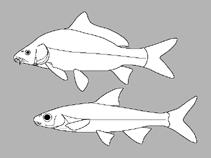 No image available for this species;
drawing shows typical species in Cyprinidae.
Imagem do Google
drawing shows typical species in Cyprinidae.
Classificação / Nomes Nomes comuns | Sinônimos | Catalog of Fishes(Gênero, Espécies) | ITIS | CoL | WoRMS | Cloffa
> Cypriniformes (Carps) > Cyprinidae (Minnows or carps) > Smiliogastrinae
Etymology: Pethia: Pethia is the generic vernacular name for small cyprinids in Sinhala; striata: The specific name is from a Latin adjective 'striata', meaning striped, in reference to the unique pattern of this fish.
Etymology: Pethia: Pethia is the generic vernacular name for small cyprinids in Sinhala; striata: The specific name is from a Latin adjective 'striata', meaning striped, in reference to the unique pattern of this fish.
Meio ambiente: milieu / Zona climática / intervalo de profundidade / faixa de distribuição Ecologia
; Água doce bentopelágico; pH range: 6.1 - ?. Tropical; 26°C - ? (Ref. 104010)
Distribuição Territórios | Áreas da FAO | Ecossistemas | Ocorrências | Mapa de pontos | Introduções | Faunafri
Asia: Tunga River basin in Kudremukh National Park, Karnataka State, India.
Tamanho / Peso / Idade
Descrição suscinta Chaves de identificação | Morfologia | Morfometria
Raios dorsais (total) : 9; Raios anais : 8. Pethia striata can be diagnosed from other species of the genus Pethia by the combination of the following characters: lateral line complete, with 20-21 pored scales up to tail fin base; upper half of body dark brown; outer edges of body scales dark, forming oblique bars, giving a distinct striped pattern along the side in both sexes; dorsal fin dark with a pale outer margin; dorsal, pectoral, pelvic, and anal fins tinged with black; caudal fin hyaline; black humeral spot one scale below the 4th lateral-line scales, a larger black blotch 3-4 scales high covering the 17th to 19th lateral-line scales, and only 2 scales between this blotch and the hypural notch. Other characters useful to distinguish from other congeners include the following: fewer transverse scales, 3 scales between lateral-line scale row and ventral fin; ½ 4+1+3 transverse scales; eight predorsal scales; a smaller humeral spot, restricted to a single scale; lacking a gray patch below the dorsal fin; two spots, a humeral spot and a caudal-peduncle blotch; 2+3-4 gill rakers on the first gill arch; a single blotch on the caudal peduncle; dark longitudinal band absent; and dorsal fin of
male is black (Ref. 104010).
Body shape (shape guide): elongated.
Body shape (shape guide): elongated.
Formed small groups of three or four individuals in shallow pools beneath dense riparian canopy. Usually found together with other cyprinid species such as Puntius sahyadriensis and Dawkinsia arulius. A few juveniles were also observed with Pethia setnai in shallow pools (Ref. 104010).
The type locality was a pool-riffle sequence in a small gently flowing clear water stream with a pH of 6.1 and water temperature of 25.5°C. The stream at the type locality has a width of 7 m and a depth of 0.6 m. The run-riffle sequence just below the type locality has a flow velocity of 0.2 m/s. This species was collected in an altitude range between 660-910 m ASL. Ochlandra sp., Ficus sp., and Elaeocarpus tuberculatus dominated the land vegetation, providing 80% shade. The substrate was composed of leaf litter mostly with Lagenandra sp., bamboo leaves, and clay. Other fishes commonly found at the type locality included the following: Devario malabaricus, Salmophasia boopis, Garra mullya, Barilius canarensis, Barbodes wynaadensis, Tor khudree, Dawkinsia arulius, Puntius sahyadriensis, Osteochilus nashii (Cyprinidae), Batasio sharavatiensis (Bagridae), and Nemacheilus denisoni (Nemacheilidae) (Ref. 104010).
Ciclo de vida ou comportamento de acasalamento Maturidade | Reprodução | Desova | Ovos | Fecundidade | Larvas
Referência principal
Carregar suas referências | Referências | Coordenador | Colaboradores
Atkore, V.M., J.D.M. Knight, K. Rema Devi and J. Krishnaswamy, 2015. A new species of Pethia from the Westen Ghats, India (Teleostei: Cyprinidae). Copeia 103(2):290-296. (Ref. 104010)
Status na Lista Vermelha da UICN (Ref. 130435: Version 2025-2 (Global))
Em perigo (EN) (B1ab(iii)); Date assessed: 28 March 2021
CITES
Not Evaluated
Ameaça para os humanos
Harmless
Uso pelos humanos
Pescarias: sem interesse
FAO - Publication: search | FishSource |
Mais informação
Ecologia Trófica
Itens alimentares (presas)
Composição da dieta
Consumo alimentar
Rações alimentares
Predadores
Itens alimentares (presas)
Composição da dieta
Consumo alimentar
Rações alimentares
Predadores
Dinâmica populacional
Parâmetros de crescimento
Idade máxima / tamanhos
Relação comprimento-peso.
Relação comprimento-comprimento.
Frequências de comprimento
Conversão de massa
Recrutamento
Abundância
Parâmetros de crescimento
Idade máxima / tamanhos
Relação comprimento-peso.
Relação comprimento-comprimento.
Frequências de comprimento
Conversão de massa
Recrutamento
Abundância
Ciclo de vida
Reprodução
Maturidade
Maturidade/Rel. das guelras
Fecundidade
Desova
Agregações de desova
Ovos
Desenvolvimento dos ovos
Larvas
Dinâmica larval
Reprodução
Maturidade
Maturidade/Rel. das guelras
Fecundidade
Desova
Agregações de desova
Ovos
Desenvolvimento dos ovos
Larvas
Dinâmica larval
Anatomia
Área branquial
Cérebro
Otólito
Área branquial
Cérebro
Otólito
Fisiologia
Composição corporal
Nutrientes
Consumo de oxigênio
Tipo de natação
Velocidade de natação
Pigmentos visuais
Som de peixe
Doenças e Parasitas
Toxicidade (LC50s)
Composição corporal
Nutrientes
Consumo de oxigênio
Tipo de natação
Velocidade de natação
Pigmentos visuais
Som de peixe
Doenças e Parasitas
Toxicidade (LC50s)
Genética
genoma
Genética
Heterozigosidade
Hereditariedade
Diversidade genética
genoma
Genética
Heterozigosidade
Hereditariedade
Diversidade genética
Relacionado a humanos
Sistemas de aquicultura
Perfis para aquacultura
Estirpes
Casos de Ciguatera
Selos, moedas, diversos.
Sistemas de aquicultura
Perfis para aquacultura
Estirpes
Casos de Ciguatera
Selos, moedas, diversos.
Ferramentas
Livro eletrônico | Guia de campo | Ferramenta auxiliar de frequências de comprimento | Ferramenta sobre a história de vida | Mapa de pontos |
Catch-MSY |
Relatórios especiais
Checar Manutenção em Aquário | Checar Planilhas de Fatos sobre as Espécies | Checar Planilhas de Fatos sobre Aquicultura
Baixar XML
Fontes da internet
AFORO (otoliths) | Aquatic Commons | BHL | Cloffa | Websites from users | Checar Observador de Peixes (FishWatcher) | CISTI | Catalog of Fishes: Gênero, Espécies | DiscoverLife | ECOTOX | FAO - Publication: search | Faunafri | Fishipedia | Fishtrace | GloBI | Google Books | Google Scholar | Google | IGFA World Record | OneZoom | Open Tree of Life | Otolith Atlas of Taiwan Fishes | PubMed | Reef Life Survey | Socotra Atlas | TreeBase | Árvore da vida | Wikipedia: Ir para, procura | World Records Freshwater Fishing | Zoobank | Registro zoológico
Estimativas baseadas em modelos
Índice de diversidade filogenética (Ref. 82804): PD50 = 0.5000 [Uniqueness, from 0.5 = low to 2.0 = high].
Bayesian length-weight: a=0.01047 (0.00454 - 0.02413), b=3.00 (2.83 - 3.17), in cm total length, based on LWR estimates for this Genus-body shape (Ref. 93245).
Nível Trófico (Ref. 69278): 2.8 ±0.2 se; based on size and trophs of closest relatives
Resiliência (Ref. 120179): Elevada, tempo mínimo de duplicação da população menor que 15 meses (Preliminary K or Fecundity.).