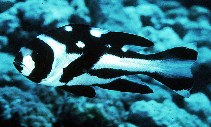
Macolor niger, Black and white snapper : fisheries, gamefish, aquarium

Macolor niger (Forsskål, 1775)

Black and white snapper
Adicionar sua observação em Fish Watcher
Native range | All suitable habitat | Point map | Year 2050
This map was computer-generated and has not yet been reviewed.
Macolor niger   AquaMaps   Data sources: GBIF OBIS
Carregue seu(sua) Fotos e vídeos
Fotos | vídeos | Imagem do Google

Classificação / Nomes Nomes comuns | Sinônimos | Catalog of Fishes(Gênero, Espécies) | ITIS | CoL | WoRMS | Cloffa

> Eupercaria/misc (Various families in series Eupercaria) > Lutjanidae (Snappers) > Lutjaninae
Etymology: Macolor: Latin, macula, -ae = stain, spot.
More on author: Forsskål.

Meio ambiente: milieu / Zona climática / intervalo de profundidade / faixa de distribuição Ecologia

marinhas associadas(os) a recifes; intervalo de profundidade 2 - 90 m (Ref. 9821). Tropical; 36°N - 30°S, 31°E - 153°W (Ref. 55)

Distribuição Territórios | Áreas da FAO | Ecossistemas | Ocorrências | Mapa de pontos | Introduções | Faunafri

Indo-Pacific: East Africa to Samoa, north to central Japan, south to Australia.

Tamanho / Peso / Idade

Maturidade: Lm ?  range ? - ? cm
Max length : 75.0 cm TL macho/indeterminado; (Ref. 5484); common length : 35.0 cm TL macho/indeterminado; (Ref. 30573)

Descrição suscinta Chaves de identificação | Morfologia | Morfometria

Espinhos dorsais (total) : 10; Raios dorsais (total) : 13 - 15; Espinhos anais: 3; Raios anais : 10 - 11. This species is distinguished by the following characters: body relatively deep and laterally compressed, greatest body depth 2.2-2.4 in SL; dorsal profile of head convex in adults, in oblique straight line in young; maxilla without scales or longitudinal ridges; preopercle with a deep notch (or gash) receiving elongate interopercular spine (none for individuals less than 16 cm SL); gill rakers of first gill arch 26-38 + 60-71 = 89-107; soft rays of dorsal fin usually 14, in anal fin 11, in pectoral fin 17; continuous dorsal fin with spinous portion distinctly notched in young; dorsal and anal fins distinctly pointed posteriorly, the soft ray of both fins, shorter than next to last ray; caudal fin rounded with middle rays elongated in small juveniles, slightly notched at intermediate sizes and emarginate in adults; pelvic fins short and rounded for all sizes; soft dorsal and anal fins with scales basally; tubed lateral-line scales 50-55; juveniles with very long pelvic fins. Colour of adults silvery grey, strongly blotched with blackish patches, lacks yellow on head and body and without blue markings on head and body, much duller iris; juveniles with black and white pattern but broader white area encompassing posterior head and adjacent body and with less than 5 white spots on back (Ref 9821, 90102).
Body shape (shape guide): fusiform / normal; Cross section: compressed.

Biologia     Glossário (p.ex. epibenthic)

Adults are found on steep outer walls of lagoon, channel and seaward slopes in large schools (Ref. 9710, 48635). Juveniles are solitary (Ref. 30573). Feeds largely on fishes and crustaceans Caught with handlines, gill nets, and traps, but also speared by divers and are frequently seen in markets and sold mainly fresh (Ref. 9821).

Ciclo de vida ou comportamento de acasalamento Maturidade | Reprodução | Desova | Ovos | Fecundidade | Larvas

Referência principal Carregar suas referências | Referências | Coordenador | Colaboradores

Allen, G.R., 1985. FAO Species Catalogue. Vol. 6. Snappers of the world. An annotated and illustrated catalogue of lutjanid species known to date. FAO Fish. Synop. 125(6):208 p. Rome: FAO. (Ref. 55)

Status na Lista Vermelha da UICN (Ref. 130435: Version 2025-2 (Global))

  Segura ou pouco preocupante (LC) ; Date assessed: 05 March 2015

CITES

Not Evaluated

CMS (Ref. 116361)

Not Evaluated

Ameaça para os humanos

  Harmless


Uso pelos humanos

Pescarias: espécies comerciais; peixe esportivo: sim; Aquário: Espécies comerciais
FAO - Publication: search | FishSource | Sea Around Us

Mais informação

Ecologia Trófica
Itens alimentares (presas)
Composição da dieta
Consumo alimentar
Rações alimentares
Predadores
Ecologia
Ecologia
Dinâmica populacional
Parâmetros de crescimento
Idade máxima / tamanhos
Relação comprimento-peso.
Relação comprimento-comprimento.
Frequências de comprimento
Conversão de massa
Recrutamento
Abundância
Ciclo de vida
Reprodução
Maturidade
Maturidade/Rel. das guelras
Fecundidade
Desova
Agregações de desova
Ovos
Desenvolvimento dos ovos
Larvas
Dinâmica larval
Distribuição
Territórios
Áreas da FAO
Ecossistemas
Ocorrências
Introduções
BRUVS - Vídeos
Anatomia
Área branquial
Cérebro
Otólito
Fisiologia
Composição corporal
Nutrientes
Consumo de oxigênio
Tipo de natação
Velocidade de natação
Pigmentos visuais
Som de peixe
Doenças e Parasitas
Toxicidade (LC50s)
Genética
genoma
Genética
Heterozigosidade
Hereditariedade
Diversidade genética
Relacionado a humanos
Sistemas de aquicultura
Perfis para aquacultura
Estirpes
Casos de Ciguatera
Selos, moedas, diversos.
Divulgação
Colaboradores
Referências
Referências

Ferramentas

Relatórios especiais

Baixar XML

Fontes da internet

Estimativas baseadas em modelos

Temperatura preferida (Ref. 123201): 24.7 - 29.1, mean 28.1 °C (based on 1828 cells).
Índice de diversidade filogenética (Ref. 82804):  PD50 = 0.7500   [Uniqueness, from 0.5 = low to 2.0 = high].
Bayesian length-weight: a=0.01585 (0.00982 - 0.02557), b=2.99 (2.86 - 3.12), in cm total length, based on LWR estimates for this species & (Sub)family-body (Ref. 93245).
Nível Trófico (Ref. 69278):  4.0   ±0.66 se; based on food items.
Resiliência (Ref. 120179):  médio(a), tempo mínimo de duplicação da população 1,4 - 4,4 anos (Preliminary K or Fecundity.).
Vulnerabilidade da pesca (Ref. 59153):  Moderate to high vulnerability (50 of 100). 🛈
Categoria de preço (Ref. 80766):   Very high.
Nutrientes (Ref. 124155):  Calcium = 25.8 [15.4, 46.1] mg/100g; Iron = 0.457 [0.254, 0.787] mg/100g; Protein = 19.1 [17.3, 20.8] %; Omega3 = 0.139 [0.095, 0.212] g/100g; Selenium = 40.8 [25.5, 69.5] μg/100g; VitaminA = 66.4 [23.9, 200.7] μg/100g; Zinc = 0.869 [0.629, 1.211] mg/100g (wet weight);