



Add your observation in Fish Watcher
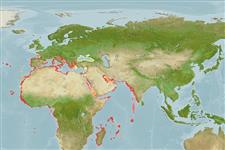
| Native range | All suitable habitat | Point map | Year 2050 |
|
| This map was computer-generated and has not yet been reviewed. |
| Lichia amia AquaMaps Data sources: GBIF OBIS |
Upload your photos and videos
Pictures | Google image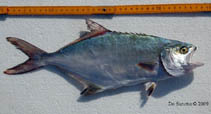 Lichia amia
Picture by De Sanctis, A.
Pictures | Google image
Picture by De Sanctis, A.
Classification / Names Common names | Synonyms | Catalog of Fishes(genus, species) | ITIS | CoL | WoRMS | Cloffa
Teleostei (teleosts) > Carangiformes (Jacks) > Carangidae (Jacks and pompanos) > Trachinotinae
Etymology: Lichia: Greek, lichia = corpse like skin colour.
More on author: Linnaeus.
Etymology: Lichia: Greek, lichia = corpse like skin colour.
More on author: Linnaeus.
Environment: milieu / climate zone / depth range / distribution range Ecology
Marine; brackish; pelagic-neritic; oceanodromous (Ref. 51243); depth range 0 - 50 m (Ref. 3197). Subtropical; 47°N - 28°S
Distribution Territories | FAO areas | Ecosystems | Occurrences | Point map | Introductions | Faunafri
Eastern Atlantic: southern Bay of Biscay to South Africa, including the Mediterranean. Western Indian Ocean: South Africa to Maputo Bay, Maputo (Mozambique)..
Length at first maturity / Size / Weight / Age
Maturity: Lm ?, range 60 - ? cm
Max length : 200 cm TL male/unsexed; (Ref. 57392); common length : 100.0 cm TL male/unsexed; (Ref. 3197); max. published weight: 50.0 kg (Ref. 27584)
Max length : 200 cm TL male/unsexed; (Ref. 57392); common length : 100.0 cm TL male/unsexed; (Ref. 3197); max. published weight: 50.0 kg (Ref. 27584)
Short description Identification keys | Morphology | Morphometrics
Dorsal spines (total): 8; Dorsal soft rays (total): 19 - 21; Anal spines: 3; Anal soft rays: 17 - 21. Diagnosis: body elongate, moderately deep and compressed; dorsal profile of head almost straight, ending in a pointed snout; eyes relatively small; upper jaw slender and rounded posteriorly, ending below or beyond posterior eye margin; 2 dorsal fins, 1st with 7 spines with only their bases connected by a membrane, 2nd with 1 spine and 19-21 soft rays; anal fin with 2 detached spines followed by 1 spine and 17-21 soft rays; pectoral fins short, comprised 1.5-1.8 times in head length; scales small, those on breast oval to strongly lanceolate, and partially embedded in the skin; lateral line very irregular and wavy, describing a convex curve over, and a concave curve behind pectoral fins; no lateral-line scutes (Ref. 57392). Brown above, silvery white below lateral line; lobes of dorsal and anal fins black distally; juveniles (to at least 12 cm fork length) with brownish black bars on sides (Ref. 3197, 57392).
Body shape (shape guide): fusiform / normal.
Body shape (shape guide): fusiform / normal.
Marine, coastal pelagic species (Ref. 57392). Adults are found in coastal waters including estuaries. Occasionally entering lower reaches of rivers like the Kunene and Orange Rivers in Namibia (Ref. 52863). Juveniles often entering estuaries (Ref. 57392). Feed mainly on fish; juveniles prefer crustaceans (Ref. 4332). Eggs are pelagic (Ref. 4233). Popular game fish (Ref. 3197).
Life cycle and mating behavior Maturity | Reproduction | Spawning | Eggs | Fecundity | Larvae
Main reference
Upload your references | References | Coordinator : Smith-Vaniz, William F. | Collaborators
Smith-Vaniz, W.F., 1986. Carangidae. p. 815-844. In P.J.P. Whitehead, M.-L. Bauchot, J.-C. Hureau, J. Nielsen and E. Tortonese (eds.) Fishes of the north-eastern Atlantic and the Mediterranean. UNESCO, Paris. vol. 2. (Ref. 4233)
IUCN Red List Status (Ref. 130435: Version 2025-2 (Global))
Least Concern (LC) ; Date assessed: 19 May 2014
CITES
Not Evaluated
Threat to humans
Harmless
Human uses
Fisheries: commercial; gamefish: yes
FAO - Fisheries: landings; Publication: search | FishSource | Sea Around Us
More information
Population dynamics
Growth parameters
Max. ages / sizes
Length-weight rel.
Length-length rel.
Length-frequencies
Mass conversion
Recruitment
Abundance
Growth parameters
Max. ages / sizes
Length-weight rel.
Length-length rel.
Length-frequencies
Mass conversion
Recruitment
Abundance
Anatomy
Gill area
Brain
Otolith
Gill area
Brain
Otolith
Physiology
Body composition
Nutrients
Oxygen consumption
Swimming type
Swimming speed
Visual pigments
Fish sound
Diseases & Parasites
Toxicity (LC50s)
Body composition
Nutrients
Oxygen consumption
Swimming type
Swimming speed
Visual pigments
Fish sound
Diseases & Parasites
Toxicity (LC50s)
Human related
Aquaculture systems
Aquaculture profiles
Strains
Ciguatera cases
Stamps, coins, misc.
Aquaculture systems
Aquaculture profiles
Strains
Ciguatera cases
Stamps, coins, misc.
Tools
Special reports
Download XML
Internet sources
AFORO (otoliths) | Aquatic Commons | BHL | Cloffa | Websites from users | Check FishWatcher | CISTI | Catalog of Fishes: genus, species | DiscoverLife | ECOTOX | FAO - Fisheries: landings; Publication: search | Faunafri | Fishipedia | Fishtrace | GloBI | Google Books | Google Scholar | Google | IGFA World Record | National databases | OneZoom | Open Tree of Life | Otolith Atlas of Taiwan Fishes | Public aquariums | PubMed | Reef Life Survey | Socotra Atlas | TreeBase | Tree of Life | Wikipedia: Go, Search | World Records Freshwater Fishing | Zoological Record
Estimates based on models
Preferred temperature (Ref. 123201): 16.2 - 29, mean 26.3 °C (based on 478 cells).
Phylogenetic diversity index (Ref. 82804): PD50 = 1.0000 [Uniqueness, from 0.5 = low to 2.0 = high].
Bayesian length-weight: a=0.01380 (0.01021 - 0.01866), b=2.93 (2.84 - 3.02), in cm total length, based on LWR estimates for this species (Ref. 93245).
Trophic level (Ref. 69278): 4.5 ±0.8 se; based on diet studies.
Resilience (Ref. 120179): Medium, minimum population doubling time 1.4 - 4.4 years (Assuming tm=2).
Prior r = 0.51, 95% CL = 0.34 - 0.76, Based on 1 data-limited stock assessment.
Nutrients (Ref. 124155): Calcium = 36.6 [20.7, 79.3] mg/100g; Iron = 1.26 [0.69, 2.33] mg/100g; Protein = 20.5 [19.3, 21.7] %; Omega3 = 0.346 [0.200, 0.608] g/100g; Selenium = 24.1 [12.4, 44.8] μg/100g; VitaminA = 9.68 [2.53, 33.46] μg/100g; Zinc = 0.526 [0.372, 0.751] mg/100g (wet weight);