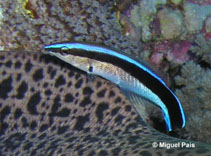
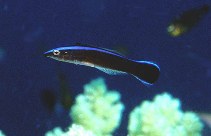
Labroides dimidiatus, Bluestreak cleaner wrasse : aquarium

Labroides dimidiatus (Valenciennes, 1839)

Bluestreak cleaner wrasse
Beobachtung melden im Fish Watcher
Native range | All suitable habitat | Point map | Year 2050
This map was computer-generated and has not yet been reviewed.
Labroides dimidiatus   AquaMaps   Data sources: GBIF OBIS
Hochladen Photos und videos
Bilder | videos | Briefmarken, Münzen, Verschiedenes. | Google Bild

Klassifizierung / Names Namen | Synonyme | Catalog of Fishes(Gattung, Arten) | ITIS | CoL | WoRMS | Cloffa

> Eupercaria/misc (Various families in series Eupercaria) > Labridae (Wrasses) > Julidinae
Etymology: Labroides: Greek, labrax, -akos = a fish, Dicentrarchus labrax + Greek, suffix, oides = similar to (Ref. 45335).
More on author: Valenciennes.

Umwelt: Milieu / Klimazone / Tiefenbereich / Verbreitungsgebiet Ökologie

seewasser riff-verbunden; standorttreu (Ref. 52884); tiefenbereich 0 - 100 m (Ref. 128797), usually 1 - 30 m (Ref. 27115). Tropical; 24°C - 28°C (Ref. 27115); 32°N - 36°S, 24°E - 124°W

Verbreitung Territorien | FAO Gebiete | Ökosysteme | Vorkommen | Punkt Karte | Einführungen | Faunafri

Indo-Pacific: Persian Gulf (Ref.80050); Red Sea and East Africa (Ref. 4392) to the Line, Marquesas, and Ducie islands, north to southern Japan, south to Lord Howe and Rapa islands.

Größe / Gewicht / Alter

Geschlechtsreife: Lm ?  range ? - ? cm
Max length : 14.0 cm TL Männchen/unbestimmt; (Ref. 55367); max. veröff. Alter: 4 Jahre (Ref. 3426)

Kurzbeschreibung Bestimmungsschlüssel | Morphologie | Morphometrie

Rückenflossenstacheln (insgesamt) : 9; Rückenflossenweichstrahlen (insgesamt) : 10 - 11; Afterflossenstacheln: 3; Afterflossenweichstrahlen: 10. Often with yellow back in deep water (Ref. 48636). Scales on lateral line: 50-52 (+2 past hypural) (Ref. 1602).
Body shape (shape guide): elongated; Cross section: compressed.

Biologie     Fachlexikon (Englisch) (z.B. epibenthic)

Adults inhabit coral rich areas of inner lagoons and subtidal reef flats to seaward reefs (Ref. 1602). They feed on crustacean ectoparasites and mucus of other fishes (Ref. 9823, 48636). Monogamous (Ref. 52884). A protogynous hermaphrodite (Ref. 55367). Stays in stations where other fish come to be cleaned. Cleaning intensity is not related to client size or commonness (Ref. 28019). Cleaning stations are occupied by a pair of adults, a group of juveniles or a group of females accompanied by a dominant male where a female becomes a functional male if the dominant male disappears (Ref. 5503). Some adults solitary and territorial. An unfamiliar visitor is usually greeted by dance-like movements with the tail maneuvering the back part of the body up and down. Juveniles behave this way when divers approach closely (Ref. 48636). Minimum depth range of 1 meter in Ref. 27115.

Lebenszyklus und Paarungsverhalten Geschlechtsreife | Fortpflanzung | Ablaichen | Eier | Fruchtbarkeit | Larven

Bi-directional sex change has been confirmed for this species (Ref. 103751). Oviparous, distinct pairing during breeding (Ref. 205). Pelagic spawners. Sex reversal is completed in 14-18 days (Ref. 34185, 34258). A monandric species (Ref. 55367). Length at sex change = 8.8 cm TL (Ref. 55367). Monogamous mating is observed as both facultative and social (Ref. 52884).

Hauptreferenz Laden Sie Ihre Referenzen hoch | Referenzen | Koordinator : Westneat, Mark | Partner

Randall, J.E., G.R. Allen and R.C. Steene, 1990. Fishes of the Great Barrier Reef and Coral Sea. University of Hawaii Press, Honolulu, Hawaii. 506 p. (Ref. 2334)

IUCN Rote Liste Status (Ref. 130435: Version 2025-2 (Global))

  nicht bedroht (LC) ; Date assessed: 12 May 2008

CITES

Not Evaluated

CMS (Ref. 116361)

Not Evaluated

Bedrohung für Menschen

  Harmless


Nutzung durch Menschen

Fischereien: nicht kommerziell; Aquarium: Kommerziell
FAO - Publication: search | FishSource | Das Meer um uns herum

Mehr Information

Trophische Ökologie
Lebensmittel (Beutetiere)
Nahrungszusammensetzung
Nahrungsaufnahme
Lebensmittelrationen
Räuber
Ökologie
Ökologie
Populationsdynamik
Wachstumsparameter
Max. Alter/Größen
Länge-Gewicht-Rel.
Länge-Länge-Verhältnis.
Längenhäufigkeiten
Massenkonvertierung
Rekrutierung
Dichte
Lebenszyklus
Fortpflanzung
Geschlechtsreife
Reifung/Kiemen rel.
Fruchtbarkeit
Ablaichen
Laichaggregationen
Eier
Eientwicklung
Larven
Larven Pop.Dyn.
Anatomie
Kiemenoberfläche
Gehirn
Otolith
Physiologie
Körperliche Zusammensetzung
Nährstoffe
Sauerstoffverbrauch
Schwimmart
Schwimmgeschwindigkeit
Visuelle Pigmente
Fischgeräusche
Krankheiten und Parasiten
Toxizität (LC50s)
Genetik
Genom
Genetik
Heterozygotie
Vererbbarkeit
Genetische Vielfalt
Menschenbezogen
Aquakultur-Systeme
Aquakultur Profile
Zuchtlinien
Ciguatera-Fälle
Briefmarken, Münzen, Verschiedenes.
Aufsuchen
Partner
Referenzen
Referenzen

Tools

Zusatzinformationen

Download XML

Internet Quellen

Schätzungen auf der Grundlage von Modellen

Bevorzugte Temperatur (Ref. 123201): 24.6 - 29, mean 27.8 °C (based on 1388 cells).
Phylogenetischer Diversitätsindex (Ref. 82804):  PD50 = 0.5156   [Uniqueness, from 0.5 = low to 2.0 = high].
Bayesian length-weight: a=0.00603 (0.00337 - 0.01079), b=3.16 (2.99 - 3.33), in cm total length, based on LWR estimates for this species & (Sub)family-body (Ref. 93245).
Trophische Ebene (Ref. 69278):  3.5   ±0.4 se; based on diet studies.
Widerstandsfähigkeit (Ref. 120179):  mittel, Verdopplung der Population dauert 1,4 - 4,4 Jahre. (tmax=4).
Anfälligkeit der Fischerei (Ref. 59153):  Low vulnerability (10 of 100). 🛈
Nährstoffe (Ref. 124155):  Calcium = 103 [54, 177] mg/100g; Iron = 0.69 [0.39, 1.37] mg/100g; Protein = 18 [15, 20] %; Omega3 = 0.104 [0.059, 0.182] g/100g; Selenium = 27.8 [13.9, 56.3] μg/100g; VitaminA = 140 [40, 597] μg/100g; Zinc = 1.76 [1.15, 2.82] mg/100g (wet weight);