



Enteromius pallidus (Smith, 1841)
Goldie barb
Adicionar o seu Fotografias e vídeos
Fotografias | Imagem do Google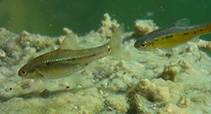 Enteromius pallidus
Fotografia de van Zyl, P.E.
Fotografias | Imagem do Google
Fotografia de van Zyl, P.E.
Classificação / Nomes Nomes comuns | Sinónimos | Catalog of Fishes(Género, Espécies) | ITIS | CoL | WoRMS | Cloffa
> Cypriniformes (Carps) > Cyprinidae (Minnows or carps) > Smiliogastrinae
Etymology: Enteromius: Greek, enteron = intestine + Greek, myo, mys = muscle (Ref. 45335).
Etymology: Enteromius: Greek, enteron = intestine + Greek, myo, mys = muscle (Ref. 45335).
Ambiente: milieu / zona climática / intervalo de profundidade / gama de distribuição Ecologia
; Água doce bentopelágico. Subtropical; 24°S - 33°S
Distribuição Territórios | Áreas FAO | Ecossistemas | Ocorrências | Mapa dos pontos | Introduções | Faunafri
Africa: endemic to the eastern Cape Fold Ecoregion in South Africa, where it is distributed from the Krom to the Great Fish river system (Ref. 52193, 122070). Specimens identified as Enteromius pallidus from tributaries of the Orange-Vaal, Tugela, Mfolozi, Pongolo, Incomati and Limpopo rivers (Ref. 7248, 13332) are not related and should be treated as misidentifications (Ref. 122070).
Comprimento na primeira maturidade / Tamanho / Peso / Idade
Descrição breve Chaves de identificação | Morfologia | Morfometria
Espinhos dorsais (total) : 0; Raios dorsais moles (total) : 10; Espinhos anais: 0; Raios anais moles: 8. Diagnosis: Enteromius pallidus can be identified by the slightly convex dorsal surface; posterior barbel 2.0 to 3.0 times the length of anterior barbel; a slightly prominent snout; an incomplete lateral line; deep translucent light brown to golden sheen with the presence of irregular and scattered spots in mature adults; and the presence of 3-7 bold spots above the lateral line in juveniles and subadults (Ref. 122070). This species belongs to the group of Enteromius species in southern Africa that is characterised by a simple and flexible unbranched primary dorsal fin ray (Ref. 122070). It is distinguished from E. amatolicus, E. anoplus, E. annectens, E. toppini and E. radiatus by possession of two pairs of prominent and long barbels vs. single pair and/or minute oral barbels in other species; it is distinguished from E. lineomaculatus, E. viviparus and E. unitaeniatus by absence of distinct chevron markings on the lateral line vs. presence of conspicuous chevron markings on the lateral line in the other three species, and from E. bifrenatus by absence of a distinct lateral stripe and absence of black tubular markings around lateral line pores vs. presence in E. bifrenatus; it is distinguished from E. anoplus, E. amatolicus, E. annectens, E. unitaeniatus, E. bifrenatus, E. gurneyi, E. motebensis, E. radiatus, E. toppini, E. treurensis and E. viviparus by the presence of scattered black spots on the body, particularly in juveniles vs. absence of scattered black spots in the other species (Ref. 122070). Lateral pigmentation pattern of E. pallidus is closely similar to that of E. brevipinnis and E. neefi, but it is distinguished from these two species by having an incomplete lateral line vs. complete lateral line in both E. neefi and E. brevipinnis; it is further separated from E. neefi by absence of wavy lines along the scale rows vs. presence of conspicuous wavy lines along the scale rows in E. neefi, and from E. brevipinnis by lack of black pigmentation around the borders of the scales vs. presence of distinct black pigmentation around the scales in E. brevipinnis, giving a mesh-like pattern on the lateral side of the fish (Ref. 122070).
Body shape (shape guide): fusiform / normal; Cross section: compressed.
Body shape (shape guide): fusiform / normal; Cross section: compressed.
Inhabits pools in clear, rocky streams often streams with emergent marginal vegetation (Ref. 7248, 52193). Spawning is likely to begin in summer, from October to November (Ref. 122070); breeding pairs lay eggs in vegetation (Ref. 7248, 52193).
Ciclo de vida e comportamento de acasalamento Maturidade | Reprodução | Desova | Ovos | Fecundidade | Larvas
Referência principal
Carregar as suas referências | Referências | Coordenador | Colaboradores
Skelton, P.H., 2001. A complete guide to the freshwater fishes of southern Africa. Cape Town (South Africa): Struik Publishers, 395 p. (Ref. 52193)
Categoria na Lista Vermelha da IUCN (Ref. 130435: Version 2025-2 (Global))
Preocupação menor (LC) ; Date assessed: 05 February 2018
CITES
Not Evaluated
Ameaça para o homem
Harmless
Utilização humana
Pescarias: espécies comerciais; Aquário: Espécies comerciais
FAO - Publication: search | FishSource |
Mais informação
Ecologia Trófica
Produtos alimentares (presas)
Composição da dieta
Consumo alimentar
Rações alimentares
Predadores
Produtos alimentares (presas)
Composição da dieta
Consumo alimentar
Rações alimentares
Predadores
Ecologia
Ecologia
Ecologia
Dinâmica das populações
Parâmetros de crescimento
Idades / tamanhos máximos
Comprimento-peso rel.
Comprimento-comprimento rel.
Frequência de comprimento
Conversão de massa
Recrutamento
Abundância
Parâmetros de crescimento
Idades / tamanhos máximos
Comprimento-peso rel.
Comprimento-comprimento rel.
Frequência de comprimento
Conversão de massa
Recrutamento
Abundância
Ciclo de vida
Reprodução
Maturidade
Maturidade/Rel. das guelras
Fecundidade
Desova
Agregações de desova
Ovos
Desenvolvimento dos ovos
Larvas
Dinâmica larvar
Reprodução
Maturidade
Maturidade/Rel. das guelras
Fecundidade
Desova
Agregações de desova
Ovos
Desenvolvimento dos ovos
Larvas
Dinâmica larvar
Anatomia
Área branquial
Cérebro
Otólitos
Área branquial
Cérebro
Otólitos
Fisiologia
Composição corporal
Nutrientes
Consumo de oxigénio
Tipo de natação
Velocidade de natação
Pigmentos visuais
Som de peixe
Doenças e Parasitas
Toxicidade (LC50s)
Composição corporal
Nutrientes
Consumo de oxigénio
Tipo de natação
Velocidade de natação
Pigmentos visuais
Som de peixe
Doenças e Parasitas
Toxicidade (LC50s)
Genética
genoma
Genética
Heterozigotia
Hereditariedade
Diversidade genética
genoma
Genética
Heterozigotia
Hereditariedade
Diversidade genética
Relacionado com o ser humano
Sistemas de aquacultura
Perfis para aquacultura
Estirpes
Casos de Ciguatera
Selos, moedas, diversos.
Sistemas de aquacultura
Perfis para aquacultura
Estirpes
Casos de Ciguatera
Selos, moedas, diversos.
Ferramentas
E-book | Guia de campo | Chaves de identificação | Ferramenta auxiliar de frequências de comprimento | Ferramenta sobre a história de vida | Mapa dos pontos |
Captura-MSY |
Relatórios especiais
Descarregue XML
Fontes da internet
AFORO (otoliths) | Aquatic Commons | BHL | Cloffa | Websites from users | Consultar FishWatcher | CISTI | Catalog of Fishes: Género, Espécies | DiscoverLife | ECOTOX | FAO - Publication: search | Faunafri | Fishipedia | Fishtrace | GloBI | Google Books | Google Scholar | Google | IGFA World Record | OneZoom | Open Tree of Life | Otolith Atlas of Taiwan Fishes | PubMed | Reef Life Survey | Socotra Atlas | TreeBase | Árvore da vida | Wikipedia: ir para, procurar | World Records Freshwater Fishing | Registo zoológico
Estimativas baseadas em modelos
Índice de diversidade filogenética (Ref. 82804): PD50 = 0.5000 [Uniqueness, from 0.5 = low to 2.0 = high].
Bayesian length-weight: a=0.00603 (0.00282 - 0.01286), b=3.06 (2.87 - 3.25), in cm total length, based on LWR estimates for this (Sub)family-body shape (Ref. 93245).
Nível Trófico (Ref. 69278): 3.0 ±0.3 se; based on size and trophs of closest relatives
Resiliência (Ref. 120179): Elevada, tempo mínimo de duplicação da população menor que 15 meses (Preliminary K or Fecundity.).