This website uses cookies to enhance your browsing experience and ensure the functionality of our site. For more detailed information about the types of cookies we use and how we protect your privacy, please visit our Privacy Information page.
×
Cookie Settings
This website uses different types of cookies to enhance your experience. Please select your preferences below:
> Eupercaria/misc (Various families in series Eupercaria) > Labridae (Wrasses) > Hypsigenyinae
Etymology: Bodianus:Bodianus after Bodiano or Pudiano, from the Portuguese pudor, meaning modesty (Jordan & Evermann, 1896); anthioides:Name from the Greek masculine noun 'anthias', a common name for members of the anthiine serranid fishes, and 'oides' for having the form of, refers to the similarity of this species to various anthiine species (Ref. 75973). More on author: Bennett.
Indo-Pacific: Red Sea to South Africa (Ref. 35918) and east to the Line and Tuamoto islands, north to southern Japan, south to New Caledonia and the Austral Islands.
Μέγεθος / Βάρος / Ηλικία
Γεννητική Ωρίμανση: Lm? range ? - ? cm Max length : 24.0 cm SL αρσενικό/απροσδιόριστο; (Ref. 1602)
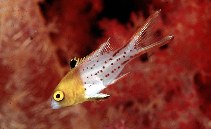
Ραχιαίες άκανθες (συνολικά) : 12; Μαλακές ραχιαίες ακτίνες (συνολικά) : 9 - 10; Εδρικές άκανθες: 3; Μαλακές εδρικές ακτίνες: 10 - 12. Undergoes relatively minor changes in color with growth. Easily identified by the unusual coloration and long tail (Ref. 48636). Body shape (shape guide): fusiform / normal; Cross section: compressed.
Adults inhabit seaward reefs. They occur on reefs rich with invertebrates such as gorgonians, seawhips and black corals (Ref. 48636). Common along steep outer reef slopes deeper than 25 m in Micronesia. Usually seen as lone individuals (Ref. 48636). Juveniles pose as cleaners (Ref. 8631). May be solitary or may exist in pairs (Ref. 5503). Oviparous, distinct pairing during breeding (Ref. 205). Maximum depth reported taken from Ref. 128797.
Κύκλος ζωής και συμπεριφορά ζευγαρώματος Γεννητική Ωρίμανση | Αναπαραγωγή | Γεννοβολία | Αβγά | Γονιμότητα | Προνύμφες
Oviparous, distinct pairing during breeding (Ref. 205).