



個人による観察記録の追加 Fish Watcher
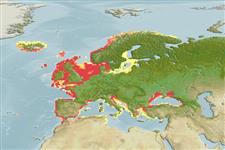
| Native range | All suitable habitat | Point map | Year 2050 |
|
| This map was computer-generated and has not yet been reviewed. |
| Acipenser sturio AquaMaps Data sources: GBIF OBIS |
アップロード 写真 そして ビデオ
画像 | 切手、コイン、その他 | グーグルの画像 Acipenser sturio
画像によって Svensson, A.
画像 | 切手、コイン、その他 | グーグルの画像
画像によって Svensson, A.
分類 / 名前 共通名の | 類義語 | Catalog of Fishes(部類, 種) | ITIS | CoL | WoRMS | Cloffa
> Acipenseriformes (Sturgeons and paddlefishes) > Acipenseridae (Sturgeons)
Etymology: Acipenser: Latin, acipenser = sturgeon, 1853 (Ref. 45335).
More on author: Linnaeus.
Etymology: Acipenser: Latin, acipenser = sturgeon, 1853 (Ref. 45335).
More on author: Linnaeus.
環境:環境 / 気候帯 / 深さの範囲 / 分布範囲 生態学
海; 新鮮な水; 汽水性の 底生の; pH range: 7.5 - ? ; dH range: 10 - 20; 昇流魚 (Ref. 138126); 深さの範囲 4 - 93 m (Ref. 51346), usually 5 - 60 m (Ref. 26160). Temperate; 10°C - 18°C (Ref. 2059); 71°N - 34°N, 25°W - 42°E (Ref. 59043)
分布 領土 | 国連食糧農業機関の区域 | エコシステム | 事件 | 目的のマップ | 導入 | Faunafri
Currently restricted only to the Garonne River in France (Ref. 137675).
Used to range from Norway to the Bay of Biscay, including the North Sea, European coasts of Atlantic, northern Mediterranean eastward to Rhodos, western and southern Black Sea; occasionally recorded from the White Sea, Iceland, Morocco and Algeria. Anadromous, in most large rivers, but not recorded from Danube upriver of delta.
Recent DNA studies using museum specimens revealed that this species co-exists with A. naccarii from the Adriatic Sea to the Iberian Peninsula (Ref. 52173). Several DNA sequence differences were found between individuals of the species from the Gironde River population and from the North and Baltic Seas showing that different populations of A. sturio are genetically divergent (Ref. 82476).
初回成熟時の長さ / サイズ / 重さ / 年齢
成熟: Lm ?, range 165 - ? cm
Max length : 600 cm TL オス/雌雄の選別がない; (Ref. 59043); common length : 125 cm TL オス/雌雄の選別がない; (Ref. 3397); 最大公表体重: 400.0 kg (Ref. 556); 最大公表体重: 400.0 kg; 最大記録サイズ: 100 年 (Ref. 556)
Max length : 600 cm TL オス/雌雄の選別がない; (Ref. 59043); common length : 125 cm TL オス/雌雄の選別がない; (Ref. 3397); 最大公表体重: 400.0 kg (Ref. 556); 最大公表体重: 400.0 kg; 最大記録サイズ: 100 年 (Ref. 556)
簡単な記述 検索表 | 形態学 | 形態計測学
背面の脊椎 (合計) : 0; 背鰭 (合計) : 30 - 44; 肛門の骨: 0; 臀鰭: 23 - 30. Body elongated, pentagonal section (Ref. 51442). Snout moderate with tip narrow and pointed (Ref. 3397), mouth inferior (Ref. 59043). Lower lip not continuous, interrupted at center (Ref. 3397). Four barbels halfway between snout tip and mouth but not reaching the latter (Ref. 3397, Ref. 51442). No scales, but 5 rows of scutes on the body: dorsal 9-16, lateral 24-39 on each side, ventral 9-14 on each side, with dense cross-lines of smaller rhombic plates between the dorsal and lateral rows (Ref. 2196, Ref. 3397, Ref. 40476, Ref. 51442). Dorsal side greenish-brown to blackish with golden tints, flanks light with silvery tints, belly white (Ref. 3397).
Body shape (shape guide): elongated.
Body shape (shape guide): elongated.
Amphihaline and anadromous fish (Ref. 51346, 51439), frequenting littoral zones (Ref. 2163, 51439, 51442). A long-lived and slow-growing species (Ref. 9988). It lives the major part of his life in sea but enters rivers for reproduction (Ref. 30578, 51442). Found on various substrates, from sand to rocks (Ref. 51346). At the sea, it occurs in coastal and estuarine zones. In freshwaters, it inhabits estuaries and large rivers (Ref. 59043). Juveniles found both in estuaries and in the sea (Ref. 2163), they slowly adapt to saltwater (Ref. 89103) and usually spend around 2-3 years in river estuaries before moving to the sea (Ref. 40152), some may migrate to the sea during their first summer (Ref. 59043). Usually solitary. Feeds on crustaceans, mollusks, polychaete worms and small fish. Today most males only reach 100-150 cm length, females 130-215 cm (Ref. 59043, 89104). Utilized fresh and frozen, and also for caviar; eaten steamed, pan-fried, broiled, boiled, microwaved and baked (Ref. 9988). A threatened species, mainly due to bycatch, poaching, habitat degradation (spawning grounds, nursery areas) and physical obstacles to migration (Ref. 26160).
ライフサイクルと交尾行動 成熟 | 繁殖 | 放精 | 卵 | 生産力 | 幼生
Anadromous species, with adults migrating to the middle reaches of large rivers mainly in spring and early summer. Spawning occurs between March and August, when water temperature rises above 20 °C at depths of 2-10 m over stony bottoms in areas with strong current (1.5-2.0 m/s) (Ref. 51442, 59043, 89103).
Mature individuals do not feed during spawning migration (Ref. 3193). Number of spawned eggs increases with age. After spawning adults return to the sea (Ref. 51442). The development of the sticky dark grey eggs (2.6-3.0 mm diameter) takes about one week at 17°C (Ref. 26160, 35388).
It is suggested that males spawn every 2 years, females every 3-4 years (Ref. 89072). Upstream spawning migrations appear to be positively correlated with water levels in rivers and distances of 1,000 kilometres or more may be covered when water levels are high (Ref. 89104).
Sturgeons in general have a high capacity for hybridization and most species are able to cross-breed (Ref. 89103, 89117). This species has been reported to cross-breed (albeit rarely) with the Danube sturgeon (Acipenser gueldenstaedti) (Ref. 89105).
主な参考文献
参考文献のアップロード | 参考文献 | コーディネーター | 協力者
Bauchot, M.-L., 1987. Poissons osseux. p. 891-1421. In W. Fischer, M.L. Bauchot and M. Schneider (eds.) Fiches FAO d'identification pour les besoins de la pêche. (rev. 1). Méditerranée et mer Noire. Zone de pêche 37. Vol. II. Commission des Communautés Européennes and FAO, Rome. (Ref. 3397)
IUCNのレッドリストの状況は (Ref. 130435: Version 2025-2 (Global))
絶滅寸前の危機的状況 (CR) (A2cde; D); Date assessed: 15 September 2020
人間に対する脅威
Harmless
人間の用途
水産業: 商業; 水産養殖: 商業
FAO - 養殖システム: 代謝; 水産業: 種の外形; Publication: search | FishSource | 私達の周りの海
より多くの情報
解剖学
カマ
脳
オトリス
カマ
脳
オトリス
用具
オーガニック・クイズ | 電子書籍 | 野外観察図鑑 | 長さ-周波数ウィザード | 生活史の基盤ツール | 目的のマップ |
キャッチ-MSY |
特記事項
XMLをダウンロードして下さい
インターネットの情報源
AFORO (otoliths) | Aquatic Commons | BHL | Cloffa | Websites from users | Check FishWatcher | CISTI | Catalog of Fishes: 部類, 種 | DiscoverLife | DORIS | ECOTOX | FAO - 養殖システム: 代謝; 水産業: 種の外形; Publication: search | Faunafri | Fishipedia | Fishtrace | GloBI | Google Books | Google Scholar | Google | IGFA World Record | 国のデーターベース | OneZoom | Open Tree of Life | Otolith Atlas of Taiwan Fishes | 公共の水族館 | PubMed | Reef Life Survey | Socotra Atlas | TreeBase | 生命の木 | Wikipedia: 行く, 検索する | World Records Freshwater Fishing | Zoobank | 動物に関する記録
モデルに基づく推定値
好ましい温度 (参照 123201): 7.3 - 18.8, mean 11 °C (based on 738 cells).
系統多様性指数 (参照 82804): PD50 = 0.5000 [Uniqueness, from 0.5 = low to 2.0 = high].
Bayesian length-weight: a=0.00263 (0.00153 - 0.00452), b=3.14 (3.00 - 3.28), in cm total length, based on LWR estimates for this species & Genus-body shape (Ref. 93245).
栄養段階 (参照 69278): 3.5 ±0.51 se; based on food items.
Generation time: 36.6 ( na - na) years. Estimated as median ln(3)/K based on 1 growth studies.
回復力 (参照 120179): 非常に低い, 14年以上の倍増期間の最小個体群 (tm=7-20; tmax=100).
栄養素 (Ref. 124155): Calcium = 8.49 [4.38, 16.01] mg/100g; Iron = 0.212 [0.119, 0.345] mg/100g; Protein = 17.7 [15.1, 20.3] %; Omega3 = 0.293 [0.144, 0.603] g/100g; Selenium = 30.4 [14.0, 64.8] μg/100g; VitaminA = 3.3 [1.0, 11.0] μg/100g; Zinc = 0.403 [0.274, 0.606] mg/100g (wet weight);