



Oreochromis amphimelas (Hilgendorf, 1905)
Manyara tilapia
muatnaik fotos/gambar dan video
Gambar | imej Google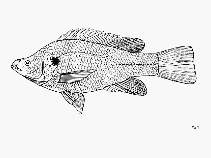 Oreochromis amphimelas
foto/gambar oleh FAO
Gambar | imej Google
foto/gambar oleh FAO
klasifikasi / Nama Nama-nama umum | Sinonim (persamaan) | Catalog of Fishes(Marga, Jenis) | ITIS | CoL | WoRMS | Cloffa
> Cichliformes (Cichlids, convict blennies) > Cichlidae (Cichlids) > Pseudocrenilabrinae
Etymology: Oreochromis: Latin, aurum = gold + Greek, chromis = a fish, perhaps a perch (Ref. 45335).
More on author: Hilgendorf.
Etymology: Oreochromis: Latin, aurum = gold + Greek, chromis = a fish, perhaps a perch (Ref. 45335).
More on author: Hilgendorf.
Lingkungan: lingkungan / zona iklim / kisaran kedalaman / jangkauan distribusi Ekologi
; air tawar; payau bentopelagis. Tropical; 3°N - 5°S
Penyebaran Wilayah | Daerah-daerah FAO | Ekosistem | Kemunculan | peta titik | Introduksi | Faunafri
Africa: several shallow saline lakes in central Tanzania (Ref. 118630), like lakes Manyara, Eyasi, Kitangiri, Singida and Sulungali (Ref. 5166, 118638).
Panjang pada saat jatuh tempo pertama / Ukuran / Berat / umur
deskripsi pendek Kunci identifiaksi (pengenalan) | Morfologi | Morfometrik
Duri punggung (Keseluruhan (total)) : 12 - 14; duri punggung lunak (Keseluruhan (total)) : 10 - 12; Duri dubur: 3; Sirip dubur lunak: 8 - 11; vertebrata, bertulang belakang: 30 - 32. Diagnosis: Slender bodied tilapia, characterised by its small eye and slender head profile with terminal mouth (Ref. 118638); further a narrow preorbital bone and scales of nape, dorsum and belly are very small, the transition from flank to belly scales abrupt, along a curve from base of pectoral fin to vent (Ref. 2). The upper profile of the head is nearly horizontal and in specimens larger than 130 mm total length there is a steep rise from the occiput to the dorsal fin; the caudal peduncle is long and dorsal and anal fins do not reach its posterior end when adpressed (Ref. 2). Live territorial males have jet black dorsal fins and are black underneath but are pinkish-red on flank and caudal fin; under stress, such as following capture, the flanks darken and the whole fish appear dark grey, apart from the reddish tailfin; females and non-territorial males grey/silver with pale ventral region (Ref. 118638).
Body shape (shape guide): short and / or deep; Cross section: compressed.
Body shape (shape guide): short and / or deep; Cross section: compressed.
Found in lakes (Ref. 4967); small bodied forms are present in Lake Eyasi, Lake Manyara and Lake Sulungali, while large bodied forms can be found in Lake Kitangiri and Lake Singida (Ref. 4967, 118638). It is microphagous (Ref. 54840). A maternal mouthbrooder (Ref. 2, 118638). Limited potential as an aquaculture species, it comprises a high proportion of the catch in lakes where it is found (Ref. 118638). IUCN conservation status is endangered, due to restricted distribution, drought and overfishing (Ref. 118638). There is some indication of hybridization with Oreochromis niloticus and O. esculentus (Ref. 118638).
Siklus hidup dan perilaku kawin Kematangan | Reproduksi, perkembang biakan | Pemijahan | telur-telur | Fekunditas | Larva
A maternal mouthbrooder (Ref. 118638). Breeding cycle of about 7 weeks; there is evidence of biparental mouthbrooding (Ref. 2).
rujukan utama
Unggah referensi Anda | Acuan | Koordinator : Kullander, Sven O. | mitra
Trewavas, E., 1983. Tilapiine fishes of the genera Sarotherodon, Oreochromis and Danakilia. British Mus. Nat. Hist., London, UK. 583 p. (Ref. 2)
Status IUCN Red List (Ref. 130435: Version 2025-2 (Global))
terancam (EN) (B1ab(i,iii,v)); Date assessed: 31 January 2006
CITES
Not Evaluated
ancaman kepada manusia
Harmless
penggunaan manusia
FAO - Publication: search | FishSource |
informasi lanjut
Ekologi trofik
Item makanan (mangsa)
Komposisi makanan
Konsumsi makanan
Ransum makanan
Pemangsa
Item makanan (mangsa)
Komposisi makanan
Konsumsi makanan
Ransum makanan
Pemangsa
Dinamika populasi
Parameter pertumbuhan
Maks. usia / ukuran
Panjang-berat rel.
Panjang-panjang rel.
ukuran frekuensi
Konversi massa
pemulihan
Kelimpahan
Parameter pertumbuhan
Maks. usia / ukuran
Panjang-berat rel.
Panjang-panjang rel.
ukuran frekuensi
Konversi massa
pemulihan
Kelimpahan
Siklus hidup
Reproduksi, perkembang biakan
Kematangan
Kedewasaan / insang rel.
Fekunditas
Pemijahan
Agregasi pemijahan
telur-telur
pekembangan telor
Larva
Dinamika larva
Reproduksi, perkembang biakan
Kematangan
Kedewasaan / insang rel.
Fekunditas
Pemijahan
Agregasi pemijahan
telur-telur
pekembangan telor
Larva
Dinamika larva
Anatomi
Area insang
Otak
Otolith
Area insang
Otak
Otolith
Fisiologi
Komposisi tubuh
Nutrisi
Konsumsi oksigen
Jenis renang
Kecepatan berenang
Pigmen visual
Suara ikan
Penyakit & Parasit
Toksisitas (LC50)
Komposisi tubuh
Nutrisi
Konsumsi oksigen
Jenis renang
Kecepatan berenang
Pigmen visual
Suara ikan
Penyakit & Parasit
Toksisitas (LC50)
Genetika
genom
Genetika
Heterozigositas
Diturunkan
Keanekaragaman Genetik
genom
Genetika
Heterozigositas
Diturunkan
Keanekaragaman Genetik
Yang berhubungan dengan manusia
Sistem akuakultur
profil budidaya air
Strain
Kasus Ciguatera
Perangko, koin, dll.
Sistem akuakultur
profil budidaya air
Strain
Kasus Ciguatera
Perangko, koin, dll.
Alat, peralatan
E-book | Penuntun lapangan | tanda freqkuenci panjang | peringkat sejarah hidup | peta titik |
Tangkap-MSY |
laporan khas
muat turun XML
Sumber internet
AFORO (otoliths) | Aquatic Commons | BHL | Cloffa | Websites from users | semak peneliti ikan | CISTI | Catalog of Fishes: Marga, Jenis | DiscoverLife | ECOTOX | FAO - Publication: search | Faunafri | Fishipedia | Fishtrace | GloBI | Google Books | Google Scholar | Google | IGFA World Record | OneZoom | Open Tree of Life | Otolith Atlas of Taiwan Fishes | PubMed | Reef Life Survey | Socotra Atlas | TreeBase | Tree of Life | Wikipedia: pergi, Cari | World Records Freshwater Fishing | Catatan Zoologi
Estimasi berdasarkan model
Indeks keanekaragaman filogenetik (Acuan 82804): PD50 = 0.5000 [Uniqueness, from 0.5 = low to 2.0 = high].
Bayesian length-weight: a=0.01905 (0.00846 - 0.04293), b=3.01 (2.82 - 3.20), in cm total length, based on LWR estimates for this (Sub)family-body shape (Ref. 93245).
Daya lenting (Acuan 120179): sedang, Waktu penggandaan populasi minimum 1.4 - 4.4 tahun (Preliminary K or Fecundity.).
Nutrisi (Ref. 124155): Calcium = 24.3 [9.2, 128.7] mg/100g; Iron = 1.05 [0.48, 2.47] mg/100g; Protein = 17.3 [15.5, 19.1] %; Omega3 = 0.174 [0.085, 0.377] g/100g; Selenium = 51.6 [24.6, 109.1] μg/100g; VitaminA = 8.8 [1.7, 41.7] μg/100g; Zinc = 1.73 [0.95, 4.05] mg/100g (wet weight);