This website uses cookies to enhance your browsing experience and ensure the functionality of our site. For more detailed information about the types of cookies we use and how we protect your privacy, please visit our Privacy Information page.
×
Cookie Settings
This website uses different types of cookies to enhance your experience. Please select your preferences below:
> Anabantiformes (Gouramies, snakeheads) > Helostomatidae (Kissing gouramies)
Etymology: Helostoma:Greek, helo = nail + Greek, stoma = mouth (Helos has the "e" long) (Ref. 45335). Eponymy: Coenraad Jacob Temminck (1778–1858) was a Dutch zoologist, illustrator and collector. [...] (Ref. 128868), visit book page. More on author: Cuvier.
Ambiente: milieu / zona climática / intervalo de profundidade / gama de distribuição Ecologia
Maturidade: Lm? range ? - ? cm Max length : 30.0 cm TL macho/indeterminado; (Ref. 7050)
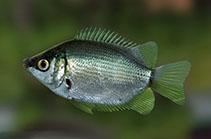
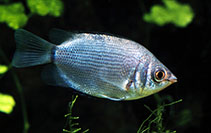
Adults occur in lakes and rivers (Ref. 56749). An air-breathing species (Ref. 118402). They prefer slow-moving water with thick vegetation. They feed on a variety of plants and animals, including green algae and zooplankton (Ref. 6459) as well as aquatic insects near the water surface (Ref. 12693). Utilized fresh for steaming, pan-frying, broiling and baking (Ref. 9987); also processed as dried or salted fish; ripe ovaries are collected and separately eaten (Ref. 56749). Large quantities of small fish are exported for aquarium use in Japan, Europe, North America, Australia and other parts of the world (Ref. 9987). Very popular with aquarists due to its habit of sucking its lips and kissing other fishes, plants and other objects (Ref. 4833). Aquarium keeping: not recommended for home aquariums; minimum aquarium size 150 cm (Ref. 51539).
Kottelat, M., 2013. The fishes of the inland waters of Southeast Asia: a catalogue and core bibliography of the fishes known to occur in freshwaters, mangroves and estuaries. The Raffles Bulletin of Zoology 2013 (Suppl. 27):1-663. (Ref. 94476)
Categoria na Lista Vermelha da IUCN (Ref. 130435: Version 2025-2 (Global))
Ciclo de vida Reprodução Maturidade Maturidade/Rel. das guelras Fecundidade Desova Agregações de desova Ovos Desenvolvimento dos ovos Larvas Dinâmica larvar
Índice de diversidade filogenética (Ref. 82804): PD50 = 1.5000 [Uniqueness, from 0.5 = low to 2.0 = high].
Bayesian length-weight: a=0.01995 (0.00906 - 0.04395), b=3.01 (2.83 - 3.19), in cm total length, based on all LWR estimates for this body shape (Ref. 93245).
Nível Trófico (Ref. 69278): 2.8 ±0.33 se; based on food items.
Generation time: 1.3 ( na - na) years. Estimated as median ln(3)/K based on 1 growth studies.
Resiliência (Ref. 120179): Elevada, tempo mínimo de duplicação da população menor que 15 meses (K=0.8; assuming tm<=1; Fec=40,000).
Vulnerabilidade da pesca (Ref. 59153): Low vulnerability (19 of 100). 🛈