



Haplochromis pelagicus Vranken, Van Steenberge, Mbalassa & Snoeks, 2023
Upload your photos and videos
Google image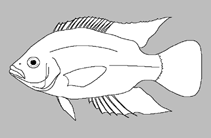 No image available for this species;
drawing shows typical species in Cichlidae.
Google image
drawing shows typical species in Cichlidae.
Classification / Names Common names | Synonyms | Catalog of Fishes(genus, species) | ITIS | CoL | WoRMS | Cloffa
Teleostei (teleosts) > Cichliformes (Cichlids, convict blennies) > Cichlidae (Cichlids) > Pseudocrenilabrinae
Etymology: Haplochromis: Greek, Haploos = single + Greek, chromis = a fish, perhaps a perch (Ref. 45335).
Etymology: Haplochromis: Greek, Haploos = single + Greek, chromis = a fish, perhaps a perch (Ref. 45335).
Environment: milieu / climate zone / depth range / distribution range Ecology
Freshwater; pelagic. Tropical
Distribution Territories | FAO areas | Ecosystems | Occurrences | Point map | Introductions | Faunafri
Africa: Lake Edward system.
Size / Weight / Age
Short description Identification keys | Morphology | Morphometrics
Dorsal spines (total): 15 - 16; Dorsal soft rays (total): 9 - 11; Anal spines: 3; Anal soft rays: 8 - 9; Vertebrae: 30 - 32. Diagnosis: Haplochromis pelagicus is a species with a very shallow body, body depth 25.4-30.7% of standard length; long and very shallow caudal peduncle, caudal peduncle length 17.2-20.1% of standard length, caudal peduncle depth 49.4-66.3% of caudal peduncle length; short upper jaw compared to lower jaw, upper jaw length 63.4-71.5% of lower jaw length; mostly inverted-triangular shaped head in anterior view with a very narrow lower jaw, lower jaw width 31.1-36.5% of lower jaw length; posterior 1/4-1/5 of premaxillary dentigerous arm often edentulous; many gill rakers, 14-18 (Ref. 128938). It differs from H. aureus by a shallower body, body depth 25.4-30.7% of standard length vs. 30.7-33.5%; shorter upper jaw, upper jaw length 26.5-29.0% of head length vs. 29.3-35.6%; more gill rakers, 14-18 vs. 12-14; dominant males with iridescent silver vs. yellow snout and cheeks, and hyaline vs. dusky and crimson anal fin (Ref. 128938). It is very similar to H. pappenheimi and differs from it by anal fin hyaline to rarely faint dusky vs. dark-dusky; major cusps of outer oral teeth bluntly vs. acutely pointed, and with a small to large flange vs. with no to a small flange, rarely a large flange; anterior outer oral teeth including rarely some vs. often several tricuspid teeth; dominant males differ further from those of H. pappenheimi by anal and caudal fins hyaline vs. crimson; belly and chest light-coloured vs. belly dark-coloured and chest speckled-black; cheek light-coloured with a very well-defined lacrimal stripe vs. dark-coloured with a well-defined lacrimal stripe; pelvic fin slightly shorter, pelvic fin length of males 23.3-27.0% of standard length vs. 25.2-33.5% (Ref. 128938).
Body shape (shape guide): fusiform / normal.
Body shape (shape guide): fusiform / normal.
Abundant in upper water layers of deepwater regions of Lake Edward, occasionally found in upper water layers of sublittoral areas of lakes Edward and George and Kazinga Channel (Ref. 128938). It feeds on copepods and chaoborid larvae, pupae and emerging adults (Ref. 128938).
Life cycle and mating behavior Maturity | Reproduction | Spawning | Eggs | Fecundity | Larvae
Main reference
Upload your references | References | Coordinator : Kullander, Sven O. | Collaborators
Vranken, N., M. Van Steenberge, M. Mbalassa and J. Snoeks, 2023. Just below the surface, the pelagic haplochromine cichlids from the Lake Edward system. Hydrobiologia 850:3173-3195. (Ref. 128938)
CITES
Not Evaluated
Threat to humans
Harmless
Human uses
FAO - Publication: search | FishSource |
More information
Population dynamics
Growth parameters
Max. ages / sizes
Length-weight rel.
Length-length rel.
Length-frequencies
Mass conversion
Recruitment
Abundance
Growth parameters
Max. ages / sizes
Length-weight rel.
Length-length rel.
Length-frequencies
Mass conversion
Recruitment
Abundance
Life cycle
Reproduction
Maturity
Maturity/Gills rel.
Fecundity
Spawning
Spawning aggregations
Eggs
Egg development
Larvae
Larval dynamics
Reproduction
Maturity
Maturity/Gills rel.
Fecundity
Spawning
Spawning aggregations
Eggs
Egg development
Larvae
Larval dynamics
Anatomy
Gill area
Brain
Otolith
Gill area
Brain
Otolith
Physiology
Body composition
Nutrients
Oxygen consumption
Swimming type
Swimming speed
Visual pigments
Fish sound
Diseases & Parasites
Toxicity (LC50s)
Body composition
Nutrients
Oxygen consumption
Swimming type
Swimming speed
Visual pigments
Fish sound
Diseases & Parasites
Toxicity (LC50s)
Genetics
Genome
Genetics
Heterozygosity
Heritability
Genetic Diversity
Genome
Genetics
Heterozygosity
Heritability
Genetic Diversity
Human related
Aquaculture systems
Aquaculture profiles
Strains
Ciguatera cases
Stamps, coins, misc.
Aquaculture systems
Aquaculture profiles
Strains
Ciguatera cases
Stamps, coins, misc.
Tools
Special reports
Download XML
Internet sources
AFORO (otoliths) | Aquatic Commons | BHL | Cloffa | Websites from users | Check FishWatcher | CISTI | Catalog of Fishes: genus, species | DiscoverLife | ECOTOX | FAO - Publication: search | Faunafri | Fishipedia | Fishtrace | GloBI | Google Books | Google Scholar | Google | IGFA World Record | OneZoom | Open Tree of Life | Otolith Atlas of Taiwan Fishes | PubMed | Reef Life Survey | Socotra Atlas | TreeBase | Tree of Life | Wikipedia: Go, Search | | Zoological Record
Estimates based on models
|
Phylogenetic diversity index (Ref. 82804) |
PD50 = 0.5000 [Uniqueness, from 0.5 = low to 2.0 = high]. |
| Bayesian length-weight | a=0.01445 (0.00671 - 0.03113), b=2.99 (2.82 - 3.16), in cm total length, based on LWR estimates for this (Sub)family-body shape (Ref. 93245). |
|
Trophic level (Ref. 69278) |
3.4 ±0.4 se; based on size and trophs of closest relatives |
|
Resilience (Ref. 120179) |
High, minimum population doubling time less than 15 months (Preliminary K or Fecundity.). |
|
Fishing Vulnerability (Ref. 59153) |
Low vulnerability (15 of 100). 🛈 |