



Lampanyctus achirus Andriashev, 1962
Lantern fish
Upload your photos and videos
Pictures | Google image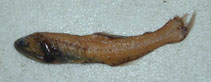 Lampanyctus achirus
Picture by Reyes, P.
Pictures | Google image
Picture by Reyes, P.
Classification / Names Common names | Synonyms | Catalog of Fishes(genus, species) | ITIS | CoL | WoRMS | Cloffa
Teleostei (teleosts) > Myctophiformes (Lanternfishes) > Myctophidae (Lanternfishes) > Lampanyctinae
Etymology: Lampanyctus: Greek, lampas, -ados = torch + Greek, nykte = night (Ref. 45335).
More on author: Andriashev.
Etymology: Lampanyctus: Greek, lampas, -ados = torch + Greek, nykte = night (Ref. 45335).
More on author: Andriashev.
Environment: milieu / climate zone / depth range / distribution range Ecology
Marine; bathypelagic; oceanodromous (Ref. 51243). Deep-water; 21°S -
Distribution Territories | FAO areas | Ecosystems | Occurrences | Point map | Introductions | Faunafri
Circumglobal from the Subtropical Convergence to south of the Antarctic Polar Front at Weddell-Scotia confluence and northern reaches of Ross Sea, and extending northwards to 21°S in meridional currents.
Length at first maturity / Size / Weight / Age
Short description Identification keys | Morphology | Morphometrics
Dorsal spines (total): 0; Dorsal soft rays (total): 13 - 16; Anal spines: 0; Anal soft rays: 15 - 19; Vertebrae: 36 - 38. 14-16 AO photophores; 9-12 tooth patches on the lower limb of the second gill arch; 34-38 lateral line organs (Ref. 36121). Pectoral fins relatively long and well developed in juveniles (easily visible in individuals up to about 6 cm SL), progressively becoming relatively shorter, with thicker rays, and covered by skin (in various stages of becoming vestigial between 5-8 cm SL). Adults (greater than 8 cm SL) with vestigial rays buried in skin and not externally visible unless skin abraded or otherwise torn (Ref. 36121).
Oceanic (Ref. 4479) and mesopelagic (Ref. 75154). Usually found below 500 m at night but shallower in upwelling regions.
Life cycle and mating behavior Maturity | Reproduction | Spawning | Eggs | Fecundity | Larvae
Main reference
Upload your references | References | Coordinator : Paxton, John | Collaborators
Zahuranec, B.J., 2000. Zoogeography and systematics of the lanternfishes of the genus Nannobrachium (Myctophidae: Lampanictini). Smithson. Contrib. Zool., 607:1-69. (Ref. 36121)
IUCN Red List Status (Ref. 130435: Version 2025-2 (Global))
Least Concern (LC) ; Date assessed: 28 June 2018
CITES
Not Evaluated
Threat to humans
Harmless
Human uses
FAO - Fisheries: landings search; Publication: search | FishSource |
More information
Population dynamics
Growth parameters
Max. ages / sizes
Length-weight rel.
Length-length rel.
Length-frequencies
Mass conversion
Recruitment
Abundance
Growth parameters
Max. ages / sizes
Length-weight rel.
Length-length rel.
Length-frequencies
Mass conversion
Recruitment
Abundance
Anatomy
Gill area
Brain
Otolith
Gill area
Brain
Otolith
Physiology
Body composition
Nutrients
Oxygen consumption
Swimming type
Swimming speed
Visual pigments
Fish sound
Diseases & Parasites
Toxicity (LC50s)
Body composition
Nutrients
Oxygen consumption
Swimming type
Swimming speed
Visual pigments
Fish sound
Diseases & Parasites
Toxicity (LC50s)
Genetics
Genome
Genetics
Heterozygosity
Heritability
Genetic Diversity
Genome
Genetics
Heterozygosity
Heritability
Genetic Diversity
Human related
Aquaculture systems
Aquaculture profiles
Strains
Ciguatera cases
Stamps, coins, misc.
Aquaculture systems
Aquaculture profiles
Strains
Ciguatera cases
Stamps, coins, misc.
Tools
Special reports
Download XML
Internet sources
AFORO (otoliths) | Aquatic Commons | BHL | Cloffa | Websites from users | Check FishWatcher | CISTI | Catalog of Fishes: genus, species | DiscoverLife | ECOTOX | FAO - Fisheries: landings search; Publication: search | Faunafri | Fishipedia | Fishtrace | GloBI | Google Books | Google Scholar | Google | IGFA World Record | OneZoom | Open Tree of Life | Otolith Atlas of Taiwan Fishes | PubMed | Reef Life Survey | Socotra Atlas | TreeBase | Tree of Life | Wikipedia: Go, Search | | Zoobank | Zoological Record
Estimates based on models
|
Phylogenetic diversity index (Ref. 82804) |
PD50 = 0.5000 [Uniqueness, from 0.5 = low to 2.0 = high]. |
| Bayesian length-weight | a=0.00490 (0.00226 - 0.01060), b=3.15 (2.97 - 3.33), in cm total length, based on LWR estimates for this Genus-body shape (Ref. 93245). |
|
Trophic level (Ref. 69278) |
3.3 ±0.3 se; based on size and trophs of closest relatives |
|
Resilience (Ref. 120179) |
Medium, minimum population doubling time 1.4 - 4.4 years (Preliminary K or Fecundity.). |
|
Fishing Vulnerability (Ref. 59153) |
Moderate vulnerability (36 of 100). 🛈 |
|
Nutrients (Ref. 124155) |
Calcium = 67.8 [17.7, 177.2] mg/100g; Iron = 0.395 [0.147, 1.294] mg/100g; Protein = 16.7 [14.7, 18.5] %; Omega3 = 0.296 [0.093, 0.904] g/100g; Selenium = 15.2 [4.6, 48.0] μg/100g; VitaminA = 50.6 [5.9, 411.1] μg/100g; Zinc = 0.812 [0.414, 1.725] mg/100g (wet weight); |