



Add your observation in Fish Watcher
| Native range | All suitable habitat | Point map | Year 2050 |

|
| This map was computer-generated and has not yet been reviewed. |
| Sebastes emphaeus AquaMaps Data sources: GBIF OBIS |
Upload your photos and videos
Pictures | Videos | Google image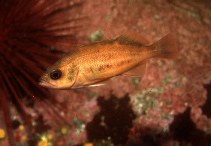 Sebastes emphaeus
Picture by Gotshall, D.W.
Pictures | Videos | Google image
Picture by Gotshall, D.W.
Classification / Names Common names | Synonyms | Catalog of Fishes(genus, species) | ITIS | CoL | WoRMS | Cloffa
Teleostei (teleosts) > Perciformes/Scorpaenoidei (Scorpionfishes) > Sebastidae (Rockfishes, rockcods and thornyheads) > Sebastinae
Etymology: Sebastes: Greek, sebastes = august, venerable (Ref. 45335); emphaeus: From the Greek emphaeus, meaning 'display' (Ref. 27436).
More on author: Starks.
Etymology: Sebastes: Greek, sebastes = august, venerable (Ref. 45335); emphaeus: From the Greek emphaeus, meaning 'display' (Ref. 27436).
More on author: Starks.
Environment: milieu / climate zone / depth range / distribution range Ecology
Marine; reef-associated; depth range 0 - 366 m (Ref. 27437). Temperate; 60°N - 38°N, 152°W - 120°W
Distribution Territories | FAO areas | Ecosystems | Occurrences | Point map | Introductions | Faunafri
Northeast Pacific: Kenai Peninsula, Alaska to northern California, USA.
Length at first maturity / Size / Weight / Age
Short description Identification keys | Morphology | Morphometrics
Dorsal spines (total): 13; Dorsal soft rays (total): 14 - 15; Anal spines: 3; Anal soft rays: 7. Head spines strong to moderate - nasal, preocular, postocular, tympanic and parietal spines present, supraocular, coronal and nuchal spines absent; anal fin rounded (Ref. 27437). Caudal fin weakly forked (Ref. 6885). Reddish brown to copper with dark blotches dorsally, fading to white, often with a dark stripe ventrally; red mouth; fins transparent, tinged with pink (Ref. 27437).
Body shape (shape guide): fusiform / normal.
Body shape (shape guide): fusiform / normal.
Inhabits reefs and rocky shorelines and found in loose congregations hovering above the bottom or resting among caves and crevices (Ref. 27436). Seeks shelter in areas of strong current (Ref. 2850). Viviparous (Ref. 34817). Flesh is tasty and flaky, but since it is rarely caught, it is seldom used as a food fish (Ref. 2850, 27436). May be used as bait for large rockfish, lingcod or cabezon (Ref. 27436).
Life cycle and mating behavior Maturity | Reproduction | Spawning | Eggs | Fecundity | Larvae
Main reference
Upload your references | References | Coordinator | Collaborators
Eschmeyer, W.N., E.S. Herald and H. Hammann, 1983. A field guide to Pacific coast fishes of North America. Boston (MA, USA): Houghton Mifflin Company. xii+336 p. (Ref. 2850)
CITES
Not Evaluated
Threat to humans
Harmless
Human uses
Fisheries: commercial; aquarium: public aquariums; bait: occasionally
FAO - Publication: search | FishSource |
More information
Population dynamics
Growth parameters
Max. ages / sizes
Length-weight rel.
Length-length rel.
Length-frequencies
Mass conversion
Recruitment
Abundance
Growth parameters
Max. ages / sizes
Length-weight rel.
Length-length rel.
Length-frequencies
Mass conversion
Recruitment
Abundance
Anatomy
Gill area
Brain
Otolith
Gill area
Brain
Otolith
Physiology
Body composition
Nutrients
Oxygen consumption
Swimming type
Swimming speed
Visual pigments
Fish sound
Diseases & Parasites
Toxicity (LC50s)
Body composition
Nutrients
Oxygen consumption
Swimming type
Swimming speed
Visual pigments
Fish sound
Diseases & Parasites
Toxicity (LC50s)
Genetics
Genome
Genetics
Heterozygosity
Heritability
Genetic Diversity
Genome
Genetics
Heterozygosity
Heritability
Genetic Diversity
Human related
Aquaculture systems
Aquaculture profiles
Strains
Ciguatera cases
Stamps, coins, misc.
Aquaculture systems
Aquaculture profiles
Strains
Ciguatera cases
Stamps, coins, misc.
Tools
Special reports
Download XML
Internet sources
AFORO (otoliths) | Aquatic Commons | BHL | Cloffa | Websites from users | Check FishWatcher | CISTI | Catalog of Fishes: genus, species | DiscoverLife | ECOTOX | FAO - Publication: search | Faunafri | Fishipedia | Fishtrace | GloBI | Google Books | Google Scholar | Google | IGFA World Record | OceanAdapt | OneZoom | Open Tree of Life | Otolith Atlas of Taiwan Fishes | Public aquariums | PubMed | Reef Life Survey | Socotra Atlas | TreeBase | Tree of Life | Wikipedia: Go, Search | | Zoological Record
Estimates based on models
|
Phylogenetic diversity index (Ref. 82804) |
PD50 = 0.5000 [Uniqueness, from 0.5 = low to 2.0 = high]. |
| Bayesian length-weight | a=0.01230 (0.00666 - 0.02273), b=3.09 (2.93 - 3.25), in cm total length, based on LWR estimates for this species & Genus-body shape (Ref. 93245). |
|
Trophic level (Ref. 69278) |
3.3 ±0.2 se; based on diet studies. |
|
Resilience (Ref. 120179) |
Medium, minimum population doubling time 1.4 - 4.4 years (K=0.54-0.70; tm=1.9; tmax=13; Fec=3,295). |
|
Fishing Vulnerability (Ref. 59153) |
Low vulnerability (20 of 100). 🛈 |
|
Price category (Ref. 80766) |
Medium. |
|
Nutrients (Ref. 124155) |
Calcium = 17.5 [5.7, 57.6] mg/100g; Iron = 0.188 [0.071, 0.478] mg/100g; Protein = 18.5 [17.2, 19.9] %; Omega3 = 0.906 [0.322, 2.494] g/100g; Selenium = 21.7 [7.0, 72.2] μg/100g; VitaminA = 106 [31, 382] μg/100g; Zinc = 0.506 [0.244, 0.954] mg/100g (wet weight); |