Common names from other countries
Elasmobranchii (hajar och rockor) (sharks and rays) >
Carcharhiniformes (Ground sharks) >
Scyliorhinidae (Cat sharks) > Scyliorhininae
Etymology: Scyliorhinus: skylion, Greek for dogfish or small shark; rhinus, from rhine (Gr.), rasp, alluding to a shark’s jagged, rasp-like skin (See ETYFish); canicula: Diminutive of canis (L.), dog; sharks were known as “sea dogs” and “dog-fishe” among mariners until the late 16th century, because of their ferocious pack-like feeding behavior (See ETYFish).
More on author: Linnaeus.
Miljö: miljö / Klimatzon / djupintervall / distributionsområde
Ekologi
marina bottenlevande; djupintervall 10 - 780 m (Ref. 56504), usually 80 - 100 m (Ref. 81056). Subtropical; 63°N - 3°N, 32°W - 37°E
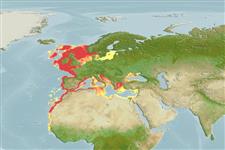
North Sea (sw coast of Sweden to Copenhagen, Denmark), Northeastern Atlantic Ocean (Ireland, United Kingdom, France, Portugal); Mediterranean Sea (Spain, France, Italy, Tunisia, Algeria, Morocco); nw Africa, close to the Strait of Gibraltar and to the north of Mauritania (20º30’N); including Norwegian Sea.
Längd vid första mognad / Storlek / Vikt / Ålder
Könsmognad: Lm 50.0, range 35 - 64 cm
Max length : 100.0 cm TL hane/ej könsbestämd; (Ref. 244); common length : 60.0 cm TL hane/ej könsbestämd; (Ref. 4645); publicerad maxvikt: 3.7 kg (Ref. 128278); rapporterad maxålder: 12 år (Ref. 81067)
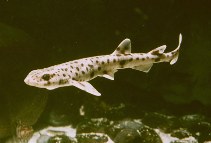
This species is distinguished from all its congeners by the following characters: shallow nasoral grooves and laterally situated posterior nasal flaps (vs. no grooves and posterior flaps on the posterior border of the excurrent apertures in congeners, except in S. duhamelii); distance between the anterior nasal flaps 6-7.5 times smaller than the anterior nasal flap width (vs. 3.5-5 times smaller in S. duhamelii; two times in the other species); lower labial furrow 2.1-2.2 times smaller than mouth width (vs. more than 3 times in other species, except S. duhamelii). Colouration: color pattern with dark spots well-defined, predominantly smaller than spiracles (vs. no dark spots in S. capensis, S. comoroensis, S. hesperius, S. meadi, S. torazame, S. torrei; reticulated pattern in S. rotifer; dark spots predominantly larger than spiracles in S. cervigoni, S. garmani, S. haeckelii, S. stellaris; diffuse spots in S. duhamelii); clasper with rough terminal dermal cover (also found only in S. capensis) (Ref. 120402).
Cross section: oval.
Most common catshark in coastal waters of Europe (Ref. 32804). Inhabits continental shelves and uppermost slopes. Found on sandy, coralline, algal, gravel or muddy bottoms. Occurs mainly between 10-100 m depth in the northeast Atlantic and up to 400 m depth in the Mediterranean Sea (Ref. 88187) and from 288-780 m in the eastern Ionian Sea (Ref. 56504). They sometimes occur in midwater. Nocturnal species, males resting on substrate and females hiding in shallow (0.5-1.5 m depth) caves and crevices during the day (Ref. 88835). Feed on a variety of benthic invertebrates, including mollusks, crustaceans, small cephalopods, polychaete worms, and small bony fishes (Ref. 244, 11889). Males have been found to forage in shallow prey-rich areas with soft sediment or areas covered with filamentous algae (Ref. 88836). Oviparous, with a single egg laid per oviduct at a time. Detect weak electric fields generated by other organisms (e.g. potential prey) (Ref. 10311). Utilized fresh and dried-salted for human consumption, also for oil and fishmeal.
Oviparous, laying paired eggs (one per oviduct) in shallow subtidal areas, although some egg cases have been found in the deeper part of intertidal zones (Ref. 244). Embryos feed solely on yolk (Ref. 50449). The egg cases are anchored to macroalgae, sea grass or sessile erect invertebrates such as poriferans, bryozoans and hydroids (Ref. 32804, 58137). The capsules have tendrils at each corner used for anchorage purposes. Egg capsule size varies according to locality and female size (Ref. 244) and ranges between 4.9-7.0 cm length and 1.5-3.0 cm width (Ref. 88837). Egg cases may be deposited throughout the year, peaking in June and July (Ref. 32804). Recent studies estimate fecundity of females from the northeast Atlantic to be at around 29-62 pups (Ref. 32804). Fully formed pups hatch after 5-11 months, depending on water temperature (Ref. 244, 32804). Newly hatched pups are about 8-10 cm in length (Ref. 78469).
Soares, K.D.A. and M.R. De Carvalho, 2019. The catshark genus Scyliorhinus (Chondrichthyes: Carcharhiniformes: Scyliorhinidae): taxonomy, morphology and distribution. Zootaxa 4601(1):1-147. (Ref. 120402)
Status på IUCN:s rödlista (Ref. 130435: Version 2025-2 (Global))
Hot mot människor
Harmless
Mänskliga användningsområden
Fiskeri: mindre kommeriell; sportfisk: ja
Verktyg
Särskilda rapporter
Ladda ner XML
Internet-källor
Uppskattningar baserade på modeller
Önskad temperatur (Ref.
123201): 7.2 - 16.2, mean 10.1 °C (based on 28 cells).
Index för fylogenetisk mångfald (Ref.
82804): PD
50 = 0.5000 [Uniqueness, from 0.5 = low to 2.0 = high].
Bayesian length-weight: a=0.00145 (0.00124 - 0.00168), b=3.21 (3.16 - 3.26), in cm total length, based on LWR estimates for this species (Ref.
93245).
Trofisk nivå (Ref.
69278): 3.8 ±0.3 se; based on diet studies.
Resiliens (Ref.
120179): Låg, lägsta populationsfördubblingstid 4,5-14 år (K=0.20; tm=9; Fec=96).
Prior r = 0.35, 95% CL = 0.23 - 0.53, Based on 1 full stock assessment.
Sårbarhet i fisket (Ref.
59153): High vulnerability (59 of 100).
🛈
Sårbarhet för klimatet (Ref.
125649): Moderate to high vulnerability (53 of 100).
🛈
Näringsämnen (Ref.
124155): Calcium = 18.1 [3.1, 101.7] mg/100g; Iron = 0.642 [0.170, 1.952] mg/100g; Protein = 18.3 [15.2, 21.3] %; Omega3 = 0.207 [0.092, 0.454] g/100g; Selenium = 33.3 [10.3, 93.4] μg/100g; VitaminA = 8.46 [2.86, 24.77] μg/100g; Zinc = 0.55 [0.27, 1.02] mg/100g (wet weight); based on
nutrient studies.