Chloroscombrus chrysurus, Atlantic bumper : fisheries

You can sponsor this page

Chloroscombrus chrysurus (Linnaeus, 1766)

Atlantic bumper
Adicionar sua observação em Fish Watcher
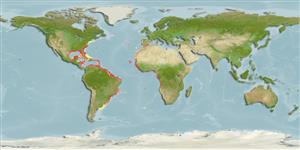
Native range | All suitable habitat | Point map | Year 2050
This map was computer-generated and has not yet been reviewed.
Chloroscombrus chrysurus   AquaMaps   Data sources: GBIF OBIS
Carregue seu(sua) Fotos e vídeos
Fotos | Sons | Imagem do Google
Image of Chloroscombrus chrysurus (Atlantic bumper)
Chloroscombrus chrysurus
Foto de Cox, C.D.

Common names from other countries

Classificação / Nomes Nomes comuns | Sinônimos | Catalog of Fishes(Gênero, Espécies) | ITIS | CoL | WoRMS | Cloffa

> Carangiformes (Jacks) > Carangidae (Jacks and pompanos) > Caranginae
Etymology: Chloroscombrus: Greek, chloros = green + Greek, skombros = the name of several fishes, a mackerel (Ref. 45335).
More on author: Linnaeus.

Meio ambiente: milieu / Zona climática / intervalo de profundidade / faixa de distribuição Ecologia

marinhas; estuarina pelagic-neritic; intervalo de profundidade 0 - 110 m (Ref. 114025). Subtropical; 42°N - 41°S, 98°W - 14°E

Distribuição Territórios | Áreas da FAO | Ecossistemas | Ocorrências | Mapa de pontos | Introduções | Faunafri

Western Atlantic: Massachusetts to Florida, USA and Bermuda to Uruguay; throughout Caribbean Sea and Gulf of Mexico (Ref. 9626); Bahamas, Antilles, along Central and South American coasts to Uruguay (Ref. 26938). Eastern Atlantic: Spain to Angola (Ref. 57392). First recorded from the Mediterranean Sea (Ref. 128468). Replaced by Chloroscombrus orqueta in eastern Pacific. These two species have not been adequately studied and may prove to be conspecific.

Comprimento de primeira maturação / Tamanho / Peso / Idade

Maturidade: Lm 12.4, range 10 - ? cm
Max length : 65.0 cm TL macho/indeterminado; (Ref. 57392); common length : 25.0 cm TL macho/indeterminado; (Ref. 5217); peso máx. publicado: 121.00 g (Ref. 128468)

Descrição suscinta Chaves de identificação | Morfologia | Morfometria

Espinhos dorsais (total) : 9; Raios dorsais (total) : 25 - 28; Espinhos anais: 3; Raios anais : 25 - 28. Diagnosis: body compressed and deep (depth comprised from 2.3 to 2.8 times in fork length) (Ref. 57392), its ventral profile distinctly more convex than the dorsal (Ref. 26938, 57392). Snout very short, its tip blunt, upper jaw extending almost to behind level of anterior eye margin; 2 dorsal fins, the first with 8 spines, the second with 1 spine and 25-28 soft rays; anal fin with 2 detached spines, followed by 1 spine and 25-28 soft rays; upper lobe of caudal fin longer than the lower; small, cycloid scales covering most of body, including chest; 5-15 weak scutes on posterior part of lateral line, at level of caudal peduncle, the latter without bilateral keels (Ref. 57392). Metallic blue above, silvery below; caudal peduncle with black saddle spot (Ref. 3197). Coloration: back greenish or bluish, sides silvery-white; a dark, saddle-shaped blotch on caudal peduncle just before caudal fin, and another at upper angle of gill cover (Ref. 57392).
Body shape (shape guide): fusiform / normal.

Biologia     Glossário (p.ex. epibenthic)

Adults are found over soft bottoms of the continental shelf; sometimes forming schools near the surface (Ref. 5217). Marine pelagic species very common in coastal lagoons and estuaries (Ref. 57392). They feed on fish, cephalopods, zooplankton and detritus (Ref. 28587). Juveniles common in brackish estuaries and often associated with jellyfish (Ref. 5217). Marketed fresh and salted.

Ciclo de vida ou comportamento de acasalamento Maturidade | Reprodução | Desova | Ovos | Fecundidade | Larvas

Referência principal Carregar suas referências | Referências | Coordenador : Smith-Vaniz, William F. | Colaboradores

Smith-Vaniz, W.F., J.-C. Quéro and M. Desoutter, 1990. Carangidae. p. 729-755. In J.C. Quero, J.C. Hureau, C. Karrer, A. Post and L. Saldanha (eds.) Check-list of the fishes of the eastern tropical Atlantic (CLOFETA). JNICT, Lisbon; SEI, Paris; and UNESCO, Paris. Vol. 2. (Ref. 7097)

Status na Lista Vermelha da UICN (Ref. 130435: Version 2025-2 (Global))

  Segura ou pouco preocupante (LC) ; Date assessed: 20 August 2012

CITES

Not Evaluated

CMS (Ref. 116361)

Not Evaluated

Ameaça para os humanos

  Harmless


Uso pelos humanos

Pescarias: espécies comerciais
FAO - pescarias: desembarques; Publication: search | FishSource | Sea Around Us

Mais informação

Ciclo de vida
Reprodução
Maturidade
Maturidade/Rel. das guelras
Fecundidade
Desova
Agregações de desova
Ovos
Desenvolvimento dos ovos
Larvas
Dinâmica larval
Anatomia
Área branquial
Cérebro
Otólito
Fisiologia
Composição corporal
Nutrientes
Consumo de oxigênio
Tipo de natação
Velocidade de natação
Pigmentos visuais
Som de peixe
Doenças e Parasitas
Toxicidade (LC50s)
Genética
genoma
Genética
Heterozigosidade
Hereditariedade
Relacionado a humanos
Sistemas de aquicultura
Perfis para aquacultura
Estirpes
Casos de Ciguatera
Selos, moedas, diversos.
Divulgação
Colaboradores
Referências
Referências

Ferramentas

Relatórios especiais

Baixar XML

Fontes da internet

Estimativas baseadas em modelos

Temperatura preferida (Ref. 123201): 23.2 - 28, mean 26.2 °C (based on 552 cells).
Índice de diversidade filogenética (Ref. 82804):  PD50 = 0.7500   [Uniqueness, from 0.5 = low to 2.0 = high].
Bayesian length-weight: a=0.01202 (0.01068 - 0.01353), b=2.94 (2.91 - 2.97), in cm total length, based on LWR estimates for this species (Ref. 93245).
Nível Trófico (Ref. 69278):  3.5   ±0.2 se; based on diet studies.
Generation time: 5.0 ( na - na) years. Estimated as median ln(3)/K based on 2 growth studies.
Resiliência (Ref. 120179):  médio(a), tempo mínimo de duplicação da população 1,4 - 4,4 anos (K=0.22-0.56; assumed tm=1-2).
Prior r = 0.57, 95% CL = 0.37 - 0.85, Based on 3 data-limited stock assessments.
Vulnerabilidade da pesca (Ref. 59153):  Low to moderate vulnerability (29 of 100). 🛈
Vulnerabilidade climática (Ref. 125649):  High to very high vulnerability (75 of 100). 🛈
Categoria de preço (Ref. 80766):   Low.
Nutrientes (Ref. 124155):  Calcium = 90.6 [51.1, 199.0] mg/100g; Iron = 1.79 [1.02, 3.33] mg/100g; Protein = 20.3 [19.1, 21.5] %; Omega3 = 0.442 [0.268, 0.757] g/100g; Selenium = 26.1 [13.5, 51.0] μg/100g; VitaminA = 6.02 [1.87, 18.28] μg/100g; Zinc = 0.834 [0.576, 1.190] mg/100g (wet weight);