Solea solea, Common sole : fisheries, aquaculture, gamefish, aquarium

You can sponsor this page

Solea solea (Linnaeus, 1758)

Common sole
Добавить Ваши наблюдения в Fish Watcher
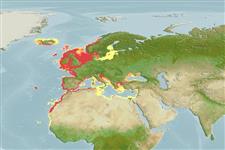
Native range | All suitable habitat | Point map | Year 2050
This map was computer-generated and has not yet been reviewed.
Solea solea   AquaMaps   Data sources: GBIF OBIS
Загрузить свой Фото и Видео
изображения | Марки, монеты и прочее. | Изображение на Google
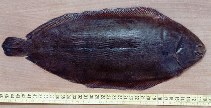
Image of Solea solea (Common sole)
Solea solea
Изображение сделано Canosa, C. & B.F. Souto


Germany territory information

Common names: Seezunge, Zunge
Occurrence: native
Salinity: brackish
Abundance: | Ref:
Importance: minor commercial | Ref: FAO, 1994
Aquaculture: | Ref:
Regulations: | Ref:
Uses: no uses
Comments: Found in the Elbe estuary (Ref. 51031).
National Checklist:
Territory Information: https://www.cia.gov/library/publications/resources/the-world-factbook/geos/gm.html
National Fisheries Authority: http://www.ble.de/index.cfm?8C712107D9244972B3C193AC1917DCE7#Handelsbezeichnungen
Occurrences: Occurrences Point map
Main Ref: Muus, B.J. and P. Dahlström, 1974
National Database: AGRDEU

Common names from other countries

Классификация / Имена народные названия | синонимы | Catalog of Fishes(род, виды) | ITIS | CoL | WoRMS | Cloffa

> Pleuronectiformes (Flatfishes) > Soleidae (Soles)
Etymology: Solea: Latin, solea = sandal (shoe); refered to the flat shape of the fish (Ref. 45335).
More on author: Linnaeus.

Окружающая среда: среда / климатическая зона / пределы глубины / диапазон распространения экология

морской; солоноватоводный демерсальный; мигрирует в океане (Ref. 51243); пределы глубины 0 - 150 m (Ref. 35388), usually 10 - 60 m (Ref. 6302). Subtropical; 8°C - 24°C (Ref. 4944); 64°N - 14°N, 25°W - 38°E (Ref. 54889)

распространение Территории | регионы FAO | Экосистемы | места находок | карта точек | интродукции | Faunafri

Eastern Atlantic: southward from Trondheim Fjord (including North Sea and western Baltic) and Mediterranean Sea (including Sea of Marmara, Bosporus and southwestern Black Sea) (Ref. 4710). Elsewhere, southward to Senegal (Ref. 4710), including Cape Verde (Ref. 5304).

Длина при первой зрелости / Размер / Вес / Возраст

половая зрелость: Lm 30.3  range ? - ? cm
Max length : 70.0 cm SL самец/пол неопределен; (Ref. 4710); common length : 35.0 cm SL самец/пол неопределен; (Ref. 5504); наибольший вес (опубликованные данные): 3.0 kg (Ref. 5504); наибольший возраст (опубликованны данные): 26 годы (Ref. 32766)

Краткое описание определительные ключи | морфология | морфометрия

колючие лучи спинного плавника (общее число) : 0; членистые (мягкие) лучи спинного плавника (общее число) : 69 - 97; колючие лучи анального плавника: 0; членистые (мягкие) лучи анального плавника: 53 - 80; позвонки: 46 - 52. This species is distinguished by the following characters: body oval, flat and asymmetric; eyes located on right side of head, except in reversed individuals (Ref. 57416). Upper eye less than its own diameter from dorsal profile of head (Ref. 4710). Anterior nostril on blind side not enlarged (Ref. 4710, 57416), but surrounded by small rim (Ref. 57416). Its distance from front margin of head 1.5-1.9x in its distance from cleft of mouth; anterior nostril on eyed side with backward-pointing tube not or only barely reaching front border of lower eye (Ref. 4710). Preopercle covered by skin and opercle entirely scaled; mouth arched and inferior; dorsal and anal fins lacking spinous rays and united to caudal fin by well-developed membrane, but caudal peduncle distinct; dorsal fin originating on horizontal axis through upper eye; pectoral fin on eyed side asymmetrical, with 7-10 rays, and on blind side slightly shorter; straight part of lateral line visible, supratemporal part slightly arched above eyes; body covered with rectangular ctenoid scales (Ref. 57416).
Body shape (shape guide): short and / or deep; Cross section: flattened.

биология     глоссарий (например epibenthic)

Adults occur at a temperature range of 8.0-24.0°C (Ref. 4944). Usually solitary. They burrow into sandy and muddy bottoms. Retreat to deeper water during winter (Ref. 9988). Juveniles are found during the first 2 to 3 years in coastal nurseries (bays and nurseries) before migrating to deeper waters (Ref. 92286). Adults feed on worms, mollusks and small crustaceans at night. Waden sea is the most important nursery area. Batch spawner (Ref. 51846). Recruitment is very variable. Frequently found pelagically during spawning migrations (Ref. 35388). Marketed fresh and frozen; utilized steamed, fried, broiled, microwaved and baked (Ref. 9988).

Жизненный цикл и брачное поведение половая зрелость | размножение | нерест | икра | Плодовитость | личинки

Spawning takes place in shallow coastal waters at temperatures of 6 - 12°C. Reproduction starts after 3-5 years of age, when 25-30cm size is reached. Spawning happens mainly during the months of February-May (for example, off the coasts of Galicia), although in warmer areas (such as the Mediterranean), it can occur at the beginning of the winter. Incubation lasts about 5 days (at 1 2°) and larval phase 35 days (at 18°C).

Основная ссылка Загрузите свои рекомендации | ссылки | координатор | соавторы

Desoutter, M., 1992. Soleidae. p. 860-865. In C. Levêque, D. Paugy, and G.G. Teugels (eds.) Faune des poissons d'eaux douces et saumâtres d'Afrique de l'Ouest Tome 2. Faune Tropicale n° 28. Musée Royal de l'Afrique Centrale, Tervuren, Belgique and O.R.S.T.O.M., Paris, France, 902. (Ref. 7395)

Статус Красного Списка МСОП (Ref. 130435: Version 2025-2 (Global))

  Нехватка данных (DD) ; Date assessed: 15 July 2014

CITES

Not Evaluated

CMS (Ref. 116361)

Not Evaluated

Угроза для людей

  Harmless


Использование человеком

рыболовство: важный объект промысла; аквакультура (рыбоводство): коммерческий; объект спортивного рыболовства: да; аквариум: общественные аквариумы
FAO - Системы аквакультуры: Производство; рыболовство: посадки, Видовой профиль; Publication: search | FIRMS - Stock assessments | FishSource | Море вокруг нас

дополнительная информация

Анатомия
жаберная область
Мозг
Отолит
генетика
Геном
генетика
Гетерозиготность
наследуемость
Связанные с человеком
Системы аквакультуры
особенности рыбоводства
степень растяжения
Случаи заболевания сигуатерой
Марки, монеты и прочее.
Информационно-просветительская работа
соавторы
ссылки
ссылки

инструменты

Специальные отчеты

Скачать в формате XML

ресурсы в Интернет

Оценки, основанные на моделях

Предпочтительная температура (ссылка 123201): 9 - 20, mean 11.4 °C (based on 678 cells).
Индекс филогенетического разнообразия (ссылка 82804):  PD50 = 0.5020   [Uniqueness, from 0.5 = low to 2.0 = high].
Bayesian length-weight: a=0.00661 (0.00575 - 0.00759), b=3.08 (3.04 - 3.12), in cm total length, based on LWR estimates for this species (Ref. 93245).
Трофический уровень (ссылка 69278):  3.2   ±0.1 se; based on diet studies.
Generation time: 3.9 (3.2 - 4.6) years. Estimated as median ln(3)/K based on 31 growth studies.
устойчивость к внешним воздействиям (ссылка 120179):  средний (среднего размера), минимальное время удвоения популяции 1.4-4.4 года (K=0.21-0.33; tm=3-5; tmax=26; Fec=100,000).
Prior r = 0.50, 95% CL = 0.33 - 0.75, Based on 40 full stock assessments.
Уязвимость рыбной ловли (Ref. 59153):  Low to moderate vulnerability (35 of 100). 🛈
Климатическая уязвимость (Ref. 125649):  Moderate vulnerability (38 of 100). 🛈
Категория цены (Ref. 80766):   Very high.
Питательные вещества (Ref. 124155):  Calcium = 79.8 [29.8, 184.5] mg/100g; Iron = 0.915 [0.416, 1.919] mg/100g; Protein = 18.3 [16.6, 20.1] %; Omega3 = 0.224 [0.141, 0.343] g/100g; Selenium = 17.2 [6.8, 47.5] μg/100g; VitaminA = 4.77 [1.36, 16.81] μg/100g; Zinc = 0.453 [0.263, 1.007] mg/100g (wet weight); based on nutrient studies.