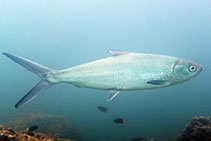
Chanos chanos, Milkfish : fisheries, aquaculture, gamefish, bait

You can sponsor this page

Chanos chanos (Fabricius, 1775)

Milkfish
Adicionar as suas observações no Fish Watcher
Native range | All suitable habitat | Point map | Year 2050
This map was computer-generated and has not yet been reviewed.
Chanos chanos   AquaMaps   Data sources: GBIF OBIS
Adicionar o seu Fotografias e vídeos
Fotografias | vídeos | Imagem do Google
Image of Chanos chanos (Milkfish)
Chanos chanos
Fotografia de Gomen See@114°E Hong Kong Reef Fish Survey


Sri Lanka territory information

Common names: Hyder's fish, Pal-kendai, Palmeen
Occurrence: native
Salinity: brackish
Abundance: | Ref:
Importance: | Ref:
Aquaculture: | Ref:
Regulations: | Ref:
Uses: no uses
Comments: Also Ref. 94476.
National Checklist:
Territory Information: https://www.cia.gov/library/publications/resources/the-world-factbook/geos/ce.html
National Fisheries Authority:
Occurrences: Occurrences Point map
Main Ref: Bianchi, G., 1985
National Database:

Common names from other countries

Classificação / Nomes Nomes comuns | Sinónimos | Catalog of Fishes(Género, Espécies) | ITIS | CoL | WoRMS | Cloffa

> Gonorynchiformes (Milkfishes) > Chanidae (Milkfish)
Etymology: Chanos: Greek, chanos, -eos, ous, and chasma, -atos = abyss, mouth opened, inmensity (Ref. 45335).

Ambiente: milieu / zona climática / intervalo de profundidade / gama de distribuição Ecologia

marinhas; Água doce; estuarina bentopelágico; anfídromo (Ref. 9814); intervalo de profundidade 1 - 30 m (Ref. 6898), usually ? - 15 m (Ref. 89972). Tropical; 15°C - 43°C (Ref. 43081); 46°N - 52°S, 19°E - 77°W

Distribuição Territórios | Áreas FAO | Ecossistemas | Ocorrências | Mapa dos pontos | Introduções | Faunafri

Indo-West Pacific: South Africa to Red Sea, to Hawaii and the Marquesas, north to Japan, south to Victoria, Australia. Eastern Pacific: San Pedro, California to the Galapagos.

Comprimento na primeira maturidade / Tamanho / Peso / Idade

Maturidade: Lm 86.1, range 68 - 70 cm
Max length : 180 cm SL macho/indeterminado; (Ref. 9710); 124.0 cm SL (female); common length : 100.0 cm SL macho/indeterminado; (Ref. 9814); peso máx. Publicado: 14.0 kg (Ref. 9814); Idade máx. registada: 15 anos (Ref. 9814)

Descrição breve Chaves de identificação | Morfologia | Morfometria

Espinhos dorsais (total) : 2; Raios dorsais moles (total) : 13 - 17; Espinhos anais: 2; Raios anais moles: 8 - 10; Vértebras: 46. This species is characterized by the following: body elongate and somewhat compressed; mouth small and toothless; single dorsal about mid-level of the body; pectoral fins falcate; caudal fin large and deeply forked; no scutes on belly; branchiostegal rays 4. Colour of the body olive green dorsally; flanks silvery; unpaired fins with dark margins (Ref. 49, 117228).
Body shape (shape guide): elongated; Cross section: oval.

Biologia     Glossário (ex. epibenthic)

Adults are found in offshore marine waters and shallow coastal embayments, but also frequently enter estuaries and occasionally penetrate freshwater streams, along continental shelves and around islands, where temperatures are greater than 20°C. (Ref. 44894, 52331). They occur in small to large schools near the coasts or around islands where reefs are well developed. Eggs and larvae are pelagic up to 2-3 weeks. Older larvae migrate onshore and settle in coastal wetlands (mangroves, estuaries) during the juvenile stage, or occasionally enter freshwater lakes. Juveniles and sub-adults return to sea where they mature sexually. Mature adults spawn only in fully saline water. Larvae eat zooplankton; juveniles and adults eat cyanobacteria, soft algae, small benthic invertebrates, and even pelagic fish eggs and larvae. Larvae are collected from rivers and are grown in culture ponds into juveniles which are marketed fresh, smoked, canned or frozen. Brood stocks can be raised and spawned in captivity to produce larvae in the hatchery (Ref. 12868). This species can thrive and grow in water as hot as 32° C (Ref. 9987).

Ciclo de vida e comportamento de acasalamento Maturidade | Reprodução | Desova | Ovos | Fecundidade | Larvas

Spawns in clear shallow waters above a bottom of sand or coral and at a distance of not more than 30 km from the shore. Females spawn up to 5 million eggs which hatch in about 24 hr. The larvae seek out clear coastal and estuarine waters warmer than 23°C with 10-32 salinity and abundant phytoplankton. Spawning and fertilization take place at night.

Referência principal Carregar as suas referências | Referências | Coordenador | Colaboradores

Bagarinao, T., 1994. Systematics, distribution, genetics and life history of milkfish, Chanos chanos. Environ. Biol. Fishes 39(1):23-41. (Ref. 9814)

Categoria na Lista Vermelha da IUCN (Ref. 130435: Version 2025-2 (Global))

  Preocupação menor (LC) ; Date assessed: 23 June 2016

CITES

Not Evaluated

CMS (Ref. 116361)

Not Evaluated

Ameaça para o homem

  Harmless


Utilização humana

Pescarias: altamente comercial; Aquacultura: espécies comerciais; peixe desportivo: sim; isco: usually
FAO - Sistemas de aquacultura: produção, perfil da espécie; pescarias: desembarques; Publication: search | FishSource | Sea Around Us

Mais informação

Ecologia Trófica
Produtos alimentares (presas)
Composição da dieta
Consumo alimentar
Rações alimentares
Predadores
Ecologia
Ecologia
Home ranges
Anatomia
Área branquial
Cérebro
Otólitos
Fisiologia
Composição corporal
Nutrientes
Consumo de oxigénio
Tipo de natação
Velocidade de natação
Pigmentos visuais
Som de peixe
Doenças e Parasitas
Toxicidade (LC50s)
Genética
genoma
Genética
Heterozigotia
Hereditariedade
Relacionado com o ser humano
Sistemas de aquacultura
Perfis para aquacultura
Estirpes
Casos de Ciguatera
Selos, moedas, diversos.
Divulgação
Colaboradores
Referências
Referências

Ferramentas

Relatórios especiais

Descarregue XML

Fontes da internet

Estimativas baseadas em modelos

Temperatura preferida (Ref. 123201): 20.7 - 29.2, mean 28.2 °C (based on 4182 cells).
Índice de diversidade filogenética (Ref. 82804):  PD50 = 1.5000   [Uniqueness, from 0.5 = low to 2.0 = high].
Bayesian length-weight: a=0.00851 (0.00649 - 0.01116), b=3.06 (2.98 - 3.14), in cm total length, based on LWR estimates for this species (Ref. 93245).
Nível Trófico (Ref. 69278):  2.5   ±0.14 se; based on food items.
Resiliência (Ref. 120179):  Baixo, tempo mínimo de duplicação da população 4,5 - 14 anos (tm=4-8; tmax=15; Fec=200,000).
Prior r = 0.28, 95% CL = 0.19 - 0.42, Based on 3 data-limited stock assessments.
Vulnerabilidade da pesca (Ref. 59153):  Very high vulnerability (90 of 100). 🛈
Vulnerabilidade climática (Ref. 125649):  High to very high vulnerability (66 of 100). 🛈
Categoria de preço (Ref. 80766):   Unknown.
Nutrientes (Ref. 124155):  Calcium = 46.4 [25.2, 89.0] mg/100g; Iron = 0.661 [0.361, 1.169] mg/100g; Protein = 19.8 [15.5, 22.5] %; Omega3 = 0.111 [0.053, 0.225] g/100g; Selenium = 87.2 [39.4, 201.1] μg/100g; VitaminA = 11.4 [3.5, 34.1] μg/100g; Zinc = 1.39 [0.95, 2.06] mg/100g (wet weight); based on nutrient studies.