



Waarneming toevoegen in Fish Watcher
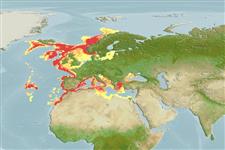
| Native range | All suitable habitat | Point map | Year 2050 |
|
| This map was computer-generated and has not yet been reviewed. |
| Chimaera monstrosa AquaMaps Data sources: GBIF OBIS |
Uploaden van uw Foto's en video's
Afbeeldingen | video's | Google afbeelding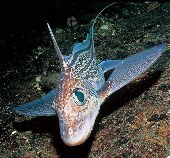 Chimaera monstrosa
Afbeelding van Svensen, E.
Afbeeldingen | video's | Google afbeelding
Afbeelding van Svensen, E.
Classificatie / Namen Lokale namen | Synoniemen | Catalog of Fishes(Genus, Soort(en)) | ITIS | CoL | WoRMS | Cloffa
Holocephali (chimeren) (chimaeras) > Chimaeriformes (Chimaeras) > Chimaeridae (Shortnose chimaeras or ratfishes)
Etymology: Chimaera: Named for the mythological creature composed of parts of multiple animals, referring to their odd mix of characteristics (See ETYFish); monstrosa: Latin for strange or grotesque, referring to its strange appearance, as if composed of parts of multiple animals (See ETYFish).
More on author: Linnaeus.
Etymology: Chimaera: Named for the mythological creature composed of parts of multiple animals, referring to their odd mix of characteristics (See ETYFish); monstrosa: Latin for strange or grotesque, referring to its strange appearance, as if composed of parts of multiple animals (See ETYFish).
More on author: Linnaeus.
Milieu: milieu / Klimaatzone / Diepte / verspreidingsgebied Ecologie
marien bathydemersaal; oceanodroom (Ref. 51243); diepte 40 - 1400 m (Ref. 104125), usually 300 - 500 m (Ref. 4443). Deep-water; 75°N - 27°N, 32°W - 35°E
Verspreiding Gebieden | FAO regio's | Ecosystemen | Voorkomen | Verspreidingskaart | Introducties | Faunafri
Northeast Atlantic (widespread), including the Mid-Atlantic Ridge and the Mediterranean Sea.
Lengte bij maturiteit / Grootte / Gewicht / Leeftijd
Maturiteit: Lm 45.9 range ? - ? cm
Max length : 150 cm TL mannelijk / geslacht onbekend; (Ref. 35388); max. gepubliceerd gewicht: 2.5 kg (Ref. 4645)
Max length : 150 cm TL mannelijk / geslacht onbekend; (Ref. 35388); max. gepubliceerd gewicht: 2.5 kg (Ref. 4645)
Korte beschrijving Determinatiesleutels | Morfologie | Morfometrie
Body shape (shape guide): elongated.
Bathydemersal to benthopelagic generally between 300 and 500 m depth. Found in the upper continental slope. Usually found in deeper waters in southern latitudes, while making a summer inshore migration up to 40-100 m in the northern areas. Sluggish, usually occurring in small groups. Feeds mainly on bottom-living invertebrates. The single dorsal spine is sharp and pointed, and although only mildly venomous can inflict a painful wound. Oviparous. Males have a clasper on the forehead that is probably used to hold on to the female during copulation. Egg capsules are about 17 cm long; young look alike adults and hatch when 10 cm long. Common by-catch when trawling for shrimps in the North Sea or Skaggerak.
Levenscyclus en paargedrag Maturiteit | Voortplanting | Paaien | Eieren | Fecunditeit | Larven
Oviparous; egg-capsules slender, club-shaped with narrow lateral membranes and a horny filament at the long pointed end, 17 cm long and 3 cm wide; deposited mainly in spring and summer. The embryos developing in about 9-12 months and hatch at 10 cm length.
Hoofdreferentie
Upload uw referenties | Referenties | Coördinator | Medewerkers
Krefft, G., 1990. Chimaeridae. p. 111-113. In J.C. Quero, J.C. Hureau, C. Karrer, A. Post and L. Saldanha (eds.) Check-list of the fishes of the eastern tropical Atlantic (CLOFETA). JNICT, Lisbon; SEI, Paris; and UNESCO, Paris. Vol. 1. (Ref. 4443)
Status op de Rode Lijst van het IUCN (Ref. 130435: Version 2025-2 (Global))
Kwetsbaar (VU) (A2bd); Date assessed: 02 September 2019
CITES
Not Evaluated
Gevaar voor de mens
Traumatogenic (Ref. 4690)
Gebruik door de mens
Visserij: van minder commercieel belang
FAO - visserij: aanvoer; Publication: search | FIRMS - Stock assessments | FishSource | Sea Around Us
Meer informatie
Trofische ecologie
Voedsel (prooien)
Dieetsamenstelling
Voedselconsumptie
Voedselrantsoenen
Predatoren
Voedsel (prooien)
Dieetsamenstelling
Voedselconsumptie
Voedselrantsoenen
Predatoren
Populatiedynamica
Groeiparameters
Max. leeftijden / maten
Lengte-gewicht rel.
Lengte-lengte rel.
Lengtefrequenties
Massaconversie
Rekrutering
Abundantie
Groeiparameters
Max. leeftijden / maten
Lengte-gewicht rel.
Lengte-lengte rel.
Lengtefrequenties
Massaconversie
Rekrutering
Abundantie
Levenscyclus
Voortplanting
Maturiteit
Rijpheid/kieuwen rel.
Fecunditeit
Paaien
Paaibestanden
Eieren
Ontwikkeling van de eieren
Larven
Larvale populatiedynamiek
Voortplanting
Maturiteit
Rijpheid/kieuwen rel.
Fecunditeit
Paaien
Paaibestanden
Eieren
Ontwikkeling van de eieren
Larven
Larvale populatiedynamiek
Fysiologie
Lichaamssamenstelling
Voedingsstoffen
Zuurstofverbruik
Type zwemmen
Zwemsnelheid
Visuele pigmenten
Vis geluid
Ziekten en parasieten
Toxiciteit (LC50)
Lichaamssamenstelling
Voedingsstoffen
Zuurstofverbruik
Type zwemmen
Zwemsnelheid
Visuele pigmenten
Vis geluid
Ziekten en parasieten
Toxiciteit (LC50)
Menselijk gerelateerd
Aquacultuursystemen
Aquacultuurprofielen
Kweeklijnen
Ciguatera gevallen
Postzegels, munten, diversen.
Aquacultuursystemen
Aquacultuurprofielen
Kweeklijnen
Ciguatera gevallen
Postzegels, munten, diversen.
Tools
Biologische quiz | E-boek | Veldgids | Lengtefrequentie Tool | Levenscyclus tool | Verspreidingskaart |
Vangst-MSY |
Speciale rapporten
Bekijk gegevens voor het houden in een aquarium | Bekijk Fact Sheets voor de soort | Bekijk Aquacultuur Fact Sheets
Download XML
Internetbronnen
AFORO (otoliths) | Aquatic Commons | BHL | Cloffa | Websites from users | Bekijk FishWatcher | CISTI | Catalog of Fishes: Genus, Soort(en) | DiscoverLife | ECOTOX | FAO - visserij: aanvoer; Publication: search | Faunafri | Fishipedia | Fishtrace | GloBI | Google Books | Google Scholar | Google | IGFA World Record | Nationale databanken | OneZoom | Open Tree of Life | Otolith Atlas of Taiwan Fishes | PubMed | Reef Life Survey | Socotra Atlas | TreeBase | Tree of Life | Wikipedia: ga naar, zoek | World Records Freshwater Fishing | Zoobank | Zoological Record
Schattingen op basis van modellen
Gewenste temperatuur (Ref. 123201): 3.7 - 14.1, mean 7.9 °C (based on 179 cells).
Fylogenetische diversiteitsindex (Ref. 82804): PD50 = 0.5000 [Uniqueness, from 0.5 = low to 2.0 = high].
Bayesian length-weight: a=0.00257 (0.00155 - 0.00426), b=3.01 (2.87 - 3.15), in cm total length, based on LWR estimates for this species & (Sub)family-body (Ref. 93245).
Trofisch niveau (Ref. 69278): 3.5 ±0.0 se; based on diet studies.
Generation time: 16.4 ( na - na) years. Estimated as median ln(3)/K based on 2 growth studies.
Weerstandsvermogen (Ref. 120179): laag, minimale populatieverdubbelingstijd 4,5-14 jaar (Assuming Fec <100;).
Voedingsstoffen (Ref. 124155): Calcium = 7.33 [2.04, 25.54] mg/100g; Iron = 0.33 [0.11, 0.85] mg/100g; Protein = 14.7 [9.9, 18.5] %; Omega3 = 0.239 [0.093, 0.622] g/100g; Selenium = 22 [6, 73] μg/100g; VitaminA = 5.79 [1.22, 27.56] μg/100g; Zinc = 0.326 [0.169, 0.636] mg/100g (wet weight);