



Aenigmachanna gollum Britz, Anoop, Dahanukar & Raghavan, 2019
Gollum snakehead
Hochladen Photos und videos
Google Bild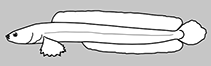 No image available for this species;
drawing shows typical species in Aenigmachannidae.
Google Bild
drawing shows typical species in Aenigmachannidae.
Klassifizierung / Names Namen | Synonyme | Catalog of Fishes(Gattung, Arten) | ITIS | CoL | WoRMS | Cloffa
> Anabantiformes (Gouramies, snakeheads) > Aenigmachannidae (Gollum snakehead fishes)
Etymology: Aenigmachanna: Name from Latin word 'aenigma', for enigma, and Channa, the genus name of Asian snakeheads; gollum: Named after the character from J. R. R. Tolkien’s books ‘The Hobbit’ and ‘The Lord of the Rings’. Gollum is a creature that went underground and during its subterranean life changed its morphological features; noun in apposition.
Eponymy: The genus and these species are named after the fictional character, Gollum, in J R R Tolkien’s The Hobbit and Lord of the Rings. [...] (Ref. 128868), visit book page.
Etymology: Aenigmachanna: Name from Latin word 'aenigma', for enigma, and Channa, the genus name of Asian snakeheads; gollum: Named after the character from J. R. R. Tolkien’s books ‘The Hobbit’ and ‘The Lord of the Rings’. Gollum is a creature that went underground and during its subterranean life changed its morphological features; noun in apposition.
Eponymy: The genus and these species are named after the fictional character, Gollum, in J R R Tolkien’s The Hobbit and Lord of the Rings. [...] (Ref. 128868), visit book page.
Umwelt: Milieu / Klimazone / Tiefenbereich / Verbreitungsgebiet Ökologie
; süßwasser benthopelagisch. Tropical
Verbreitung Territorien | FAO Gebiete | Ökosysteme | Vorkommen | Punkt Karte | Einführungen | Faunafri
Asia: India.
Größe / Gewicht / Alter
Kurzbeschreibung Bestimmungsschlüssel | Morphologie | Morphometrie
This species is distinguished from species of Channa and Parachanna by the following unique characters among channids: very slender with maximum body depth only 11.1-11.3% SL; eel-like body with head length only 20.8-21.6% SL; a large mouth with jaw length 60.4-61.1 % HL; A 43-44; absence of a body lateral line with pored scales; scales in a lateral series 83-85; colour pattern and absence of buoyancy; differs from other channids by having 64 vertebrae, D 56-57, and absence of pelvic fins (Ref. 120401).
Cross section: circular.
Cross section: circular.
The fish collected from Malappuram was in a paddy field (Ref. 120401). The fish collected from Peringara was found, at the height of summer, with the water surface in the well was at a depth of about 5 metres below the ground surface; it came to light when the water in the well, normally clear, suddenly turned muddy and the well was drained to facilitate cleaning. Peringara is situated in a large natural wetland that abuts the Kuttanad lowlands, kniwn as ‘the rice bowl’ of Kerala (Ref. 120659).
Lebenszyklus und Paarungsverhalten Geschlechtsreife | Fortpflanzung | Ablaichen | Eier | Fruchtbarkeit | Larven
Hauptreferenz
Laden Sie Ihre Referenzen hoch | Referenzen | Koordinator | Partner
Britz, R., V.K. Anoop, N. Dahanukar and R. Raghavan, 2019. The subterranean Aenigmachanna gollum, a new genus and species of snakehead (Teleostei: Channidae) from Kerala, South India. Zootaxa 4603(2):377-388. (Ref. 120401)
IUCN Rote Liste Status (Ref. 130435: Version 2025-2 (Global))
Verwundbar (VU) (B1ab(ii,iii)+2ab(ii,iii)); Date assessed: 28 February 2020
CITES
Not Evaluated
Bedrohung für Menschen
Harmless
Nutzung durch Menschen
FAO - Publication: search | FishSource |
Mehr Information
Trophische Ökologie
Lebensmittel (Beutetiere)
Nahrungszusammensetzung
Nahrungsaufnahme
Lebensmittelrationen
Räuber
Lebensmittel (Beutetiere)
Nahrungszusammensetzung
Nahrungsaufnahme
Lebensmittelrationen
Räuber
Ökologie
Ökologie
Ökologie
Populationsdynamik
Wachstumsparameter
Max. Alter/Größen
Länge-Gewicht-Rel.
Länge-Länge-Verhältnis.
Längenhäufigkeiten
Massenkonvertierung
Rekrutierung
Dichte
Wachstumsparameter
Max. Alter/Größen
Länge-Gewicht-Rel.
Länge-Länge-Verhältnis.
Längenhäufigkeiten
Massenkonvertierung
Rekrutierung
Dichte
Lebenszyklus
Fortpflanzung
Geschlechtsreife
Reifung/Kiemen rel.
Fruchtbarkeit
Ablaichen
Laichaggregationen
Eier
Eientwicklung
Larven
Larven Pop.Dyn.
Fortpflanzung
Geschlechtsreife
Reifung/Kiemen rel.
Fruchtbarkeit
Ablaichen
Laichaggregationen
Eier
Eientwicklung
Larven
Larven Pop.Dyn.
Anatomie
Kiemenoberfläche
Gehirn
Otolith
Kiemenoberfläche
Gehirn
Otolith
Physiologie
Körperliche Zusammensetzung
Nährstoffe
Sauerstoffverbrauch
Schwimmart
Schwimmgeschwindigkeit
Visuelle Pigmente
Fischgeräusche
Krankheiten und Parasiten
Toxizität (LC50s)
Körperliche Zusammensetzung
Nährstoffe
Sauerstoffverbrauch
Schwimmart
Schwimmgeschwindigkeit
Visuelle Pigmente
Fischgeräusche
Krankheiten und Parasiten
Toxizität (LC50s)
Genetik
Genom
Genetik
Heterozygotie
Vererbbarkeit
Genetische Vielfalt
Genom
Genetik
Heterozygotie
Vererbbarkeit
Genetische Vielfalt
Menschenbezogen
Aquakultur-Systeme
Aquakultur Profile
Zuchtlinien
Ciguatera-Fälle
Briefmarken, Münzen, Verschiedenes.
Aquakultur-Systeme
Aquakultur Profile
Zuchtlinien
Ciguatera-Fälle
Briefmarken, Münzen, Verschiedenes.
Tools
Zusatzinformationen
Download XML
Zusammenfassung | Punktdaten | Namen | Photos
Internet Quellen
AFORO (otoliths) | Aquatic Commons | BHL | Cloffa | Websites from users | FishWatcher Einträge suchen | CISTI | Catalog of Fishes: Gattung, Arten | DiscoverLife | ECOTOX | FAO - Publication: search | Faunafri | Fishipedia | Fishtrace | GloBI | Google Books | Google Scholar | Google | IGFA World Record | OneZoom | Open Tree of Life | Otolith Atlas of Taiwan Fishes | PubMed | Reef Life Survey | Socotra Atlas | TreeBase | Tree of Life | Wikipedia: Gehe zu, Suchen | World Records Freshwater Fishing | Zoobank | Zoologischer Rekord
Schätzungen auf der Grundlage von Modellen
Phylogenetischer Diversitätsindex (Ref. 82804): PD50 = 1.5000 [Uniqueness, from 0.5 = low to 2.0 = high].
Bayesian length-weight: a=0.00389 (0.00180 - 0.00842), b=3.12 (2.94 - 3.30), in cm total length, based on all LWR estimates for this body shape (Ref. 93245).
Trophische Ebene (Ref. 69278): 3.4 ±0.5 se; based on size and trophs of closest relatives