This website uses cookies to enhance your browsing experience and ensure the functionality of our site. For more detailed information about the types of cookies we use and how we protect your privacy, please visit our Privacy Information page.
×
Cookie Settings
This website uses different types of cookies to enhance your experience. Please select your preferences below:
> Cyprinodontiformes (Rivulines, killifishes and live bearers) > Aphaniidae (Oriental killifishes)
Etymology: Esmaeilius:Named for Hamid Reza Esmaeili (Shiraz) for his extensive contribution to the understanding of diversity within this genus; shirini:Named for the stream and village of Khosroshirin, the type locality. Eponymy: Dr Hamid Reza Esmaeili is an Iranian biologist and ichthyologist at Shiraz University, Shiraz where he is full Professor of Ichthyology. [...] (Ref. 128868), visit book page.
Meio ambiente: milieu / Zona climática / intervalo de profundidade / faixa de distribuição Ecologia
Asia: Khosroshirin Stream in the uppermost reaches of the Kor River Basin and its connected springs including Paselari and Pahn springs in Iran.
Tamanho / Peso / Idade
Maturidade: Lm? range ? - ? cm Max length : 3.0 cm SL macho/indeterminado; (Ref. 94548); 3.6 cm SL (female)
Descrição suscinta Chaves de identificação | Morfologia | Morfometria
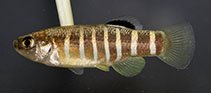
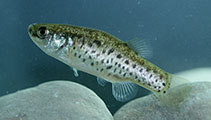
Raios dorsais (total) : 10 - 12; Raios anais : 10 - 11. This species can be easily diagnosed at the genetic level from all its congeners in Iran by having 17 fixed molecular apomorphies (14 transitions and three transversions) in cytochrome b gene. In addition, it differs from Aphanius sophiae by having 61 fixed molecular apomorphies (46 transitions and 15 transversions). Males are distinguished from all other Iranian species by having only 7-10 wide clearly defined white flank bars, which is the lowest number of white flank bars among the Iranian inland Aphanius species, and bright to yellowish anal fin without clear white margin. Both males and females differ from other Aphanius species in Iran by having a significantly longer caudal peduncle and a smaller dorsal fin depth (measurements relative to the standard length) . The otoliths are diagnostic because they display a distinctive combination of characters such as a straight ventral rim, an angular to rectangular posteroventral edge and a wide but short and truncated rostrum. In addition, dorsal part of this species is longer than in the other examined species (Ref. 94548). Body shape (shape guide): fusiform / normal.
Inhabits Khosroshirin Stream in the uppermost reaches of the Kor River Basin and its connected springs including Paselari and Pahn springs. Paselari spring is composed of muddy substrate with small gravels, and water surface covered by dense filamentous green algae. The surrounding area is vegetated with reed (Phragmatis sp.), rush (Juncus sp.), shrubs and trees. Water current is high in Khosroshirin stream while low in Paselari and Pahn springs. The following mean values of physico-chemical paramaters of three stations from Paselari spring were recorded: nitrates 1.95 mg l-1, nitrites 0.42 mg l-1, phosphates 0.59 mg l-1, ammonia 0.12 mg l-1, dissolved oxygem (DO) 8.92 mg-1, DO% 122.6, total dissolved solids 191.7 mg-1, conductivity 395 μs cm-1, salinity 0.18 0/00, pH 7.9 and water temperature 17.05°C . Collected together with Acanthobrama persidis, Alburnus mossulensis, Capoeta aculeata, Capoeta saadi (Cyprinidae) and Onchorhynchus mykiss (Salmonidae) from Khosroshirin Stream. Threatened mainly by the carnivorous exotic O. mykiss (Ref. 94548).
Ciclo de vida ou comportamento de acasalamento Maturidade | Reprodução | Desova | Ovos | Fecundidade | Larvas
Gholami, Z., H.R. Esmaeili, D. Erpenbeck and B. Reichenbacher, 2013. Phylogenetic analysis of Aphanius from the endorheic Kor River Basin in the Zagros Mountains, South-western Iran (Teleostei: Cyprinodontiformes: Cyprinodontidae). J. Zool. Sys. Evol. Res. 52(2):130-141. (Ref. 94548)
Status na Lista Vermelha da UICN (Ref. 130435: Version 2025-2 (Global))
Ecologia Trófica Itens alimentares (presas) Composição da dieta Consumo alimentar Rações alimentares Predadores
Ecologia Ecologia
Dinâmica populacional Parâmetros de crescimento Idade máxima / tamanhos Relação comprimento-peso. Relação comprimento-comprimento. Frequências de comprimento Conversão de massa Recrutamento Abundância
Ciclo de vida Reprodução Maturidade Maturidade/Rel. das guelras Fecundidade Desova Agregações de desova Ovos Desenvolvimento dos ovos Larvas Dinâmica larval
Fisiologia Composição corporal Nutrientes Consumo de oxigênio Tipo de natação Velocidade de natação Pigmentos visuais Som de peixe Doenças e Parasitas Toxicidade (LC50s)
Índice de diversidade filogenética (Ref. 82804): PD50 = 0.5156 [Uniqueness, from 0.5 = low to 2.0 = high].
Bayesian length-weight: a=0.00977 (0.00589 - 0.01620), b=3.28 (3.14 - 3.42), in cm total length, based on LWR estimates for this species & Genus-body shape (Ref. 93245).
Nível Trófico (Ref. 69278): 3.0 ±0.4 se; based on size and trophs of closest relatives
Resiliência (Ref. 120179): Elevada, tempo mínimo de duplicação da população menor que 15 meses (Preliminary K or Fecundity.).
Vulnerabilidade da pesca (Ref. 59153): Low vulnerability (10 of 100). 🛈