



Hypsolebias guanambi Costa & Amorim, 2011
Upload your photos and videos
Google image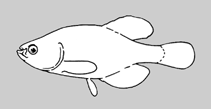 No image available for this species;
drawing shows typical species in Rivulidae.
Google image
drawing shows typical species in Rivulidae.
Classification / Names Common names | Synonyms | Catalog of Fishes(genus, species) | ITIS | CoL | WoRMS | Cloffa
Teleostei (teleosts) > Cyprinodontiformes (Rivulines, killifishes and live bearers) > Rivulidae (Rivulines) > Cynolebiinae
Etymology: guanambi: Named after the city of Guanambi, around which vast plain areas flooded by the Caunaúba de Dentro River drainage are inhabited by five endemic annual fish species, including Hypsolebias guanambi, thus constituting an important area of endemism for the Rivulidae. The specific name is derived from the Tupi-Guarani, meaning hummingbird.
More on authors: Costa & Amorim.
Etymology: guanambi: Named after the city of Guanambi, around which vast plain areas flooded by the Caunaúba de Dentro River drainage are inhabited by five endemic annual fish species, including Hypsolebias guanambi, thus constituting an important area of endemism for the Rivulidae. The specific name is derived from the Tupi-Guarani, meaning hummingbird.
More on authors: Costa & Amorim.
Environment: milieu / climate zone / depth range / distribution range Ecology
Freshwater; benthopelagic. Tropical
Distribution Territories | FAO areas | Ecosystems | Occurrences | Point map | Introductions | Faunafri
South America: known only from seasonal pools associated to São Francisco River in Bahia, Brazil.
Size / Weight / Age
Short description Identification keys | Morphology | Morphometrics
Distinguished from all members of the Hypsolebias flavicaudatus species complex, except H. nitens, by having the dorsal and anal fins with short filamentous rays, the tip of the filaments reaching between the basal and middle portion of the caudal fin (vs. reaching the posterior portion of the caudal fin or surpassing its posterior edge). Can be diagnosed from all species of the complex, except H. flavicaudatus and H. gilbertobrasili, by the presence of bluish white dots on the antero-basal portion of the dorsal fin in males; from H. nitens in possessing body depth 35.8-39.5% SL. Differs from H. nitens and H. flavicaudatus by having the largest spot on the middle part of the flank in females larger than pupil (vs. smaller), caudal peduncle more slender (caudal peduncle depth 13.1-14.7% SL vs. 15.5-17.3% SL); from H. flagellatus, H. gilbertobrasili, H. janaubensis and H. radiseriatus by having the second proximal radial of the dorsal fin inmales between the neural spines of vertebrae 8 and 9 (vs. between the neural spines of vertebrae 6 and 8); from H. gilbertobrasili and H. flavicaudatus in having more dark grey bars on the flank in males (11-14 vs. 8-10). Possesses only 4-6 teeth on the second pharyngobranchial bone, contrasting to 7-11 in all other species of the complex (Ref. 89836).
Body shape (shape guide): short and / or deep.
Body shape (shape guide): short and / or deep.
Inhabits seasonal pools. Sympatric with Hypsolebias carlettoi. Presently confined to a small, disturbed area with extent of occurrence of about 0.05 km2 and area of occupancy about 0.003 square km (Ref. 89836).
Life cycle and mating behavior Maturity | Reproduction | Spawning | Eggs | Fecundity | Larvae
Main reference
Upload your references | References | Coordinator : Costa, Wilson J.E.M. | Collaborators
Costa, W.J.E.M. and P.F. Amorim, 2011. A new annual killifish species of the Hypsolebias flavicaudatus complex from the São Francisco River basin, Brazilian Caatinga (Cyprinodontiformes: Rivulidae). Vertebr. Zool. 61(1):99-104. (Ref. 87364)
IUCN Red List Status (Ref. 130435: Version 2025-2 (Global))
Vulnerable (VU) (D2); Date assessed: 07 November 2018
CITES
Not Evaluated
Threat to humans
Harmless
Human uses
FAO - Publication: search | FishSource |
More information
Trophic ecology
Food items (preys)
Diet composition
Food consumption
Food rations
Predators
Food items (preys)
Diet composition
Food consumption
Food rations
Predators
Ecology
Ecology
Ecology
Population dynamics
Growth parameters
Max. ages / sizes
Length-weight rel.
Length-length rel.
Length-frequencies
Mass conversion
Recruitment
Abundance
Growth parameters
Max. ages / sizes
Length-weight rel.
Length-length rel.
Length-frequencies
Mass conversion
Recruitment
Abundance
Life cycle
Reproduction
Maturity
Maturity/Gills rel.
Fecundity
Spawning
Spawning aggregations
Eggs
Egg development
Larvae
Larval dynamics
Reproduction
Maturity
Maturity/Gills rel.
Fecundity
Spawning
Spawning aggregations
Eggs
Egg development
Larvae
Larval dynamics
Anatomy
Gill area
Brain
Otolith
Gill area
Brain
Otolith
Physiology
Body composition
Nutrients
Oxygen consumption
Swimming type
Swimming speed
Visual pigments
Fish sound
Diseases & Parasites
Toxicity (LC50s)
Body composition
Nutrients
Oxygen consumption
Swimming type
Swimming speed
Visual pigments
Fish sound
Diseases & Parasites
Toxicity (LC50s)
Genetics
Genome
Genetics
Heterozygosity
Heritability
Genetic Diversity
Genome
Genetics
Heterozygosity
Heritability
Genetic Diversity
Human related
Aquaculture systems
Aquaculture profiles
Strains
Ciguatera cases
Stamps, coins, misc.
Aquaculture systems
Aquaculture profiles
Strains
Ciguatera cases
Stamps, coins, misc.
Tools
Special reports
Download XML
Internet sources
AFORO (otoliths) | Aquatic Commons | BHL | Cloffa | Websites from users | Check FishWatcher | CISTI | Catalog of Fishes: genus, species | DiscoverLife | ECOTOX | FAO - Publication: search | Faunafri | Fishipedia | Fishtrace | GloBI | Google Books | Google Scholar | Google | IGFA World Record | OneZoom | Open Tree of Life | Otolith Atlas of Taiwan Fishes | PubMed | Reef Life Survey | Socotra Atlas | TreeBase | Tree of Life | Wikipedia: Go, Search | World Records Freshwater Fishing | Zoobank | Zoological Record
Estimates based on models
Phylogenetic diversity index (Ref. 82804): PD50 = 0.5000 [Uniqueness, from 0.5 = low to 2.0 = high].
Bayesian length-weight: a=0.01995 (0.00906 - 0.04395), b=3.01 (2.83 - 3.19), in cm total length, based on all LWR estimates for this body shape (Ref. 93245).
Trophic level (Ref. 69278): 3.2 ±0.4 se; based on size and trophs of closest relatives