



Adicionar as suas observações no Fish Watcher
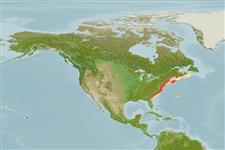
| Native range | All suitable habitat | Point map | Year 2050 |
|
| This map was computer-generated and has not yet been reviewed. |
| Tautoga onitis AquaMaps Data sources: GBIF OBIS |
Adicionar o seu Fotografias e vídeos
Fotografias | Imagem do Google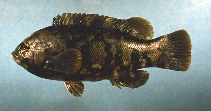 Tautoga onitis
Fotografia de Flescher, D.
Fotografias | Imagem do Google
Fotografia de Flescher, D.
Classificação / Nomes Nomes comuns | Sinónimos | Catalog of Fishes(Género, Espécies) | ITIS | CoL | WoRMS | Cloffa
> Eupercaria/misc (Various families in series Eupercaria) > Labridae (Wrasses) > Labrinae
Etymology: Tautoga: Plural of the word "taut", an Indian Brazil name translated by Roger William from f the Narragansett, "tautauog" = sheepshead.
More on author: Linnaeus.
Etymology: Tautoga: Plural of the word "taut", an Indian Brazil name translated by Roger William from f the Narragansett, "tautauog" = sheepshead.
More on author: Linnaeus.
Ambiente: milieu / zona climática / intervalo de profundidade / gama de distribuição Ecologia
marinhas; estuarina associadas(os) a recifes; intervalo de profundidade 1 - 75 m. Subtropical; 46°N - 31°N, 81°W - 58°W
Distribuição Territórios | Áreas FAO | Ecossistemas | Ocorrências | Mapa dos pontos | Introduções | Faunafri
Western Atlantic: slightly east of Halifax in Nova Scotia, Canada to South Carolina in USA; most abundant between Cape Cod and Delaware Bay.
Comprimento na primeira maturidade / Tamanho / Peso / Idade
Maturidade: Lm 23.6, range 18 - 26.5 cm
Max length : 91.0 cm TL macho/indeterminado; (Ref. 7251); peso máx. Publicado: 11.3 kg (Ref. 40637); Idade máx. registada: 34 anos (Ref. 6486)
Max length : 91.0 cm TL macho/indeterminado; (Ref. 7251); peso máx. Publicado: 11.3 kg (Ref. 40637); Idade máx. registada: 34 anos (Ref. 6486)
Descrição breve Chaves de identificação | Morfologia | Morfometria
Espinhos dorsais (total) : 16 - 17; Raios dorsais moles (total) : 10; Espinhos anais: 3; Raios anais moles: 7 - 8. Distinguished from Tautogolabrus adspersus which occurs in the same area and further north, by its steep, rounded dorsal head profile; stouter body; scaled lower gill cover; and the more backward location of the pelvic fins.
Body shape (shape guide): fusiform / normal; Cross section: compressed.
Body shape (shape guide): fusiform / normal; Cross section: compressed.
Found close to shore on hard-bottom habitats, occasionally entering brackish water. Adult male territorial and active during the day to feed and rests in crevices at night. Prefers temperatures above 10°C. Spawning was noted in June-July in Canadian waters, but appears more protracted (April-July) in coastal waters of Virginia, USA. Feeds mainly on mussels, gastropods, other mollusks and crustaceans. This species has gained popularity as a prized food and sport fish (Ref. 6486, 4926, 41297). Investigation on the diel and seasonal activity patterns of the adult tautog in its southern range were conducted using ultrasonic telemetry (Ref. 41297).
Ciclo de vida e comportamento de acasalamento Maturidade | Reprodução | Desova | Ovos | Fecundidade | Larvas
Spawns in groups or in pairs. Pairing occurs between females and size-dominant males exhibiting strong territoriality and performing a protracted courtship (Ref. 6488). Gonochorism is confirmed for this species (Ref. 103751).
Referência principal
Carregar as suas referências | Referências | Coordenador : Westneat, Mark | Colaboradores
Leim, A.H. and W.B. Scott, 1966. Fishes of the Atlantic coast of Canada. Bull. Fish. Res. Board Can. (155):485 p. (Ref. 4926)
Categoria na Lista Vermelha da IUCN (Ref. 130435: Version 2025-2 (Global))
Vulnerável (VU) (A2bd); Date assessed: 12 July 2008
CITES
Not Evaluated
Ameaça para o homem
Harmless
Utilização humana
Pescarias: pouco comercial; peixe desportivo: sim; Aquário: Aquários públicos
FAO - pescarias: desembarques; Publication: search | FishSource | Sea Around Us
Mais informação
Ecologia Trófica
Produtos alimentares (presas)
Composição da dieta
Consumo alimentar
Rações alimentares
Predadores
Produtos alimentares (presas)
Composição da dieta
Consumo alimentar
Rações alimentares
Predadores
Dinâmica das populações
Parâmetros de crescimento
Idades / tamanhos máximos
Comprimento-peso rel.
Comprimento-comprimento rel.
Frequência de comprimento
Conversão de massa
Recrutamento
Abundância
Parâmetros de crescimento
Idades / tamanhos máximos
Comprimento-peso rel.
Comprimento-comprimento rel.
Frequência de comprimento
Conversão de massa
Recrutamento
Abundância
Ciclo de vida
Reprodução
Maturidade
Maturidade/Rel. das guelras
Fecundidade
Desova
Agregações de desova
Ovos
Desenvolvimento dos ovos
Larvas
Dinâmica larvar
Reprodução
Maturidade
Maturidade/Rel. das guelras
Fecundidade
Desova
Agregações de desova
Ovos
Desenvolvimento dos ovos
Larvas
Dinâmica larvar
Fisiologia
Composição corporal
Nutrientes
Consumo de oxigénio
Tipo de natação
Velocidade de natação
Pigmentos visuais
Som de peixe
Doenças e Parasitas
Toxicidade (LC50s)
Composição corporal
Nutrientes
Consumo de oxigénio
Tipo de natação
Velocidade de natação
Pigmentos visuais
Som de peixe
Doenças e Parasitas
Toxicidade (LC50s)
Relacionado com o ser humano
Sistemas de aquacultura
Perfis para aquacultura
Estirpes
Casos de Ciguatera
Selos, moedas, diversos.
Sistemas de aquacultura
Perfis para aquacultura
Estirpes
Casos de Ciguatera
Selos, moedas, diversos.
Ferramentas
E-book | Guia de campo | Ferramenta auxiliar de frequências de comprimento | Ferramenta sobre a história de vida | Mapa dos pontos |
Captura-MSY |
Relatórios especiais
Descarregue XML
Fontes da internet
AFORO (otoliths) | Alien/Invasive Species database | Aquatic Commons | BHL | Cloffa | Websites from users | Consultar FishWatcher | CISTI | Catalog of Fishes: Género, Espécies | DiscoverLife | ECOTOX | FAO - pescarias: desembarques; Publication: search | Faunafri | Fishipedia | Fishtrace | GloBI | Google Books | Google Scholar | Google | IGFA World Record | OneZoom | Open Tree of Life | Otolith Atlas of Taiwan Fishes | Aquários públicos | PubMed | Reef Life Survey | Socotra Atlas | TreeBase | Árvore da vida | Wikipedia: ir para, procurar | World Records Freshwater Fishing | Registo zoológico
Estimativas baseadas em modelos
Temperatura preferida (Ref. 123201): 5.3 - 22.8, mean 10.9 °C (based on 96 cells).
Índice de diversidade filogenética (Ref. 82804): PD50 = 1.0000 [Uniqueness, from 0.5 = low to 2.0 = high].
Bayesian length-weight: a=0.01259 (0.00824 - 0.01922), b=3.05 (2.92 - 3.18), in cm total length, based on LWR estimates for this species & (Sub)family-body (Ref. 93245).
Nível Trófico (Ref. 69278): 3.3 ±0.47 se; based on food items.
Resiliência (Ref. 120179): Baixo, tempo mínimo de duplicação da população 4,5 - 14 anos (K=0.09; tm=2-3; tmax=34).
Nutrientes (Ref. 124155): Calcium = 16.1 [7.1, 31.7] mg/100g; Iron = 0.447 [0.241, 0.886] mg/100g; Protein = 19.5 [16.6, 21.7] %; Omega3 = 0.193 [0.107, 0.343] g/100g; Selenium = 18.8 [9.2, 37.9] μg/100g; VitaminA = 39.3 [11.0, 166.7] μg/100g; Zinc = 0.912 [0.612, 1.593] mg/100g (wet weight);