



Sargocentron lepros (Allen & Cross, 1983)
Spiny squirrelfish
個人による観察記録の追加 Fish Watcher
| Native range | All suitable habitat | Point map | Year 2050 |

|
| This map was computer-generated and has not yet been reviewed. |
| Sargocentron lepros AquaMaps Data sources: GBIF OBIS |
アップロード 写真 そして ビデオ
画像 | グーグルの画像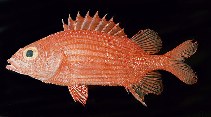 Sargocentron lepros
画像によって Randall, J.E.
画像 | グーグルの画像
画像によって Randall, J.E.
分類 / 名前 共通名の | 類義語 | Catalog of Fishes(部類, 種) | ITIS | CoL | WoRMS | Cloffa
> Holocentriformes (Squirrelfishes, soldierfishes) > Holocentridae (Squirrelfishes, soldierfishes) > Holocentrinae
Etymology: Sargocentron: Greek, sargos = sargus + Greek, kentron = sting (Ref. 45335).
Etymology: Sargocentron: Greek, sargos = sargus + Greek, kentron = sting (Ref. 45335).
環境:環境 / 気候帯 / 深さの範囲 / 分布範囲 生態学
海 関連する礁; 深さの範囲 10 - 45 m (Ref. 30874). Tropical
分布 領土 | 国連食糧農業機関の区域 | エコシステム | 事件 | 目的のマップ | 導入 | Faunafri
Indo-Pacific: Christmas Island in the eastern Indian Ocean to Australia eastward to Fiji and Samoa. Recently recorded from the Chesterfield Islands (Ref. 11897).
サイズ / 重さ / 年齢
簡単な記述 検索表 | 形態学 | 形態計測学
背面の脊椎 (合計) : 11; 背鰭 (合計) : 12 - 14; 肛門の骨: 4; 臀鰭: 8 - 9. Body light red to orange-red with narrow darker red stripes separating scale rows; white streak on head absent (except beneath maxilla); 4-5 oblique scale rows on cheek; body depth 2.65-2.95 in SL; head length (HL) 2.55-2.8 in SL; snout length 3.8-4.15 in HL; interorbital width 5.25-6.35 in HL; dorsal head profile slightly convex; maxilla extending to between verticals at front edge of iris and center of eye; upper jaw length 2.35-2.6 in HL; rounded anterior end of nasal bone; medial margin of nasal bone without retrorse spine; moderately large nasal fossa without spines; upper surface of nasal bone between nasal fossa and premaxillary groove edge with a retrorse spine; 2 opercular spines, with the lower 1/2-3/4 length of the upper; preopercular spine 4.8-6.35 HL; spinules on posterior margin of preopercle 17 (3.3 cm SL specimen), 19 (4.9 cm), 26 (5.3 cm), 30-36 (6.4-8.1 cm); 4th to 6th dorsal spines subequal, the longest, 2.3-2.65 in HL; 3rd anal spine 1.5-1.95 in HL; broadly rounded caudal-fin lobes (Ref. 27370).
Body shape (shape guide): fusiform / normal; Cross section: compressed.
Body shape (shape guide): fusiform / normal; Cross section: compressed.
Nocturnal. Minimum depth reported taken from Ref. 11897. Solitary and cryptic, found in outer reef slopes of oceanic islands, mainly in the South Pacific (Ref 90102).
ライフサイクルと交尾行動 成熟 | 繁殖 | 放精 | 卵 | 生産力 | 幼生
主な参考文献
参考文献のアップロード | 参考文献 | コーディネーター : Randall, John E. | 協力者
Randall, J.E., 1998. Revision of the Indo-Pacific squirrelfishes (Beryciformes: Holocentridae: Holocentrinae) of the genus Sargocentron, with descriptions of four new species. Indo-Pac. Fish. (27):105 p. (Ref. 27370)
CITES
Not Evaluated
人間に対する脅威
Harmless
人間の用途
水産業: 興味がない
FAO - Publication: search | FishSource | 私達の周りの海
より多くの情報
ライフサイクル
繁殖
成熟
成熟度/エラ
生産力
放精
産卵群
卵
卵の開発
幼生
幼生の動力
繁殖
成熟
成熟度/エラ
生産力
放精
産卵群
卵
卵の開発
幼生
幼生の動力
解剖学
カマ
脳
オトリス
カマ
脳
オトリス
生理学
体組成
栄養素
酸素消費
水泳タイプ
泳ぐ速さ
視覚色素
フィッシュ・サウンド
病気と寄生虫
毒性(LC50)
体組成
栄養素
酸素消費
水泳タイプ
泳ぐ速さ
視覚色素
フィッシュ・サウンド
病気と寄生虫
毒性(LC50)
遺伝子の
ゲノム
遺伝子の
ヘテロ接合性
遺伝
遺伝的多様性
ゲノム
遺伝子の
ヘテロ接合性
遺伝
遺伝的多様性
用具
特記事項
XMLをダウンロードして下さい
インターネットの情報源
AFORO (otoliths) | Aquatic Commons | BHL | Cloffa | Websites from users | Check FishWatcher | CISTI | Catalog of Fishes: 部類, 種 | DiscoverLife | ECOTOX | FAO - Publication: search | Faunafri | Fishipedia | Fishtrace | GloBI | Google Books | Google Scholar | Google | IGFA World Record | OneZoom | Open Tree of Life | Otolith Atlas of Taiwan Fishes | PubMed | Reef Life Survey | Socotra Atlas | TreeBase | 生命の木 | Wikipedia: 行く, 検索する | World Records Freshwater Fishing | 動物に関する記録
モデルに基づく推定値
好ましい温度 (参照 123201): 23.1 - 28.7, mean 27.2 °C (based on 154 cells).
系統多様性指数 (参照 82804): PD50 = 0.5000 [Uniqueness, from 0.5 = low to 2.0 = high].
Bayesian length-weight: a=0.01698 (0.00810 - 0.03560), b=2.96 (2.79 - 3.13), in cm total length, based on LWR estimates for this Genus-body shape (Ref. 93245).
栄養段階 (参照 69278): 4.1 ±0.68 se; based on food items.
回復力 (参照 120179): 高い, 15か月以下の倍増期間の最小個体群 (Preliminary K or Fecundity.).
栄養素 (Ref. 124155): Calcium = 64.6 [24.5, 255.3] mg/100g; Iron = 0.545 [0.212, 1.665] mg/100g; Protein = 18.8 [17.6, 20.0] %; Omega3 = 0.163 [0.070, 0.380] g/100g; Selenium = 31.5 [17.3, 65.0] μg/100g; VitaminA = 82.6 [29.8, 245.6] μg/100g; Zinc = 1.75 [0.72, 3.35] mg/100g (wet weight);