



Envoyez vos Photos et vidéos
Images | vidéos | Timbres, pièces de monnaie, divers | Images Google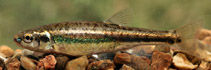 Phoxinus phoxinus
Photo de Sediva, A.
Images | vidéos | Timbres, pièces de monnaie, divers | Images Google
Photo de Sediva, A.
Classification / Noms Noms communs | Synonymes | Catalog of Fishes(Genre, Espèce) | ITIS | CoL | WoRMS | Cloffa
> Cypriniformes (Carps) > Leuciscidae (Minnows) > Phoxininae
Etymology: Phoxinus: Greek, phoxinos = certain river fish (Ref. 45335).
More on author: Linnaeus.
Etymology: Phoxinus: Greek, phoxinos = certain river fish (Ref. 45335).
More on author: Linnaeus.
Environnement : milieu / zone climatique / profondeur / gamme de distribution Écologie
; eau douce; saumâtre démersal; pH range: 7.0 - 7.5; dH range: 10 - 20; potamodrome (Ref. 51243). Temperate; 2°C - 20°C (Ref. 1672); 73°N - 37°N, 10°W - 179°E
Distribution Territoires | Zones FAO | Écosystèmes | Occurrences | Carte par point | Introductions | Faunafri
Eurasia: basins of Atlantic, North and Baltic Seas, Arctic and northern Pacific Ocean, from Garonne (France) eastward to Anadyr and Amur drainages and Korea; Ireland (possibly introduced), Great Britain northward to 58°N. Scandinavia and Russia northernmost extremity, Rhône drainage. Recorded from upper and middle Volga and Ural drainages, Lake Balkhash (Kazakhstan) and upper Syr-Darya drainage (Aral basin), but else identifications need verification. At least one country reports adverse ecological impact after introduction. Several species are confused under Phoxinus phoxinus.
Longueur à la première maturité / Taille / Poids / Âge
Maturité: Lm 5.2, range 5 - 5.8 cm
Max length : 14.0 cm TL mâle / non sexé; (Ref. 556); common length : 7.0 cm TL mâle / non sexé; (Ref. 556); âge max. reporté: 11 années (Ref. 59043)
Max length : 14.0 cm TL mâle / non sexé; (Ref. 556); common length : 7.0 cm TL mâle / non sexé; (Ref. 556); âge max. reporté: 11 années (Ref. 59043)
Description synthétique Clés d'identification | Morphologie | Morphométrie
Épines dorsales (Total) : 3; Rayons mous dorsaux (Total) : 6 - 8; Épines anales: 3; Rayons mous anaux: 6 - 8; Vertèbres: 38 - 40. Diagnosed from its congeners in Europe by having lateral line usually reaching beyond anal fin base, a midlateral row of vertically elongated blotches whose depth is about 1/3-1/2 of body depth at same position, often fused in a midlateral stripe (in preserved individuals), caudal peduncle depth 2.6-3.1 times in its length, patches of breast scales separated by unscaled area or (rarely) connected anteriorly by 1-2 rows of scales, snout length 29-34% HL ( 1.1-1.4 times eye diameter), and anal fin origin in front of base of last dorsal ray (Ref. 59043). Caudal fin with 19 rays (Ref. 2196).
Body shape (shape guide): elongated.
Body shape (shape guide): elongated.
Gregarious (Ref. 2196). Found in a wide range of cold and well oxygenated habitats from small, fast-flowing streams to large Nordic lowland rivers and from small upland lakes to large oligotrophic lakes. Usually occurs in association with salmonid fishes (Ref. 59043). Feeds on algae, plant debris (in rivers), mollusks, crustaceans and insects (Ref. 30578). Spawns over clean gravel areas in flowing water or on wave-washed shores of lakes. Overwinters in coarse substrate or in deep pools with low current (Ref. 59043). Migrates upstream for spawning in shallow gravel areas. Important laboratory fish, for research on sensory organs of fishes. Mean maximum age is 6 years (Ref. 41616). Locally threatened due to pollution and excessive stocking of species of Salmo (Ref. 59043).
Cycle de vie et comportement reproducteur Maturité | Reproduction | Frai | Œufs | Fécondité | Larves
Males and females form school separately and arrive on the spawning site at differen times. Spawn over clean gravel areas in flowing water or on wave-washed shores of lakes. Deposit eggs in shallow water on sand or gravel bottom which hatch in 4-5 days at 18°C. Females lay sticky eggs deep into clean gravel (Ref. 59043).
Référence principale
Téléchargez vos références | Références | Coordinateur | Collaborateurs
Kottelat, M. and J. Freyhof, 2007. Handbook of European freshwater fishes. Publications Kottelat, Cornol and Freyhof, Berlin. 646 pp. (Ref. 59043)
Statut dans la liste rouge de l'IUCN (Ref. 130435: Version 2025-2 (Global))
Préoccupation mineure (LC) ; Date assessed: 12 January 2024
CITES
Not Evaluated
Menace pour l'homme
Potential pest (Ref. 13686)
Utilisations par l'homme
Pêcheries: intérêt commercial mineur; Aquarium: Commercial; appât: usually
FAO - Publication: search | FishSource |
Plus d'informations
Écologie trophique
Aliments (proies)
Composition du régime alimentaire
Consommation alimentaire
Rations alimentaires
Prédateurs
Aliments (proies)
Composition du régime alimentaire
Consommation alimentaire
Rations alimentaires
Prédateurs
Dynamique des populations
Paramètres de croissance
Âges / tailles maximales
Longueur-poids rel.
Rel. longueur-longueur.
Fréquences de longueurs
Conversion de masse
Recrutement
Abondance
Paramètres de croissance
Âges / tailles maximales
Longueur-poids rel.
Rel. longueur-longueur.
Fréquences de longueurs
Conversion de masse
Recrutement
Abondance
Cycle de vie
Reproduction
Maturité
Maturité/épines rel.
Fécondité
Frai
Agrégats de frai
Œufs
Développement de l'œuf
Larves
Dynamique des populations larvaires
Reproduction
Maturité
Maturité/épines rel.
Fécondité
Frai
Agrégats de frai
Œufs
Développement de l'œuf
Larves
Dynamique des populations larvaires
Anatomie
Surface branchiale
Cerveau
Otolithe
Surface branchiale
Cerveau
Otolithe
Physiologie
Composition corporelle
Nutriments
Consommation d'oxygène
Type de natation
Vitesse de nage
Pigments visuels
Son de poisson
Maladies et parasites
Toxicité (CL50)
Composition corporelle
Nutriments
Consommation d'oxygène
Type de natation
Vitesse de nage
Pigments visuels
Son de poisson
Maladies et parasites
Toxicité (CL50)
Liées à l'homme
Systèmes d'aquaculture
Profils d'aquaculture
Souches
Cas de ciguatera
Timbres, pièces de monnaie, divers
Systèmes d'aquaculture
Profils d'aquaculture
Souches
Cas de ciguatera
Timbres, pièces de monnaie, divers
Outils
Quiz bio | E-book | Guide de terrain | Clés d'identification | Générateur de fréquences de longueur | Outil de dynamique de population | Carte par point |
Capture-MSY |
Articles particuliers
Télécharger en XML
Sources Internet
AFORO (otoliths) | Alien/Invasive Species database | Aquatic Commons | BHL | Cloffa | Websites from users | FishWatcher | CISTI | Catalog of Fishes: Genre, Espèce | DiscoverLife | DORIS | ECOTOX | FAO - Publication: search | Faunafri | Fishipedia | Fishtrace | GloBI | Google Books | Google Scholar | Google | IGFA World Record | Bases de données nationales | OneZoom | Open Tree of Life | Otolith Atlas of Taiwan Fishes | Aquariums publics | PubMed | Reef Life Survey | Socotra Atlas | TreeBase | Arbre de Vie | Wikipedia: aller à, chercher | World Records Freshwater Fishing | Zoological Record
Estimations basées sur des modèles
Indice de diversité phylogénétique (Réf. 82804): PD50 = 0.5000 [Uniqueness, from 0.5 = low to 2.0 = high].
Bayesian length-weight: a=0.00708 (0.00531 - 0.00944), b=3.14 (3.06 - 3.22), in cm total length, based on LWR estimates for this species (Ref. 93245).
Niveau trophique (Réf. 69278): 3.2 ±0.4 se; based on diet studies.
Generation time: 4.0 ( na - na) years. Estimated as median ln(3)/K based on 2 growth studies.
Résilience (Réf. 120179): Milieu, temps minimum de doublement de population : 1,4 à 4,4 années (tm=1-6; tmax=13; fec=200).