



Adicionar o seu Fotografias e vídeos
Imagem do Google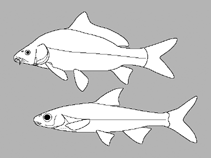 No image available for this species;
drawing shows typical species in Cyprinidae.
Imagem do Google
drawing shows typical species in Cyprinidae.
Classificação / Nomes Nomes comuns | Sinónimos | Catalog of Fishes(Género, Espécies) | ITIS | CoL | WoRMS | Cloffa
> Cypriniformes (Carps) > Cyprinidae (Minnows or carps) > Smiliogastrinae
Etymology: Pethia: Pethia is the generic vernacular name for small cyprinids in Sinhala; lutea: The specific name 'lutea' is Latin for yellow and is named in reference to the bright yellow colored body in life. Gender feminine.
Etymology: Pethia: Pethia is the generic vernacular name for small cyprinids in Sinhala; lutea: The specific name 'lutea' is Latin for yellow and is named in reference to the bright yellow colored body in life. Gender feminine.
Ambiente: milieu / zona climática / intervalo de profundidade / gama de distribuição Ecologia
; Água doce bentopelágico. Tropical
Distribuição Territórios | Áreas FAO | Ecossistemas | Ocorrências | Mapa dos pontos | Introduções | Faunafri
Asia: Maharashtra State, India.
Tamanho / Peso / Idade
Descrição breve Chaves de identificação | Morfologia | Morfometria
Raios dorsais moles (total) : 11; Raios anais moles: 8; Vértebras: 30. Distinguished from other species of Pethia by the combination of the following characters: distinct humped nape; no barbels; lips fleshy; distinct lateral fold on snout; complete lateral line; 19-22 pored lateral line scales; 8 predorsal scales; 9-10 prepelvic scales; 14-15 preanal scales; 4½-4 scales between dorsal fin origin and lateral line, and 2½-3 scale between lateral line and pelvic fin origin; last simple dorsal fin ray strong and serrated with 6-9 serrae on distal half of spine whereas 2-4 on apical half of spine; 13-15 branched pectoral fin rays; seven branched pelvic fin rays; caudal fin with 6-7+6-7 principal rays and 8-9+8-9 branched rays; 5 supraneurals; 6 predorsal neural spine; deep and enlarged infraorbital three; gill rakers three on epibranchial, one at angle and 14-15 on first ceratobranchial; one humeral band covering 3rd and 4th lateral line scale and extends to one scale up and down; one caudal blotch encircling caudal peduncle dorsally covering 17th-19th lateral line scale; dorsal fin without any bands and body dark yellow with iridescence on scale (Ref. 96472).
Body shape (shape guide): fusiform / normal.
Body shape (shape guide): fusiform / normal.
Occurs in riffles and runs with boulders and gravels as substratum. Encountered only in clear unpolluted river stretches with well oxygenated waters and were not observed in pools and ditches. Adults are mostly found in association with submerged vegetation. Occurs together with other fish species of genera Salmostoma, Devario, Dawkinsia, Garra, Puntius, Systomus and Anguilla (Ref. 96472).
Ciclo de vida e comportamento de acasalamento Maturidade | Reprodução | Desova | Ovos | Fecundidade | Larvas
Referência principal
Carregar as suas referências | Referências | Coordenador | Colaboradores
Katwate, U., C. Katwate, R. Raghavan, M.S. Paingankar and N. Dahanukar, 2014. Pethia lutea, a new species of barb (Teleostei: Cyprinidae) and new records of P. Punctata from Northern Western Ghats of India. J. Threatened Taxa 6(6):5797-5818. (Ref. 96472)
Categoria na Lista Vermelha da IUCN (Ref. 130435: Version 2025-2 (Global))
Vulnerável (VU) (B1ab(iii)); Date assessed: 28 June 2020
CITES
Not Evaluated
Ameaça para o homem
Harmless
Utilização humana
FAO - Publication: search | FishSource |
Mais informação
Ecologia Trófica
Produtos alimentares (presas)
Composição da dieta
Consumo alimentar
Rações alimentares
Predadores
Produtos alimentares (presas)
Composição da dieta
Consumo alimentar
Rações alimentares
Predadores
Dinâmica das populações
Parâmetros de crescimento
Idades / tamanhos máximos
Comprimento-peso rel.
Comprimento-comprimento rel.
Frequência de comprimento
Conversão de massa
Recrutamento
Abundância
Parâmetros de crescimento
Idades / tamanhos máximos
Comprimento-peso rel.
Comprimento-comprimento rel.
Frequência de comprimento
Conversão de massa
Recrutamento
Abundância
Ciclo de vida
Reprodução
Maturidade
Maturidade/Rel. das guelras
Fecundidade
Desova
Agregações de desova
Ovos
Desenvolvimento dos ovos
Larvas
Dinâmica larvar
Reprodução
Maturidade
Maturidade/Rel. das guelras
Fecundidade
Desova
Agregações de desova
Ovos
Desenvolvimento dos ovos
Larvas
Dinâmica larvar
Anatomia
Área branquial
Cérebro
Otólitos
Área branquial
Cérebro
Otólitos
Fisiologia
Composição corporal
Nutrientes
Consumo de oxigénio
Tipo de natação
Velocidade de natação
Pigmentos visuais
Som de peixe
Doenças e Parasitas
Toxicidade (LC50s)
Composição corporal
Nutrientes
Consumo de oxigénio
Tipo de natação
Velocidade de natação
Pigmentos visuais
Som de peixe
Doenças e Parasitas
Toxicidade (LC50s)
Genética
genoma
Genética
Heterozigotia
Hereditariedade
Diversidade genética
genoma
Genética
Heterozigotia
Hereditariedade
Diversidade genética
Relacionado com o ser humano
Sistemas de aquacultura
Perfis para aquacultura
Estirpes
Casos de Ciguatera
Selos, moedas, diversos.
Sistemas de aquacultura
Perfis para aquacultura
Estirpes
Casos de Ciguatera
Selos, moedas, diversos.
Ferramentas
E-book | Guia de campo | Ferramenta auxiliar de frequências de comprimento | Ferramenta sobre a história de vida | Mapa dos pontos |
Captura-MSY |
Relatórios especiais
Descarregue XML
Fontes da internet
AFORO (otoliths) | Aquatic Commons | BHL | Cloffa | Websites from users | Consultar FishWatcher | CISTI | Catalog of Fishes: Género, Espécies | DiscoverLife | ECOTOX | FAO - Publication: search | Faunafri | Fishipedia | Fishtrace | GloBI | Google Books | Google Scholar | Google | IGFA World Record | OneZoom | Open Tree of Life | Otolith Atlas of Taiwan Fishes | PubMed | Reef Life Survey | Socotra Atlas | TreeBase | Árvore da vida | Wikipedia: ir para, procurar | World Records Freshwater Fishing | Zoobank | Registo zoológico
Estimativas baseadas em modelos
Índice de diversidade filogenética (Ref. 82804): PD50 = 0.5000 [Uniqueness, from 0.5 = low to 2.0 = high].
Bayesian length-weight: a=0.01047 (0.00454 - 0.02413), b=3.00 (2.83 - 3.17), in cm total length, based on LWR estimates for this Genus-body shape (Ref. 93245).
Nível Trófico (Ref. 69278): 2.7 ±0.2 se; based on size and trophs of closest relatives
Resiliência (Ref. 120179): Elevada, tempo mínimo de duplicação da população menor que 15 meses (Preliminary K or Fecundity.).