



Carica il tuo foto e Video
Google image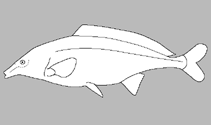 No image available for this species;
drawing shows typical species in Mormyridae.
Google image
drawing shows typical species in Mormyridae.
Classificazione / Nomi Nomi Comuni | Sinonimi | Catalog of Fishes(Genere, Specie) | ITIS | CoL | WoRMS | Cloffa
> Osteoglossiformes (Bony tongues) > Mormyridae (Elephantfishes)
Etymology: Paramormyrops: Greek, para = near + Greek, mormyros = a fish (Sparus sp) (Ref. 45335); sphekodes: The name sphekodes comes from the Greek, σφήκα, for wasp, which may refer to the fish's elongate and slender body (Ref. 116799).
More on author: Sauvage.
Etymology: Paramormyrops: Greek, para = near + Greek, mormyros = a fish (Sparus sp) (Ref. 45335); sphekodes: The name sphekodes comes from the Greek, σφήκα, for wasp, which may refer to the fish's elongate and slender body (Ref. 116799).
More on author: Sauvage.
Ambiente: milieu / zona climatica / distribuzione batimetrica / gamma di distribuzione Ecologia
; acqua dolce benthopelagico. Tropical
Distribuzione Territories | Aree FAO | Ecosistemi | Presenze | Mappa dei ritrovamenti | Introduzioni | Faunafri
Africa: Ogowe River and other coastal river basins in Cameroon, Gabon and Republic of Congo (Ref. 81635). Possibly a narrowly distributed species, endemic to a relatively small part of the upper Ogowe River basin (Ref. 116799). Reports from the Congo River basin (Ref. 1878, 3203, 51193, 88779, 120641) unconfirmed in other sources (Ref. 81635, 116799).
Dimensione / Peso / Età
Breve descrizione Chiavi di identificazione | Morfologia | Morfometria
Spine dorsali (totale) : 0; Raggi dorsali molli (totale) : 20 - 23; Spine anali: 0; Raggi anali molli: 24 - 28; Vertebre: 43 - 45. Diagnosis: Paramormyrops sphekodes is distinguished from all other Paramormyrops by this combination of characters: 5 teeth in upper jaw, 6 in lower; 12 circumpeduncular scales; sharp head profile, V-shaped when viewed from above; snout angle 48-56° corresponding to an interorbital width 1-1.36 times the snout length; body depth 15.4-17.31% of standard length, body depth at pectoral fin 84-94% of body depth at urogenital pore; eye diameter 13-16% of head length measured from snout tip to posterior edge of bony operculum; snout length 24-27% of head length; ration of head length to depth 1.1-1.24; head length 21-23% of standard length; EOD waveform with two phases, head-positive then negative, EOD duration 1.635 ± 0.226 ms with a corresponding power spectrum peak at 1573 ± 531 Hz; electric organ composed of type NPp electrocytes, that is having Non-Penetrating stalks innervated on the posterior face of the cell (Ref. 116799). With five teeth in the upper jaw and six in the lower, P. sphekodes differs from P. hopkinsi, P. jacksoni and P. tavernei, which have seven or more teeth in the upper jaw and eight or more in the lower jaw; with 12 circumpeduncular scales, it differs from P. longicaudatus, P. batesii and P. tavernei, which all have 16 or more; with its relatively sharp V-shaped head profile, it differs from P. batesii, P. gabonensis, P. retrodorsalis, P. tavernei and P. kingsleyae which have distinctly blunt or U-shaped snouts; Paramormyrops sphekodes has type NPp electrocytes in its electric organ, as do seven other Paramormyrops from Lower Guinea, while P. batesii and P. kingsleyae have electric organs composed of electrocytes with penetrating stalks innervated on the anterior face (Ref. 116799). Paramormyrops sphekodes differs from P. curvifrons in head and snout shape; head and snout are shorter, deeper and more rounded when viewed laterally in P. sphekodes compared to P. curvifrons; Paramormyrops curvifrons also has a downward sloping forehead, protruding snout and enlarged chin; the ratio head length to standard length is 23.5-26.9 in P. curvifrons, higher than 21.5-23.4 in P. sphekodes, while the ratio of head depth to head length is reduced in P. curvifrons compared to P. sphekodes; the ratio of pre-pectoral distance to pre-dorsal distance is greater in P. curvifrons compared to P. sphekodes, and P. curvifrons has a significantly narrower snout than P. sphekodes measured by either snout angle or ratio interorbital width to snout length (Ref. 116799).
Body shape (shape guide): fusiform / normal.
Body shape (shape guide): fusiform / normal.
Found in large river habitats with rocky bottoms, sandy substrate, with rushing water and rapids (Ref. 116799).
Ciclo vitale e comportamento di accoppiamento Maturità | Riproduzione | Deposizione | Uova | Fecondità | Larve
Riferimento principale
Caricare le referenze | Bibliografia | Coordinatore | Collaboratori
Hopkins, C.D., S. Lavoué and J.P. Sullivan, 2007. Mormyridae. p. 219-334. In M.L.J. Stiassny, G.G. Teugels and C.D. Hopkins (eds.) The fresh and brackish water fishes of Lower Guinea, West-Central Africa. Volume I. Collection Faune et Flore tropicales 42. Institut de Recherche pour le Développement, Paris, France, Muséum National d’Histoire Naturelle, Paris, France, and Musée Royal de l’Afrique Centrale, Tervuren, Belgium. 800 pp. (Ref. 81635)
Stato della Lista Rossa IUCN (Ref. 130435: Version 2025-2 (Global))
Least Concern (LC) ; Date assessed: 16 February 2009
CITES
Not Evaluated
Minaccia per l'uomo
Harmless
Usi umani
FAO - Publication: search | FishSource |
Informazioni ulteriori
Ecologia trofica
Articoli alimentari (prede)
Alimentazione
Consumo di cibo
Razioni alimentari
Predatori
Articoli alimentari (prede)
Alimentazione
Consumo di cibo
Razioni alimentari
Predatori
Dinamica della popolazione
Parametri di crescita
Età massima / dimensioni massime
Rapporto lunghezza-peso.
Lunghezza-lunghezza rel.
Lunghezza-frequenze
Conversione di massa
Reclutamento
Abbondanza
Parametri di crescita
Età massima / dimensioni massime
Rapporto lunghezza-peso.
Lunghezza-lunghezza rel.
Lunghezza-frequenze
Conversione di massa
Reclutamento
Abbondanza
Ciclo di vita
Riproduzione
Maturità
Maturità/Gli occhielli sono relativi.
Fecondità
Deposizione
Aggregazioni riproduttive
Uova
Sviluppo delle uova
Larve
Dinamica popolazioni larvali
Riproduzione
Maturità
Maturità/Gli occhielli sono relativi.
Fecondità
Deposizione
Aggregazioni riproduttive
Uova
Sviluppo delle uova
Larve
Dinamica popolazioni larvali
Anatomia
Area branchiale
Cervello
Otolite
Area branchiale
Cervello
Otolite
Fisiologia
Composizione corporea
Nutrienti
Consumo di ossigeno
Tipo di nuoto
Velocità di nuoto
Pigmenti visivi
Suono del pesce
Malattie e parassiti
Tossicità (LC50)
Composizione corporea
Nutrienti
Consumo di ossigeno
Tipo di nuoto
Velocità di nuoto
Pigmenti visivi
Suono del pesce
Malattie e parassiti
Tossicità (LC50)
Genetica
Genome
Genetica
Eterozigosi
Ereditarietà
Diversità genetica
Genome
Genetica
Eterozigosi
Ereditarietà
Diversità genetica
Legato all'uomo
Sistemi di acquacoltura
Profili di acquacoltura
Varietà
Casi di Ciguatera
Francobolli, monete, materiale vario.
Sistemi di acquacoltura
Profili di acquacoltura
Varietà
Casi di Ciguatera
Francobolli, monete, materiale vario.
Strumenti
Libro elettronico | Giuda pratica | Chiavi di identificazione | Generatore frequenze di lunghezza | Strumento Parametri Biologici | Mappa dei ritrovamenti |
Cattura-MSY |
Rapporti speciali
Controllo della manutenzione dell'acquario | Verificare la presenza di schede informative sulle specie | Verifica delle schede informative sull'acquacoltura
Scarica XML
Fonti Internet
AFORO (otoliths) | Aquatic Commons | BHL | Cloffa | Websites from users | Check FishWatcher | CISTI | Catalog of Fishes: Genere, Specie | DiscoverLife | ECOTOX | FAO - Publication: search | Faunafri | Fishipedia | Fishtrace | GloBI | Google Books | Google Scholar | Google | IGFA World Record | OneZoom | Open Tree of Life | Otolith Atlas of Taiwan Fishes | PubMed | Reef Life Survey | Socotra Atlas | TreeBase | Tree of Life | Wikipedia: Go, ricerca | World Records Freshwater Fishing | Record zoologico
Stime basate su modelli
Indice di diversità filogenetica (Fonte Biblio. 82804): PD50 = 0.5010 [Uniqueness, from 0.5 = low to 2.0 = high].
Bayesian length-weight: a=0.01259 (0.00585 - 0.02711), b=2.87 (2.69 - 3.05), in cm total length, based on LWR estimates for this (Sub)family-body shape (Ref. 93245).
Livello trofico (Fonte Biblio. 69278): 3.1 ±0.3 se; based on size and trophs of closest relatives
Resilienza (Fonte Biblio. 120179): Medio, tempo minimo di raddoppiamento della popolazione 1.4 - 4.4 anni (Assuming Fec < 5,000).