



Oreochromis mortimeri (Trewavas, 1966)
Kariba tilapia
Carregue seu(sua) Fotos e vídeos
Imagem do Google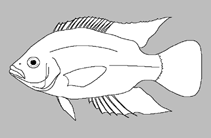 No image available for this species;
drawing shows typical species in Cichlidae.
Imagem do Google
drawing shows typical species in Cichlidae.
Classificação / Nomes Nomes comuns | Sinônimos | Catalog of Fishes(Gênero, Espécies) | ITIS | CoL | WoRMS | Cloffa
> Cichliformes (Cichlids, convict blennies) > Cichlidae (Cichlids) > Pseudocrenilabrinae
Etymology: Oreochromis: Latin, aurum = gold + Greek, chromis = a fish, perhaps a perch (Ref. 45335); mortimeri: Named for M.A.E. Mortimer, a fish culturist who conducted a great deal of productive fish culture research in Zambia between 1951 and 1965 (Ref. 13337).
Eponymy: M A E Mortimer was a Research and Administrative Officer of the Zambian Department of Game and Fisheries. [...] (Ref. 128868), visit book page.
More on author: Trewavas.
Etymology: Oreochromis: Latin, aurum = gold + Greek, chromis = a fish, perhaps a perch (Ref. 45335); mortimeri: Named for M.A.E. Mortimer, a fish culturist who conducted a great deal of productive fish culture research in Zambia between 1951 and 1965 (Ref. 13337).
Eponymy: M A E Mortimer was a Research and Administrative Officer of the Zambian Department of Game and Fisheries. [...] (Ref. 128868), visit book page.
More on author: Trewavas.
Meio ambiente: milieu / Zona climática / intervalo de profundidade / faixa de distribuição Ecologia
; Água doce bentopelágico. Tropical; 10°S - 19°S
Distribuição Territórios | Áreas da FAO | Ecossistemas | Ocorrências | Mapa de pontos | Introduções | Faunafri
Africa: Middle Zambezi and its tributaries, including Luangwa River (except probably the upper reaches of its tributaries Lunsemfwa and Mulungwishi above the escarpment), Hunyani River and Lake Kariba (Ref. 5166). Introduced to Kipopo and the Lufira River (upper Congo River basin) in Democratic Republic of the Congo (Ref. 1978).
Comprimento de primeira maturação / Tamanho / Peso / Idade
Maturidade: Lm 22.0 range ? - ? cm
Max length : 48.0 cm TL macho/indeterminado; (Ref. 5309); peso máx. publicado: 4.1 kg (Ref. 13337); idade máx. registrada: 8 anos (Ref. 2)
Max length : 48.0 cm TL macho/indeterminado; (Ref. 5309); peso máx. publicado: 4.1 kg (Ref. 13337); idade máx. registrada: 8 anos (Ref. 2)
Descrição suscinta Chaves de identificação | Morfologia | Morfometria
Espinhos dorsais (total) : 16 - 17; Raios dorsais (total) : 10 - 13; Espinhos anais: 3; Raios anais : 10 - 12; Vértebras: 29 - 30. Diagnosis: jaws greatly enlarged in mature males; scales in 2-3 rows on cheek; caudal peduncle relatively shorter than in O. mossambicus (Ref. 2). In life greenish grey (Ref. 2), green-blue (Ref. 52307) or grey-blue with a darker spot on each scale (Ref. 2, 52307). Females and immature males often with 1-3 dark mid-lateral blotches (Ref. 2, 52307), which may appear only as the fish dies (Ref. 2). Breeding males: predominantly iridescent blue-green to bronze (Ref. 2, 52307), with iridescent spots on dorsal and caudal fins (Ref. 2), a dorsal fin with a red edge that is not as pronounced as in O. mossambicus, and a narrow (as opposed to wide) red band at posterior end of caudal fin (Ref. 12524, 13337).
Body shape (shape guide): short and / or deep; Cross section: compressed.
Body shape (shape guide): short and / or deep; Cross section: compressed.
Forms schools (Ref. 2, 54048). Is mainly diurnal; salt-tolerant (Ref. 2). Feeds mainly on (filamentous) algae (Ref. 2, 12524, 13337, 52307, 54048) and diatoms, as well as higher plants (Ref. 2, 52307), dipterous larvae, cladocerans, copepods (Ref. 2), aquatic and terrestrial insects, shrimps, worms (Ref. 12524, 13337, 54048) and mollusks (Ref. 54048). Mouthbrooder; spawns several times per year (Ref. 12524, 13337, 54048).
Ciclo de vida ou comportamento de acasalamento Maturidade | Reprodução | Desova | Ovos | Fecundidade | Larvas
Nest a saucer-shaped depression with a raised mound in the middle (Ref. 12524, 13337), made by the male in a breeding arena in shallow water down to about 4m (Ref. 54048). Females are lured to these through male courtship displays; female collects eggs in mouth after spawning and fertilisation, and moves off; mouthbrooding females may shoal together and do not feed at this time; eggs hatch after about ten days but remain in the mouth for a further few days; juveniles make short feeding sorties once the storage yolk is used up, but seldom stray far and dart into her mouth when danger threatens; after about another 10 days young are released in warm shallow water in the margins (nursery areas), where they feed independently in small shoals (Ref. 54048). Young released from mouthbrooding female are about 1cm long (Ref. 2). Female returns to the breeding arena where she spawns again (Ref. 54048).
Referência principal
Carregar suas referências | Referências | Coordenador : Kullander, Sven O. | Colaboradores
Trewavas, E., 1983. Tilapiine fishes of the genera Sarotherodon, Oreochromis and Danakilia. British Mus. Nat. Hist., London, UK. 583 p. (Ref. 2)
Status na Lista Vermelha da UICN (Ref. 130435: Version 2025-2 (Global))
Criticamente em perigo (CR) (A2ae); Date assessed: 01 March 2007
CITES
Not Evaluated
Ameaça para os humanos
Harmless
Uso pelos humanos
Pescarias: espécies comerciais; Aquacultura: experimental; peixe esportivo: sim
FAO - Publication: search | FishSource |
Mais informação
Ecologia Trófica
Itens alimentares (presas)
Composição da dieta
Consumo alimentar
Rações alimentares
Predadores
Itens alimentares (presas)
Composição da dieta
Consumo alimentar
Rações alimentares
Predadores
Dinâmica populacional
Parâmetros de crescimento
Idade máxima / tamanhos
Relação comprimento-peso.
Relação comprimento-comprimento.
Frequências de comprimento
Conversão de massa
Recrutamento
Abundância
Parâmetros de crescimento
Idade máxima / tamanhos
Relação comprimento-peso.
Relação comprimento-comprimento.
Frequências de comprimento
Conversão de massa
Recrutamento
Abundância
Ciclo de vida
Reprodução
Maturidade
Maturidade/Rel. das guelras
Fecundidade
Desova
Agregações de desova
Ovos
Desenvolvimento dos ovos
Larvas
Dinâmica larval
Reprodução
Maturidade
Maturidade/Rel. das guelras
Fecundidade
Desova
Agregações de desova
Ovos
Desenvolvimento dos ovos
Larvas
Dinâmica larval
Anatomia
Área branquial
Cérebro
Otólito
Área branquial
Cérebro
Otólito
Fisiologia
Composição corporal
Nutrientes
Consumo de oxigênio
Tipo de natação
Velocidade de natação
Pigmentos visuais
Som de peixe
Doenças e Parasitas
Toxicidade (LC50s)
Composição corporal
Nutrientes
Consumo de oxigênio
Tipo de natação
Velocidade de natação
Pigmentos visuais
Som de peixe
Doenças e Parasitas
Toxicidade (LC50s)
Genética
genoma
Genética
Heterozigosidade
Hereditariedade
Diversidade genética
genoma
Genética
Heterozigosidade
Hereditariedade
Diversidade genética
Relacionado a humanos
Sistemas de aquicultura
Perfis para aquacultura
Estirpes
Casos de Ciguatera
Selos, moedas, diversos.
Sistemas de aquicultura
Perfis para aquacultura
Estirpes
Casos de Ciguatera
Selos, moedas, diversos.
Ferramentas
Livro eletrônico | Guia de campo | Chaves de identificação | Ferramenta auxiliar de frequências de comprimento | Ferramenta sobre a história de vida | Mapa de pontos |
Catch-MSY |
Relatórios especiais
Checar Manutenção em Aquário | Checar Planilhas de Fatos sobre as Espécies | Checar Planilhas de Fatos sobre Aquicultura
Baixar XML
Fontes da internet
AFORO (otoliths) | Banco de dados para Espécies Aliens/Invasivas | Aquatic Commons | BHL | Cloffa | Websites from users | Checar Observador de Peixes (FishWatcher) | CISTI | Catalog of Fishes: Gênero, Espécies | DiscoverLife | ECOTOX | FAO - Publication: search | Faunafri | Fishipedia | Fishtrace | GloBI | Google Books | Google Scholar | Google | IGFA World Record | OneZoom | Open Tree of Life | Otolith Atlas of Taiwan Fishes | PubMed | Reef Life Survey | Socotra Atlas | TreeBase | Árvore da vida | Wikipedia: Ir para, procura | World Records Freshwater Fishing | Registro zoológico
Estimativas baseadas em modelos
|
Índice de diversidade filogenética (Ref. 82804) |
PD50 = 0.5000 [Uniqueness, from 0.5 = low to 2.0 = high]. |
| Bayesian length-weight | a=0.01995 (0.00965 - 0.04126), b=3.02 (2.85 - 3.19), in cm total length, based on LWR estimates for this species & (Sub)family-body (Ref. 93245). |
|
Nível Trófico (Ref. 69278) |
2.2 ±0.0 se; based on diet studies. |
| Generation time | 4.3 ( na - na) years. Estimated as median ln(3)/K based on 1 growth studies. |
|
Resiliência (Ref. 120179) |
médio(a), tempo mínimo de duplicação da população 1,4 - 4,4 anos (tmax=8). |
|
Vulnerabilidade da pesca (Ref. 59153) |
Moderate vulnerability (39 of 100). 🛈 |
|
Categoria de preço (Ref. 80766) |
Unknown. |