



Aggiungete la vostra osservazione in Fish Watcher
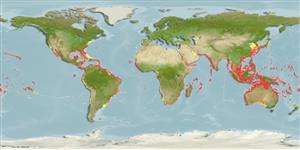
| Native range | All suitable habitat | Point map | Year 2050 |
|
| This map was computer-generated and has not yet been reviewed. |
| Mobula birostris AquaMaps Data sources: GBIF OBIS |
Carica il tuo foto e Video
Immagini | Video | Francobolli, monete, materiale vario. | Google image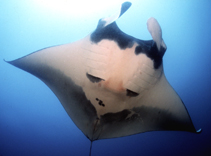 Mobula birostris
Immagine di Marshall, A.
Immagini | Video | Francobolli, monete, materiale vario. | Google image
Immagine di Marshall, A.
Classificazione / Nomi Nomi Comuni | Sinonimi | Catalog of Fishes(Genere, Specie) | ITIS | CoL | WoRMS | Cloffa
Elasmobranchi (squali e razze) (sharks and rays) > Myliobatiformes (Stingrays) > Mobulidae (Devilrays)
More on author: Walbaum.
More on author: Walbaum.
Ambiente: milieu / zona climatica / distribuzione batimetrica / gamma di distribuzione Ecologia
marino associati a barriera corallina; oceanodromo (Ref. 51243); distribuzione batimetrica 0 - 1000 m (Ref. 106604). Subtropical; 42°N - 38°S, 180°W - 180°E (Ref. 55255)
Distribuzione Territories | Aree FAO | Ecosistemi | Presenze | Mappa dei ritrovamenti | Introduzioni | Faunafri
Circumglobal, tropical to temperate: in the Northern Hemisphere, as far north as southern California and Rhode Island on the United States west and east coasts, Mutsu Bay, Aomori, Japan, the Sinai Peninsula, Egypt and the Azores Islands; in the Southern Hemisphere, as far south as Peru, Uruguay, South Africa and New Zealand. In
some locations, including Mozambique, it is sympatric with Manta alfredi.
Lunghezza alla prima maturità / Dimensione / Peso / Età
Maturità: Lm 422.0, range 380 - 460 cm
Max length : 910 cm WD maschio/sesso non determinato; (Ref. 58048); common length : 450 cm WD maschio/sesso non determinato; (Ref. 3176); peso massimo pubblicato: 3.0 t (Ref. 5377); Età massima riportata: 20 anni (Ref. 31742)
Max length : 910 cm WD maschio/sesso non determinato; (Ref. 58048); common length : 450 cm WD maschio/sesso non determinato; (Ref. 3176); peso massimo pubblicato: 3.0 t (Ref. 5377); Età massima riportata: 20 anni (Ref. 31742)
Breve descrizione Chiavi di identificazione | Morfologia | Morfometria
A giant ray having an extremely broad head with long head fins, and a terminal mouth; upper surface of disc covered with denticles, and tail usually without a spine (Ref. 5578). Blackish above, sometimes with white shoulder patches; white below, with grey edging on disc (Ref. 5578). Tail whiplike but short (Ref. 7251).
Body shape (shape guide): other; Cross section: flattened.
Body shape (shape guide): other; Cross section: flattened.
Mainly in near-shore waters, near coral and rocky reefs; sometimes found over deep water (Ref. 12951). Reported along productive coastlines with regular upwelling, oceanic island groups and offshore pinnacles and seamounts (Ref. 82755). Penetrates shallow muddy bays and the intertidal and occurs off river mouths (Ref. 9911). Pelagic (Ref. 58302). Occurs singly or in loose aggregations (Ref. 12951). Mainly plankton feeders, but may feed on small and moderate-sized fishes as well (Ref. 9911). Leaps out the water mainly in spring and autumn, possibly as part of mating behavior (Ref. 31742). Easily approached (Ref. 9911). Ovoviviparous (Ref. 6902). Commonly caught by tuna gillnet and harpoon fisheries. Utilized for its gill filter plates (very high value), meat, cartilage and skin (Ref.58048). Liver yields oil and skin used as abrasive (Ref. 6902). World's largest ray (Ref. 37816).
Ciclo vitale e comportamento di accoppiamento Maturità | Riproduzione | Deposizione | Uova | Fecondità | Larve
Exhibit ovoviparity (aplacental viviparity), with embryos feeding initially on yolk, then receiving additional nourishment from the mother by indirect absorption of uterine fluid enriched with mucus, fat or protein through specialised structures (Ref. 50449). Bears up to 2 young (Ref. 5578); born at 122-127 cm WD (Ref.58048). A female of 550 cm width and weighing 1050 kg was collected in the Galapagos in June and was carrying a well-developed embryo of 12.7 kg (Ref. 28023). Size at partuition might be from 1.1 to 1.3 m and from 9.1 to 1.14 kg (Ref. 31742).
Yano et al (1999) (Ref. 35892) describe the mating behavior of manta rays based on observations off Ogasawara Islands, Japan, in the following sequence:
1) 'chasing', the male rapidly follows behind the tail of the female and attacks her several times;
2) 'nipping', the male nips the tip of the pectoral fin of the female and then moves to the ventral surface of the female;
3) 'copulating', the male inserts a clasper into the cloacaof the female and copulates abdomen-to-abdomen, up to 123 seconds;
4) 'post-copulating';
5) 'separating'. (Ref. 49562).
Riferimento principale
Caricare le referenze | Bibliografia | Coordinatore | Collaboratori
Last, P.R. and J.D. Stevens, 1994. Sharks and rays of Australia. CSIRO, Australia. 513 p. (Ref. 6871)
Stato della Lista Rossa IUCN (Ref. 130435: Version 2025-2 (Global))
Endangered (EN) (A2bcd+3d); Date assessed: 12 November 2019
Minaccia per l'uomo
Harmless (Ref. 9911)
Usi umani
Pesca: scarso interesse commerciale
FAO - Publication: search | FishSource | Sea Around Us
Informazioni ulteriori
Ecologia trofica
Articoli alimentari (prede)
Alimentazione
Consumo di cibo
Razioni alimentari
Predatori
Articoli alimentari (prede)
Alimentazione
Consumo di cibo
Razioni alimentari
Predatori
Dinamica della popolazione
Parametri di crescita
Età massima / dimensioni massime
Rapporto lunghezza-peso.
Lunghezza-lunghezza rel.
Lunghezza-frequenze
Conversione di massa
Reclutamento
Abbondanza
Parametri di crescita
Età massima / dimensioni massime
Rapporto lunghezza-peso.
Lunghezza-lunghezza rel.
Lunghezza-frequenze
Conversione di massa
Reclutamento
Abbondanza
Ciclo di vita
Riproduzione
Maturità
Maturità/Gli occhielli sono relativi.
Fecondità
Deposizione
Aggregazioni riproduttive
Uova
Sviluppo delle uova
Larve
Dinamica popolazioni larvali
Riproduzione
Maturità
Maturità/Gli occhielli sono relativi.
Fecondità
Deposizione
Aggregazioni riproduttive
Uova
Sviluppo delle uova
Larve
Dinamica popolazioni larvali
Fisiologia
Composizione corporea
Nutrienti
Consumo di ossigeno
Tipo di nuoto
Velocità di nuoto
Pigmenti visivi
Suono del pesce
Malattie e parassiti
Tossicità (LC50)
Composizione corporea
Nutrienti
Consumo di ossigeno
Tipo di nuoto
Velocità di nuoto
Pigmenti visivi
Suono del pesce
Malattie e parassiti
Tossicità (LC50)
Legato all'uomo
Sistemi di acquacoltura
Profili di acquacoltura
Varietà
Casi di Ciguatera
Francobolli, monete, materiale vario.
Sistemi di acquacoltura
Profili di acquacoltura
Varietà
Casi di Ciguatera
Francobolli, monete, materiale vario.
Strumenti
Quiz organico | Libro elettronico | Giuda pratica | Chiavi di identificazione | Generatore frequenze di lunghezza | Strumento Parametri Biologici | Mappa dei ritrovamenti |
Cattura-MSY |
Rapporti speciali
Controllo della manutenzione dell'acquario | Verificare la presenza di schede informative sulle specie | Verifica delle schede informative sull'acquacoltura
Scarica XML
Fonti Internet
AFORO (otoliths) | Aquatic Commons | BHL | Cloffa | Websites from users | Check FishWatcher | CISTI | Catalog of Fishes: Genere, Specie | DiscoverLife | DORIS | ECOTOX | FAO - Publication: search | Faunafri | Fishipedia | Fishtrace | GloBI | Google Books | Google Scholar | Google | IGFA World Record | Database Nazionali | OneZoom | Open Tree of Life | Otolith Atlas of Taiwan Fishes | PubMed | Reef Life Survey | Socotra Atlas | TreeBase | Tree of Life | Wikipedia: Go, ricerca | World Records Freshwater Fishing | Record zoologico
Stime basate su modelli
Temperatura preferita (Fonte Biblio. 123201): 22.8 - 29, mean 27.6 °C (based on 3220 cells).
Indice di diversità filogenetica (Fonte Biblio. 82804): PD50 = 0.5020 [Uniqueness, from 0.5 = low to 2.0 = high].
Bayesian length-weight: a=0.01000 (0.00244 - 0.04107), b=3.04 (2.81 - 3.27), in cm total length, based on all LWR estimates for this body shape (Ref. 93245).
Livello trofico (Fonte Biblio. 69278): 3.5 ±0.50 se; based on food items.
Generation time: 7.3 ( na - na) years. Estimated as median ln(3)/K based on 2 growth studies.
Resilienza (Fonte Biblio. 120179): Molto basso, tempo minimo di raddoppiamento della popolazione più di 14 anni (tm=6; tmax>20; Fec=1).
Nutrienti (Ref. 124155): Calcium = 2.4 [0.4, 10.8] mg/100g; Iron = 0.339 [0.080, 0.946] mg/100g; Protein = 23 [18, 28] %; Omega3 = 0.1 [0.0, 0.4] g/100g; Selenium = 26.2 [7.4, 97.2] μg/100g; VitaminA = 10.6 [3.1, 37.8] μg/100g; Zinc = 0.305 [0.144, 0.613] mg/100g (wet weight);