



Microglanis sparsus Ruiz, 2016
Carregue seu(sua) Fotos e vídeos
Imagem do Google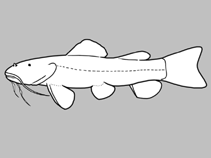 No image available for this species;
drawing shows typical species in Pseudopimelodidae.
Imagem do Google
drawing shows typical species in Pseudopimelodidae.
Classificação / Nomes Nomes comuns | Sinônimos | Catalog of Fishes(Gênero, Espécies) | ITIS | CoL | WoRMS | Cloffa
> Siluriformes (Catfishes) > Pseudopimelodidae (Bumblebee catfishes, dwarf marbled catfishes) > Batrochoglaninae
Etymology: Microglanis: Greek, mikros = small + Greek, glanis = a fish that can eat the bait without touching the hook; a cat fish (Ref. 45335); sparsus: Name from Latin 'sparsus' meaning ‘sprayed’, referring to the mottled color pattern observed on this species; an adjective.
Etymology: Microglanis: Greek, mikros = small + Greek, glanis = a fish that can eat the bait without touching the hook; a cat fish (Ref. 45335); sparsus: Name from Latin 'sparsus' meaning ‘sprayed’, referring to the mottled color pattern observed on this species; an adjective.
Meio ambiente: milieu / Zona climática / intervalo de profundidade / faixa de distribuição Ecologia
; Água doce demersal. Tropical
Distribuição Territórios | Áreas da FAO | Ecossistemas | Ocorrências | Mapa de pontos | Introduções | Faunafri
South America: Brazil.
Tamanho / Peso / Idade
Descrição suscinta Chaves de identificação | Morfologia | Morfometria
Raios anais : 9 - 11. This species is distinguished from all its congeners by the following set of characters: lateral line short and not reaching vertical through last dorsal-fin ray, with only 5-7 pores; pectoral-fin spine generally with only retrorse serrations; anal-fin rays 9-11. Colouration: head and trunk are mottled with light and dark brown color; light transverse band on the occipital region is narrow, mottled brown, and poorly defined; dark brown saddles poorly defined on the nuchal, subdorsal, and subadipose regions; axis of gill filaments with a dark stripe. Further distinguished in having a smaller adipose fin base length 18.8-20.4% SL (vs. 20.4-31.8 in M. cibelae, M. cottoides, M. eurystoma, M. leptostriatus, M. minutus, M. nigripinnis, M. parahybae, M. pataxo, M. robustus); greater caudal peduncle length 15.7-17.6% SL (vs. 10.0-15.7 in M. carlae, M. cibelae, M. cottoides, M. eurystoma, M. iheringi, M. maculatus, M. malabarbai, M. nigripinnis, M. parahybae, M. pataxo, M. pellopterygius, M. poecilus, M. secundus, M. variegatus); and greater caudal-peduncle depth 13.1-14.7% SL (vs. 10.1-13.1 in M. carlae, M. cibelae, M. cottoides, M. eurystoma, M. iheringi, M. leptostriatus, M. malabarbai, M. minutus, M. reikoae, M. nigripinnis, M. parahybae, M. pataxo, M. pellopterygius, M. poecilus, M. secundus, M. variegatus) (Ref. 130492).
Cross section: oval.
Cross section: oval.
Locality of collection has a well-preserved riparian forest, a river bed mainly muddy, with some sandy patches covered by organic matter, and abundant submerged leaf-litter. Stomach contents of two specimens examined included Ephemeroptera, Chironomidae larvae, and adult Diptera, denoting an insectivorous habit, typical for benthonic small catfish (Ref. 130492).
Ciclo de vida ou comportamento de acasalamento Maturidade | Reprodução | Desova | Ovos | Fecundidade | Larvas
Referência principal
Carregar suas referências | Referências | Coordenador : Shibatta, Oscar Akio | Colaboradores
Ruiz, W.B.G., 2016. Three new species of catfishes of the genus Microglanis from Brazil (Teleostei: Pseudopimelodidae), with comments on the characters used within the genus. Ichthyol. Explor. Freshwat. 27(3):211-232. [22 Nov. 2016 is the publication date without ZooBank registration, 18 Nov. with an electronic prepublication date; this serves as the date for Oct., Nov. and Dec.] (Ref. 130492)
Status na Lista Vermelha da UICN (Ref. 130435: Version 2025-2 (Global))
Dados insuficientes (DD) ; Date assessed: 02 February 2021
CITES
Not Evaluated
Ameaça para os humanos
Harmless
Uso pelos humanos
Pescarias: sem interesse
FAO - Publication: search | FishSource |
Mais informação
Ecologia Trófica
Itens alimentares (presas)
Composição da dieta
Consumo alimentar
Rações alimentares
Predadores
Itens alimentares (presas)
Composição da dieta
Consumo alimentar
Rações alimentares
Predadores
Ecologia
Ecologia
Ecologia
Dinâmica populacional
Parâmetros de crescimento
Idade máxima / tamanhos
Relação comprimento-peso.
Relação comprimento-comprimento.
Frequências de comprimento
Conversão de massa
Recrutamento
Abundância
Parâmetros de crescimento
Idade máxima / tamanhos
Relação comprimento-peso.
Relação comprimento-comprimento.
Frequências de comprimento
Conversão de massa
Recrutamento
Abundância
Ciclo de vida
Reprodução
Maturidade
Maturidade/Rel. das guelras
Fecundidade
Desova
Agregações de desova
Ovos
Desenvolvimento dos ovos
Larvas
Dinâmica larval
Reprodução
Maturidade
Maturidade/Rel. das guelras
Fecundidade
Desova
Agregações de desova
Ovos
Desenvolvimento dos ovos
Larvas
Dinâmica larval
Anatomia
Área branquial
Cérebro
Otólito
Área branquial
Cérebro
Otólito
Fisiologia
Composição corporal
Nutrientes
Consumo de oxigênio
Tipo de natação
Velocidade de natação
Pigmentos visuais
Som de peixe
Doenças e Parasitas
Toxicidade (LC50s)
Composição corporal
Nutrientes
Consumo de oxigênio
Tipo de natação
Velocidade de natação
Pigmentos visuais
Som de peixe
Doenças e Parasitas
Toxicidade (LC50s)
Genética
genoma
Genética
Heterozigosidade
Hereditariedade
Diversidade genética
genoma
Genética
Heterozigosidade
Hereditariedade
Diversidade genética
Relacionado a humanos
Sistemas de aquicultura
Perfis para aquacultura
Estirpes
Casos de Ciguatera
Selos, moedas, diversos.
Sistemas de aquicultura
Perfis para aquacultura
Estirpes
Casos de Ciguatera
Selos, moedas, diversos.
Ferramentas
Livro eletrônico | Guia de campo | Ferramenta auxiliar de frequências de comprimento | Ferramenta sobre a história de vida | Mapa de pontos |
Catch-MSY |
Relatórios especiais
Checar Manutenção em Aquário | Checar Planilhas de Fatos sobre as Espécies | Checar Planilhas de Fatos sobre Aquicultura
Baixar XML
Fontes da internet
AFORO (otoliths) | Aquatic Commons | BHL | Cloffa | Websites from users | Checar Observador de Peixes (FishWatcher) | CISTI | Catalog of Fishes: Gênero, Espécies | DiscoverLife | ECOTOX | FAO - Publication: search | Faunafri | Fishipedia | Fishtrace | GloBI | Google Books | Google Scholar | Google | IGFA World Record | OneZoom | Open Tree of Life | Otolith Atlas of Taiwan Fishes | PubMed | Reef Life Survey | Socotra Atlas | TreeBase | Árvore da vida | Wikipedia: Ir para, procura | World Records Freshwater Fishing | Zoobank | Registro zoológico
Estimativas baseadas em modelos
Índice de diversidade filogenética (Ref. 82804): PD50 = 0.5000 [Uniqueness, from 0.5 = low to 2.0 = high].
Bayesian length-weight: a=0.00692 (0.00292 - 0.01638), b=3.12 (2.91 - 3.33), in cm total length, based on LWR estimates for this (Sub)family-body shape (Ref. 93245).
Nível Trófico (Ref. 69278): 3.1 ±0.4 se; based on size and trophs of closest relatives