This website uses cookies to enhance your browsing experience and ensure the functionality of our site. For more detailed information about the types of cookies we use and how we protect your privacy, please visit our Privacy Information page.
×
Cookie Settings
This website uses different types of cookies to enhance your experience. Please select your preferences below:
Western Atlantic: Canada (off Scotian shelf) to Brazil; including countries of the Gulf of Mexico and the West Indies. A southern form that may prove to be a separate species is known from Rio de Janeiro, Brazil and questionably from Suriname.
Comprimento na primeira maturidade / Tamanho / Peso / Idade
Maturidade: Lm6.3 range ? - ? cm Max length : 17.8 cm SL macho/indeterminado; (Ref. 137577); Idade máx. registada: 1.00 anos (Ref. 1285)
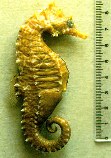
Generally in coastal waters; often around man-made structures (Ref. 26938). Usually attached to gorgonians or seagrasses but may occur in floating Sargassum or swimming freely in midwater (Ref. 9710). Those that live in Sargassum usually have bony protuberances and fleshy tabs that may serve as camouflage. Has been reared in captivity (Ref. 35420, 35422). Move into deeper waters during winter (Ref. 36630). Feeds by sucking in small organisms, using its long face as a pipette (Ref. 26938); like small crustaceans (Ref. 27549). Ovoviviparous (Ref. 205). The male carries the eggs in a brood pouch which is found under the tail (Ref. 205). Length type refers to Height (= from top of coronet to the tip of straightened tail).
Lourie, S.A., R.A. Pollom and S.J. Foster, 2016. A global revision of the seahorses Hippocampus Rafinesque 1810 (Actinopterygii: Syngnathiformes): taxonomy and biogeography with recommendations for further research. Zootaxa 4146(1):1-66. (Ref. 115213)
Categoria na Lista Vermelha da IUCN (Ref. 130435: Version 2025-2 (Global))
Fisiologia Composição corporal Nutrientes Consumo de oxigénio Tipo de natação Velocidade de natação Pigmentos visuais Som de peixe Doenças e Parasitas Toxicidade (LC50s)
Temperatura preferida (Ref. 123201): 12.1 - 27, mean 24 °C (based on 144 cells).
Índice de diversidade filogenética (Ref. 82804): PD50 = 0.5000 [Uniqueness, from 0.5 = low to 2.0 = high].
Bayesian length-weight: a=0.00447 (0.00176 - 0.01132), b=3.00 (2.78 - 3.22), in cm total length, based on LWR estimates for this (Sub)family-body shape (Ref. 93245).
Nível Trófico (Ref. 69278): 3.5 ±0.51 se; based on food items.
Generation time: 3.2 ( na - na) years. Estimated as median ln(3)/K based on 1 growth studies.
Resiliência (Ref. 120179): Elevada, tempo mínimo de duplicação da população menor que 15 meses (K=0.34; tmax=1; Fec=1,552).
Vulnerabilidade da pesca (Ref. 59153): Low to moderate vulnerability (31 of 100). 🛈