This website uses cookies to enhance your browsing experience and ensure the functionality of our site. For more detailed information about the types of cookies we use and how we protect your privacy, please visit our Privacy Information page.
×
Cookie Settings
This website uses different types of cookies to enhance your experience. Please select your preferences below:
> Eupercaria/misc (Various families in series Eupercaria) > Gerreidae (Mojarras)
Etymology: Gerres:Latin, gerres = a kind of anchovies; cited by Plinius. More on author: Cuvier.
Ambiente: milieu / zona climática / intervalo de profundidade / gama de distribuição Ecologia
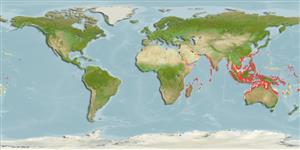
marinhas associadas(os) a recifes; intervalo de profundidade 0 - 50 m (Ref. 86942). Tropical; 30°N - 36°S, 19°E - 165°W
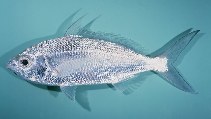
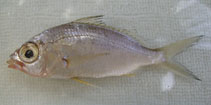
Espinhos dorsais (total) : 9; Raios dorsais moles (total) : 10; Espinhos anais: 3; Raios anais moles: 7. Scales between 5th dorsal fin spine base and lateral line, 4-4.5. Upper jaw extending almost to the level of anterior margin of dermal eye opening. Second dorsal fin spine longest, 19-26% of SL (mean 23%). Caudal fin dusky (rarely with dark distal margin); lower edge of lower caudal fin hyaline. Dusky stripes absent or very indistinct along scale rows above lateral line (sometimes 4-9 slightly oblique dusky bands in specimens less than about 10 cm SL); 4-9 slightly oblique dusky bands or columns of ovoid dark spots (rarely brownish) immediately below lateral line, but more obvious in preserved or stressed live specimens (Ref. 41108). Adult body plain silver; may have faint dusky bars especially juveniles. Body elongate, depth max 2.8-3.3 in SL. Preopercle lower flange scaleless. Caudal fin forked deeply and with long lobes; pectoral fins do not reach beyond level of anus. (Ref. 90102) Body shape (shape guide): fusiform / normal; Cross section: compressed.
Prefers coralline areas (Ref. 30573). Migrates to specific sandy areas near outer reef edge to spawn in late afternoons during full moon. Feeds on small benthic organisms living on sandy bottoms (Ref. 3409, 48635). In Palau, migrates to specific sandy spots near the outer reef edge to spawn in late afternoons around full moon (Ref. 37816). Forms schools. Feeds on small invertebrates found in the sand. Marketed fresh (Ref. 12915).
Ciclo de vida e comportamento de acasalamento Maturidade | Reprodução | Desova | Ovos | Fecundidade | Larvas
Ciclo de vida Reprodução Maturidade Maturidade/Rel. das guelras Fecundidade Desova Agregações de desova Ovos Desenvolvimento dos ovos Larvas Dinâmica larvar
Fisiologia Composição corporal Nutrientes Consumo de oxigénio Tipo de natação Velocidade de natação Pigmentos visuais Som de peixe Doenças e Parasitas Toxicidade (LC50s)
Temperatura preferida (Ref. 123201): 24.9 - 29.3, mean 28.5 °C (based on 3192 cells).
Índice de diversidade filogenética (Ref. 82804): PD50 = 0.5000 [Uniqueness, from 0.5 = low to 2.0 = high].
Bayesian length-weight: a=0.01000 (0.00574 - 0.01742), b=3.00 (2.86 - 3.14), in cm total length, based on LWR estimates for this species & Genus-body shape (Ref. 93245).
Nível Trófico (Ref. 69278): 3.5 ±0.37 se; based on food items.
Resiliência (Ref. 120179): Médio, tempo mínimo de duplicação da população 1,4 - 4,4 anos (Preliminary K or Fecundity.).
Vulnerabilidade da pesca (Ref. 59153): Low to moderate vulnerability (27 of 100). 🛈
Vulnerabilidade climática (Ref. 125649): High to very high vulnerability (70 of 100). 🛈