This website uses cookies to enhance your browsing experience and ensure the functionality of our site. For more detailed information about the types of cookies we use and how we protect your privacy, please visit our Privacy Information page.
×
Cookie Settings
This website uses different types of cookies to enhance your experience. Please select your preferences below:
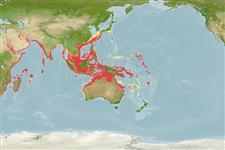
Indo-Pacific: Red Sea and the Persian Gulf to Natal, South Africa and east to Fiji, north to Japan, south to the Arafura Sea (Ref. 9819) and northern Australia. Recently recorded from Tonga (Ref. 53797). Appears to be absent from Micronesia, Polynesia, and most islands of the western Indian Ocean. Often confused with Epinephelus chlorostigma.
Comprimento na primeira maturidade / Tamanho / Peso / Idade
Maturidade: Lm20.0, range 19 - ? cm Max length : 53.0 cm TL macho/indeterminado; (Ref. 131628); common length : 35.0 cm TL macho/indeterminado; (Ref. 5450); peso máx. Publicado: 2.0 kg (Ref. 131628); Idade máx. registada: 15 anos (Ref. 27352)
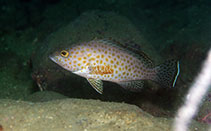
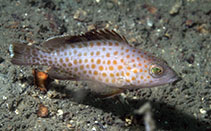
Espinhos dorsais (total) : 11; Raios dorsais moles (total) : 15 - 17; Espinhos anais: 3; Raios anais moles: 8. This species is distinguished by the following characters: body depth less than head length, 2.7-3.3 in SL (for specimens 14-31 cm SL); head length 2.4-2.8 in SL; D XI,15-17; pectoral rays 17-19 (usually 17-18); body scales ctenoid, cycloid scales on thorax and ventrally on abdomen; body with auxiliary scales; anal fin of adults rounded to slightly angular, longest soft ray 2.0-2.6 in HL; gill rakers of first gill arch 8-10 + 14-16; pyloric caeca 11-17; preopercle with 2-7 enlarged serrae at the angle; upper edge of operculum straight or slightly convex; midlateral part of lower jaw with 2 rows of teeth; lateral-line scales 49-53; caudal fin slightly convex in juveniles, truncate or slightly emarginate in adults. Colour of head, body, and fins pale, covered with numerous close-set brown, brownish yellow or greenish yellow spots (becoming smaller and increase in number as growth increases), the largest about size of pupil, those on front of head smaller than those on operculum; pectoral fins pale, with small dark spots on the rays; posterior edge of caudal fin with a distinct white margin (Ref. 39231, 90102). Body shape (shape guide): short and / or deep; Cross section: compressed.
Usually found in seagrass beds or on fine sediment bottoms near rocky reefs, dead coral, or alcyonarians (Ref. 5222), in shallow continental shelf waters (Ref. 27353). Juveniles are common at water depths to 80 m (Ref. 6390). Probably spawn during restricted periods and form aggregations when doing so (Ref. 27352). Eggs and early larvae are probably pelagic (Ref. 6390). Feed on fish and benthic invertebrates, primarily prawns and crabs (Ref. 4787, 27354). Caught with hook-and-line, traps, and trawls; common in the markets of Hong Kong, Singapore and probably throughout its range (Ref. 39231).
Heemstra, P.C. and J.E. Randall, 1993. FAO Species Catalogue. Vol. 16. Groupers of the world (family Serranidae, subfamily Epinephelinae). An annotated and illustrated catalogue of the grouper, rockcod, hind, coral grouper and lyretail species known to date. Rome: FAO. FAO Fish. Synop. 125(16):382 p. (Ref. 5222)
Categoria na Lista Vermelha da IUCN (Ref. 130435: Version 2025-2 (Global))
Ciclo de vida Reprodução Maturidade Maturidade/Rel. das guelras Fecundidade Desova Agregações de desova Ovos Desenvolvimento dos ovos Larvas Dinâmica larvar
Fisiologia Composição corporal Nutrientes Consumo de oxigénio Tipo de natação Velocidade de natação Pigmentos visuais Som de peixe Doenças e Parasitas Toxicidade (LC50s)